Here in our Universe, one great mystery is how, if matter and antimatter can only be created or destroyed in equal-and-opposite amounts, our Universe came to be dominated by normal (regular) matter, with barely a trace of antimatter present. Sure, dark energy (68%) and dark matter (27%) might make up the majority of the Universe, but the rest of it is made up of particles from the Standard Model: quarks, gluons, leptons, and photons. Of that 5%, nearly all of it (4.9%) is regular matter, made of protons, neutrons, and electrons, while the amount of antimatter — like antiprotons, antineutrons, or positrons — is negligible.
And yet, in every particle physics reaction we’ve ever measured, matter and antimatter can only ever be created or destroyed in equal amounts: making one proton requires also making one antiproton; destroying one electron requires destroying one positron as well. So what explains the imbalance that we observe everywhere in the Universe: in the Solar System, galaxy, Local Group, and across the entirety of space? That’s what Matt Kucera wants to know, specifically asking:
“Can you help unpack the consequences of that CP violation to explain how it leads to the slight imbalance favoring matter? Does CP violation play a role both in antimatter creation and annihilation?”
It’s an extremely deep question: one that requires us to go down to the subatomic level to understand the connection between the quantum and the cosmic.

We don’t often think about the cosmic and the quantum being related, and for good reasons. In our everyday experience, quantum mechanics typically only shows up when dealing with extremely simple, small-scale systems: where just a few quantum particles, or quanta, are present within a very small volume of space. Quantum effects often show up when considering the behavior of atoms, protons, electrons, or photons, but not so much when considering larger-scale systems: molecules, cells, rocks, humans, planets, or galaxies.
For example, you can pass an electron through a double slit and the outcome of where it lands will be indeterminate: only describable by a probabilistic wavefunction that corresponds to an interference pattern. In this case, the outcome is not predictable directly. However, if you have a similar double slit that you passed a pebble through, even if nothing or no one observes which slit the pebble goes through, there are only two options: either it will correspond to a straight-line trajectory where it went through the first slit or the second slit. It’s one of the weirder, more counterintuitive aspects of quantum physics: the double-slit experiment.

Indeed, today, most quantum effects are only observable under specific circumstances: at small scales, for systems with few quanta in them, in isolated or shielded environments. Without such conditions in place, the quantum behavior you’re seeking to observe often gets destroyed. But early on in cosmic history, the Universe was smaller, denser, and hotter. In fact, the entire Universe, sufficiently early on, can be viewed as an extremely energetic inferno of quantum particles: colliding and interacting frequently as the background spacetime rapidly expands.
Under the conditions that were present in the early Universe, processes that only occur on extremely brief timescales today — or at extremely high energies created in particle accelerators or by interacting cosmic rays — were ubiquitous: occurring frequently, commonly, and everywhere. When we collide particles together at extremely high energies, such as at CERN’s Large Hadron Collider, we can recreate those conditions that were present in the early Universe, at least, briefly, and in one location. By building detectors around the collision points and measuring what comes out, we can gain insights into the physics that occurred extremely early on: what the Universe was like just fractions-of-a-second after the onset of the hot Big Bang.

And this is important! When we observe collisions of particles under laboratory conditions, at a variety of energies, we learn a few incredibly valuable lessons.
- If you smash two particles together with enough energy (in the center-of-mass frame of the collision), there’s a chance that you’ll spontaneously create an extra pair of particles, one matter and one antimatter, if there’s enough extra energy available to do via Einstein’s famed equation: E = mc².
- If you have a matter particle collide with its antimatter counterpart (a proton with an antiproton, an electron with a positron, a muon with an antimuon, etc.), those particles will annihilate, usually to two photons (although other options are possible), where the energy of the two photons is related to the particle’s original masses by that same equation: E = mc².
- And if you have collisions that are sufficiently energetic, at extremely high energies, you can even produce some of the rarest, shortest-lived particles of all: top quarks and antiquarks, Higgs bosons, W-and-Z bosons, and — if they exist — even heavier, exotic particles beyond the Standard Model that have yet to be discovered.
However, all of these possibilities have something in common with one another: they can only create or destroy matter particles in equal abundance to the creation or destruction of antimatter particles.

There is, at present here in 2026, no known reaction that results in the net creation or destruction of matter or antimatter; they can only be created in equal amounts to one another. This poses a great puzzle for the Universe that we observe. Because matter and antimatter annihilate wherever they collide, and there are stars, galaxies, gas, dust, and plasmas located all across the Universe — even in the depths of intergalactic space — then if there were any regions of the Universe that were dominated by antimatter instead of regular (normal) matter, we’d be able to detect those annihilation signatures at the interfaces.
If there were planets made of antimatter, we’d notice from their interactions with material surrounding their parent stars. If there were stars made of antimatter, we’d notice from annihilations arising from interaction with the interstellar medium. If there were galaxies made of antimatter, we’d notice from interactions of the circumgalactic medium. If there were galaxy clusters made of antimatter, we’d notice from annihilation signatures where clusters collide. And if there were regions of the distant cosmos dominated by antimatter, we’d see annihilation signatures imprinted in the cosmic web.
The complete absence of any such signals — as evidence for antimatter only appears in high-energy environments, where (for example) electron-positron pairs are created around supermassive black holes — strongly supports our picture that the Universe is dominated, everywhere, by matter, with antimatter playing a negligible role. (This is further supported by Big Bang Nucleosynthesis and observations of the CMB, among other lines of evidence.)

You might look at the current state of affairs and declare that we’ve got an unsolvable puzzle on our hands. On the one hand, we live in a Universe that’s asymmetric between matter and antimatter: it’s clearly made of a lot more matter than antimatter, with one extra proton (or neutron) for every 1.6 billion photons in the Universe, plus one extra electron to balance out the electric charge of every proton. On the other hand, we only know how to make protons (or neutrons) by also making an equal number of antiprotons (or antineutrons), and the only way to make an extra electron is to make an extra positron as well.
But all the way back in 1967, Soviet physicist Andrei Sakharov figured out three conditions that, if taken all together, could create a matter-antimatter asymmetry in the Universe from a hot, dense past that was initially symmetric between matter and antimatter. These three criteria, known collectively as the Sakharov conditions, are as follows:
- You need an out-of-equilibrium Universe or out-of-equilibrium conditions, such as particles that decay instead of annihilating, or a phase transition that occurs abruptly.
- You need a Universe where both charge conjugation (C) symmetry (where you replace particles with antiparticles), and where the combination of charge conjugation with parity (CP) symmetry (where you replace particles with antiparticles that are the mirror-image-reflection of the initial configuration), are violated.
- And you need a Universe that admits the existence of baryon-number (B) violating interactions.
It might surprise you to learn that our Universe, with just the presently known laws of physics, allows for all three of these in the early Universe.

Credit: Models and Data Analysis Initiative/Duke University
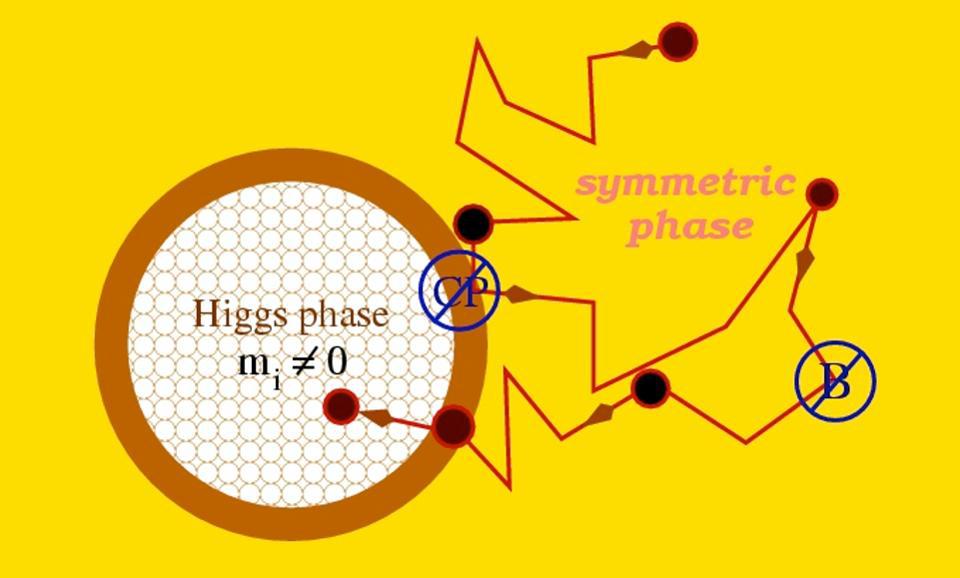
The out-of-equilibrium part is easy: the expanding Universe is perhaps the ultimate out-of-equilibrium system. The fact that there are unstable particles as part of the Standard Model means that they’ll decay, not annihilate away: another out-of-equilibrium example. And transitions like electroweak symmetry breaking — which is a smooth second-order phase transition under the Standard Model but could yet be first-order (and involve quantum tunneling) depending on what beyond the Standard Model physics exists at high energies in our Universe — could create another out-of-equilibrium opportunity.
Similarly, although there’s no baryon number violation that’s ever been directly observed, nor is there a baryon-violating Feynman diagram that we can write down, baryon number violation is actually a part of the Standard Model: through what are known as sphaleron interactions. In this process, groups of three baryons (or antibaryons) are converted into three leptons (or antileptons), violating both baryon number (B) and lepton number (L) individually, but conserving the difference between them: B – L. Although this lies beyond the energy reach of the Large Hadron Collider, it’s conceivable that the Future Circular Collider, if it begins colliding protons together with a strong enough magnetic field to bend them, could observe such interactions directly.

Credit: © CERN
That leaves C-violation and CP-violation. In the Standard Model, we’ve seen both, but only in the weak interactions. CP-violation has been observed in systems containing strange quarks, bottom quarks, and charm quarks, and has been most exquisitely measured by the LHCb collaboration at the Large Hadron Collider. Unfortunately, the amount of CP-violation in the Standard Model is extremely small: billions of times smaller than the amount needed to create the matter-antimatter asymmetry we observe. The quest to explain the origin of our Universe’s matter-antimatter asymmetry continues.
In general, there are four main mechanisms that are generally considered for baryogenesis, all of which involve out-of-equilibrium conditions, large amounts of CP-violation, and baryon number-violating interactions. They are:
- GUT-scale baryogenesis, where new, superheavy bosons are created at extremely high energies, they decay, and their decays create a matter-antimatter asymmetry from an initially symmetric state.
- Leptogenesis, where an asymmetry in the lepton sector is first created through neutrino behavior, and then sphaleron interactions transfer some of that asymmetry into the baryon sector, conserving B – L in the process.
- Affleck-Dine baryogenesis, which arises in supersymmetry, and the decays of squarks and sleptons (the superpartners of the quarks and leptons) lead to a net baryon and lepton number once the decays complete.
- And baryogenesis as a consequence of electroweak symmetry breaking, where a first-order phase transition of the Higgs field creates the right conditions to give rise to more matter than antimatter.
For a variety of reasons, the leptogenesis and electroweak symmetry breaking scenarios are currently the most popular, but all four scenarios require new, beyond the Standard Model physics to be viable.
The easiest way to illustrate how CP-violation plays a key role, however, is to consider the GUT baryogenesis scenario, where two new species of particles (and antiparticles) would have arisen in the early Universe: X and Y bosons. These bosons, a consequence of various Grand Unified Theories, would have fractional charges, with the X having a charge of +4/3 and the Y having a charge of -1/3, and couple to both quarks and leptons. Because of the symmetries that exist between matter and antimatter, there are many properties that the X and Y bosons have that their antiparticle counterparts must also have, including:
- the same rest masses,
- the same mean lifetimes,
- the same decay pathways,
- the same magnitude (but opposite sign) of electric charge,
- the same spin,
along with many others.
However, there’s one profoundly important property that is allowed to be different between X’s and anti-X’s, as well as Y’s and anti-Y’s if CP-symmetry is violated: what we call the branching ratios of their decays. If the X can decay through two or more pathways, then the anti-X must decay through the antimatter counterparts of those pathways. However, the percentages of X’s that decay through the first and second pathways does not have to match the percentages of anti-X’s that decay through those two pathways; there can be a difference. As shown in the graph below, this tiny difference, a consequence of CP-violation, is completely sufficient to create a matter-antimatter asymmetry after these superheavy bosons decay, even if they began from a symmetric state.
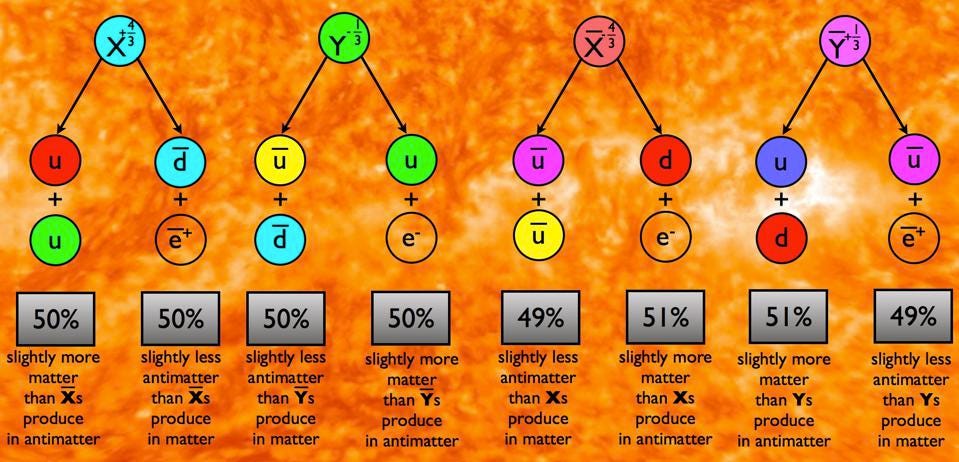
To work out the math, imagine, as you see above, that you start out with 1000 X, anti-X, Y, and anti-Y particles apiece. They all decay according to the two pathways you see above, in the (non-symmetric) ratios you see above. That means:
- 1000 X particles yield 1000 up quarks, 500 down antiquarks, and 500 positrons,
- 1000 Y particles yield 500 up antiquarks, 500 down antiquarks, 500 up quarks, and 500 electrons,
- 1000 anti-X particles yield 980 up antiquarks, 510 down quarks, and 510 electrons, and
- 1000 anti-Y particles yield 510 up quarks, 510 down quarks, 490 up antiquarks, and 490 positrons.
Now, let’s add up all of those products, and allow all of the matter-antimatter (quark-antiquark and electron-positron) pairs to annihilate away. We wind up with a net of: 40 up quarks, 20 down quarks, and 20 electrons. Since two up quarks and one down quark make a proton, that’s a net of 20 protons and 20 electrons, arising from an initially symmetric state.
Of course, that’s only an illustrative example; in reality, we have no evidence for X and Y bosons, or for such a large-magnitude example of CP-violation. However, we do have evidence that a matter-antimatter asymmetry exists, and in order to create one, this type of difference is required: a difference in the behavior of decaying particles from the decays of their mirrored antiparticles. CP-violation is sure to remain an important area of research in particle physics and cosmology, and is ultimately a key puzzle piece at the center of the matter-antimatter asymmetry problem. Hopefully, it’s now a little more clear to you just how it can play such an important role!
Send in your Ask Ethan questions to startswithabang at gmail dot com!
This article Ask Ethan: Why does our Universe require CP-violation? is featured on Big Think.