-
Health
-
Neuroscience
Landmark finding that showed brains of kids with ADHD mature later was actually a mirage in the data, new research finds

By
RJ Mackenzie
published
22 May 2026
in News
When you purchase through links on our site, we may earn an affiliate commission. Here’s how it works.

A new study reveals more insights into how ADHD affects young brains.
(Image credit: Maskot via Getty Images)
-
Copy link
-
Facebook
-
X
-
Reddit
-
Pinterest
-
Flipboard
Share this article
0
Join the conversation
Follow us
Add us as a preferred source on Google
Newsletter
Subscribe to our newsletter
Two decades ago, a landmark study showed that the brains of kids with attention-deficit/hyperactivity disorder (ADHD) take longer to mature. But new research suggests that this result, which was based on brain scans from a few hundred children, was a mirage.
What was thought to be a hallmark of the ADHD brain, the study found, instead reflects average sex differences in how the brains of boys and girls develop over childhood. The earlier dataset, which used a smaller sample size, may have become skewed to more closely reflect the average boy's brain development, the new research suggested.
In 2007, a research project forged a new path in the study of ADHD. A team based at the National Institute of Mental Health showed that children with ADHD, who outwardly struggled with attention and impulsivity, had differences in their brains underlying these behavioral symptoms, compared with children without ADHD.
You may like
-
 The brain's memory center doesn't start as a blank slate, study suggests
-
 Neanderthals' brains weren't to blame for their demise, new study suggests
-
 Estrogen in both the male and female brain shapes responses to trauma, study suggests
The team used MRI to look inside the brains of 223 children with ADHD and a similarly sized control group of children without the condition. The study found that the brains of children with ADHD developed differently than the brains of kids without ADHD. Throughout childhood, the thickness of the cortex — the outer layer of the brain — increases and then decreases. The team showed that this process was significantly delayed in kids with ADHD.
At the time, this finding made perfect sense, because it matched well with ADHD behaviors, said Matthew Albaugh, a clinical neuroscientist at the University of Vermont. "You see kids that maybe are acting a little younger than their chronological age," he told Live Science.
The 2008 paper was "foundational" in the field, Albaugh said. The study even showed that kids with ADHD had earlier maturation in the areas of the brain responsible for movement, which was thought to explain their hyperactivity. The work told a commonsense story, researchers thought at the time.
Sex differences undermine brain data
But science is rarely that neat. In their new study, published May 18 in the journal PNAS, Albaugh and his colleagues cast doubt on those earlier findings.
Sign up for the Live Science daily newsletter now
Get the world’s most fascinating discoveries delivered straight to your inbox.
Contact me with news and offers from other Future brandsReceive email from us on behalf of our trusted partners or sponsorsBy submitting your information you agree to the Terms & Conditions and Privacy Policy and are aged 16 or over.
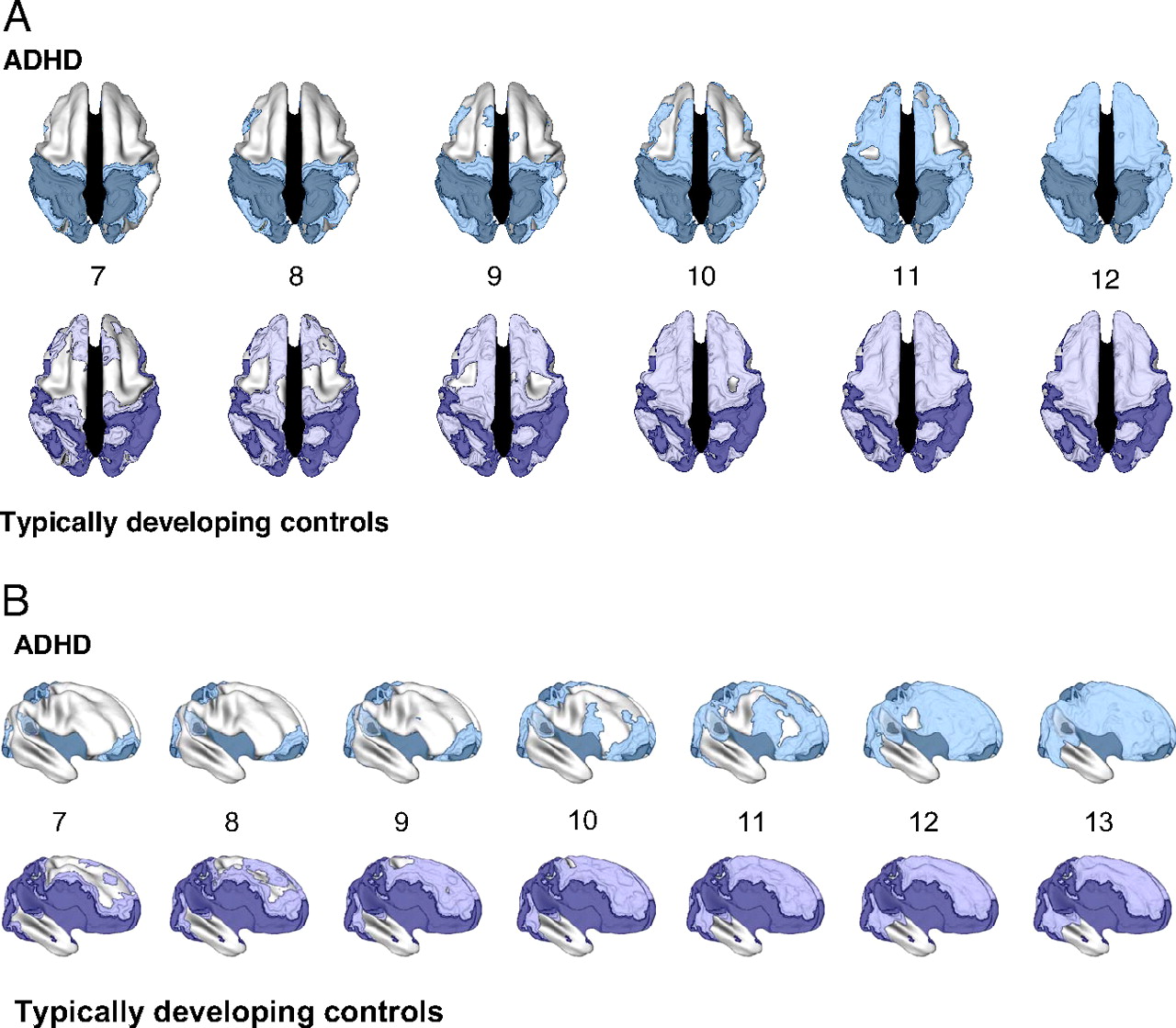
Results from a 2007 study show the differences in brain development between children with ADHD (in blue) and a child without the disorder (in purple) through ages 7 to 13. This data showed delayed cortical thinning in children with ADHD, but a new study casts doubt on that finding.
(Image credit: P. Shaw et al. (2007))
The new work exploited a powerful data source to show that the previously reported delayed maturation is likely a mirage in the data, caused by differences in how boys' and girls' brains develop. When these different patterns are taken into account, there's no difference between ADHD and non-ADHD brain maturation, the study authors wrote.
The team set out to replicate the 2008 paper, using data from the Adolescent Brain Cognitive Development (ABCD) study, a National Institutes of Health-funded project that is tracking over 11,000 9- and 10-year-olds for roughly a decade, said study first author Shannon O'Connor, a research project assistant at the University of Vermont. The study measures various behavioral traits and brain metrics and is the largest imaging study of its kind to follow people over time in the United States, O'Connor told Live Science.
The ABCD study asked parents to report any problems with their child's attention. When the researchers initially examined the relationship between attention problems and cortical thickness, they found the same associations as the original study uncovered nearly 20 years earlier.
What to read next
-
 AI 'mirages' mean tools used to analyze medical scans could fabricate their findings
-
 Brain aging results from a loss of control over how genes are regulated, mouse study suggests
-
 How menopause affects the brain — and what we still don't know
But the team wanted to use the rich dataset provided by the ABCD to test what would happen if they accounted for other factors in the children's lives. O'Connor had noticed that, in other studies of the ABCD data, boys tended to show a lower rate of cortical thinning than girls. When the team accounted for these different rates, the associations between attention problems and brain structure disappeared.
"That's what made the whole house of cards topple," Albaugh said. Earlier studies had accounted for the differences between boys and girls at single snapshots, but not over time, he noted. As kids dropped out of these smaller studies, their carefully balanced analyses may have swung to disproportionately reflect boys’ lower rate of cortical thinning.
Digging further into the data, the team split the cohort into just boys and just girls. In both sexes individually, there was no relationship between cortical thickness and attention.
The replication crisis rolls on
Dr. Max Wiznitzer, a pediatric neurologist at Case Western Reserve University who was not involved with the new study, said it was "well designed" and "asked the right questions." The new findings were based on parent-reported attention problems rather than ADHD diagnoses, so Albaugh's team conducted a series of follow-up studies looking at subsets of the patients who were diagnosed clinically, which produced similar results.
The new findings add to the overall replication crisis affecting neuroscience. New, powerful datasets and more precise imaging techniques have undermined, rather than strengthened, notable neuroscience studies that have guided the field. Albaugh said these new datasets suggest that many of these early findings "may have been flukes."
Notably, the influence of sex differences has been largely overlooked in neuroscience, and this research highlights how acknowledging sex as a factor can refine a study's conclusions.
Related stories
- Babies' brain activity changes dramatically before and after birth, groundbreaking study finds
- Is there really a difference between male and female brains? Emerging science is revealing the answer.
- In 'Secrets of the Brain,' Jim Al-Khalili explores 600 million years of brain evolution to understand what makes us human
Albaugh was quick to emphasize that the findings don't change the underlying knowledge that ADHD is a biological condition that has a strong genetic component. But it does leave the field lacking reliable biological signatures for the condition, Wiznitzer said.
The study should encourage researchers in the field to seek biological signatures that can be used to guide the diagnosis and treatment of individual patients rather than groups, he added. Cortical thickness was never used in those ways.
"If I put someone on medication and their behavior improves, in a way, it doesn't matter what their cortical thickness is," Wiznitzer said. "Clinically, there's the improvement, which is what you're after."
Article Sources
O’Connor, S. D., Loughnan, R., Ahern, J., Fan, C. C., Althoff, R. R., Garavan, H., Potter, A., & Albaugh, M. D. (2026). Attention problems and cortical maturation in a large longitudinal sample of youths: The importance of accounting for sex differences. Proceedings of the National Academy of Sciences, 123(21), e2605729123. https://doi.org/10.1073/pnas.2605729123
See how much you know about the most complex organ in the human body with our brain quiz!

RJ MackenzieLive Science Contributor
RJ Mackenzie is an award-nominated science and health journalist. He has degrees in neuroscience from the University of Edinburgh and the University of Cambridge. He became a writer after deciding that the best way of contributing to science would be from behind a keyboard rather than a lab bench. He has reported on everything from brain-interface technology to shape-shifting materials science, and from the rise of predatory conferencing to the importance of newborn-screening programs. He is a former staff writer of Technology Networks.
View More
You must confirm your public display name before commenting
Please logout and then login again, you will then be prompted to enter your display name.
Logout
Read more
Neuroscience
The brain's memory center doesn't start as a blank slate, study suggests
Neanderthals
Neanderthals' brains weren't to blame for their demise, new study suggests
SPONSORED_LABEL
SPONSORED_HEADLINE
SPONSORED_DISCLAIMER
SPONSORED_STRAPLINE
Neuroscience
Estrogen in both the male and female brain shapes responses to trauma, study suggests
Health
AI 'mirages' mean tools used to analyze medical scans could fabricate their findings
SPONSORED_LABEL
SPONSORED_HEADLINE
SPONSORED_DISCLAIMER
SPONSORED_STRAPLINE
Latest in Neuroscience

Neuroscience
Why aren't brain transplants possible?
Neuroscience
The brain's memory center doesn't start as a blank slate, study suggests
SPONSORED_LABEL
SPONSORED_HEADLINE
SPONSORED_DISCLAIMER
SPONSORED_STRAPLINE
Neuroscience
Estrogen in both the male and female brain shapes responses to trauma, study suggests
Neuroscience
First-of-its-kind map of the mouse nose reveals surprises about the sense of smell
SPONSORED_LABEL
SPONSORED_HEADLINE
SPONSORED_DISCLAIMER
SPONSORED_STRAPLINE