- Search What are you curious about? Popular SearchesCritical thinkingPhilosophyEmotional IntelligenceFree Will Latest Videos Latest Articles
-
Topics
Philosophy
- Ethics
- Religion
- Flourishing
- Knowledge
- Philosophy of Science
- Philosophy of Art
- Language
- Political Theory
- Identity
- Meaning & Purpose
Science & Tech
- Physics
- Biology
- Aerospace
- Health
- Geology
- Computing
- Engineering
- Energy
- Biotechnology
- Astronomy
Mind & Behavior
- Psychology
- Neuroscience
- Decision-Making
- Mental Health
- Consciousness
- Emotional Intelligence
- Personality
- Relationships
- Parenting
Business
- Entrepreneurship
- Leadership
- Finance
- Marketing
- Innovation
- Strategy
- Management
- Artificial Intelligence
- Startups
- Economics
History & Society
- History
- Literature
- Art
- Music
- Film
- Progress
- Culture
- Sociology
- Policy
- Geopolitics
- Latest
-
Videos
Latest Videos
 Over-optimizing your life is making you fragile, not better
with
Brad Stulberg
Over-optimizing your life is making you fragile, not better
with
Brad Stulberg
 This isn’t a trip, it’s the most challenging therapy session of your life
with
Rachel Yehuda
This isn’t a trip, it’s the most challenging therapy session of your life
with
Rachel Yehuda
 The physiology of dreams, explained by 2 scientists
with
Patrick McNamara
The physiology of dreams, explained by 2 scientists
with
Patrick McNamara
 Reboot your mind for flow, unanxiousness, and resilience
with
Steven Kotler
Reboot your mind for flow, unanxiousness, and resilience
with
Steven Kotler
 The science behind the strangest biological phenomena
with
David J. Linden
The science behind the strangest biological phenomena
with
David J. Linden
 The hidden reason smart people stop growing
with
Robert Herjavec
See All
The hidden reason smart people stop growing
with
Robert Herjavec
See All
-
Columns
 Mini Philosophy
A philosophy column for personal reflection.
Mini Philosophy
A philosophy column for personal reflection.
 Starts With A Bang
An astrophysics column on big questions and our universe.
Starts With A Bang
An astrophysics column on big questions and our universe.
 Books
A literature column to feed your curiosity.
Books
A literature column to feed your curiosity.
 The Long Game
A business column on long-term thinking.
The Long Game
A business column on long-term thinking.
 Strange Maps
A geography column on history and society.
Strange Maps
A geography column on history and society.
 The Well
A collection of essays and videos on life’s biggest questions.
The Well
A collection of essays and videos on life’s biggest questions.
 13.8
A column at the intersection of science and culture.
13.8
A column at the intersection of science and culture.
-
Classes
Featured Classes
 Members
6 videos
How to Become Antifragile
Tal Ben-Shahar
Positive psychologist
Members
6 videos
How to Become Antifragile
Tal Ben-Shahar
Positive psychologist
 Members
7 videos
Understanding Trauma
Bessel van der Kolk
Psychiatrist and neuroscientist
Members
7 videos
Understanding Trauma
Bessel van der Kolk
Psychiatrist and neuroscientist
 Members
9 videos
The 6 Disciplines of Strategic Thinking
Michael Watkins
Professor of Leadership and Organizational Change, IMD Business School, and Author, “The Six Disciplines of Strategic Thinking”
Members
9 videos
The 6 Disciplines of Strategic Thinking
Michael Watkins
Professor of Leadership and Organizational Change, IMD Business School, and Author, “The Six Disciplines of Strategic Thinking”
 Members
12 videos
Radical Respect at Work
Kim Scott
Co-Founder, Radical Candor, and Author, Radical Respect: How to Work Together Better
Members
12 videos
Radical Respect at Work
Kim Scott
Co-Founder, Radical Candor, and Author, Radical Respect: How to Work Together Better
 Members
8 videos
How to Think Like a Spy
Andrew Bustamante
Former CIA Operative and Founder, Everyday Spy
Members
8 videos
How to Think Like a Spy
Andrew Bustamante
Former CIA Operative and Founder, Everyday Spy
 Members
7 videos
Managing the Voice in Your Head
Ethan Kross
Professor of Psychology and Management & Organizations; Author, University of Michigan
Browse
Members
7 videos
Managing the Voice in Your Head
Ethan Kross
Professor of Psychology and Management & Organizations; Author, University of Michigan
Browse
-
More
- Newsletters
- Monthly Issues
- Events
- Big Think+ Learning
- Creative Studio
- Advertise with Us
- About
- Careers
- View our Twitter (X) feed View our Youtube channel View our Instagram feed View our Substack feed View our Spotify feed
-
My account
- My Classes
- My Account
- My List
- BT+ for my Business
- Early Releases
- Sign Out
- Membership
- Latest
-
Topics
Back
Philosophy
Science & Tech
Mind & Behavior
Business
History & Society
-
Videos
Back
Latest Videos
Over-optimizing your life is making you fragile, not better
Brad Stulberg breaks down the biology, philosophy, and psychology behind genuine excellence and how to reach it.
This isn’t a trip, it’s the most challenging therapy session of your life
Rachel Yehuda, a leading PTSD researcher, has spent her career uncovering the way that trauma can leave impressions on our...
The physiology of dreams, explained by 2 scientists
Have you ever woken up after a dream and thought to yourself, “That made absolutely no sense”? According to modern...
Reboot your mind for flow, unanxiousness, and resilience
“We can use neuroscience and tools from psychology to learn how to take advantage of anxiety.” From Zen Buddhism to...
The science behind the strangest biological phenomena
Neuroscientist David Linden sheds light on the biology behind phenomena that medicine has long struggled to explain, from voodoo death...
The hidden reason smart people stop growing
Shark Tank’s Robert Herjavec breaks down why the traditional idea of mentorship is not only outdated, but actively getting in...
 The neuroscience behind synesthesia
Neurologist Richard Cytowic has spent decades studying synesthesia, the phenomenon where one sense involuntarily triggers another.
The neuroscience behind synesthesia
Neurologist Richard Cytowic has spent decades studying synesthesia, the phenomenon where one sense involuntarily triggers another.
 The real lesson from the first time globalization died
Archaeologist Eric Cline has spent his career forensically reconstructing why the Bronze Age collapsed, and the answer is far stranger...
The real lesson from the first time globalization died
Archaeologist Eric Cline has spent his career forensically reconstructing why the Bronze Age collapsed, and the answer is far stranger...
-
Columns
Back
Columns
Mini Philosophy
A philosophy column for personal reflection.
Starts With A Bang
An astrophysics column on big questions and our universe.
Books
A literature column to feed your curiosity.
The Long Game
A business column on long-term thinking.
Strange Maps
A geography column on history and society.
The Well
A collection of essays and videos on life’s biggest questions.
13.8
A column at the intersection of science and culture.
-
Classes
Back
Featured Classes
Members
6 videos
How to Become Antifragile
Tal Ben-Shahar
Positive psychologist
Members
7 videos
Understanding Trauma
Bessel van der Kolk
Psychiatrist and neuroscientist
Members
9 videos
The 6 Disciplines of Strategic Thinking
Michael Watkins
Professor of Leadership and Organizational Change, IMD Business School, and Author, “The Six Disciplines of Strategic Thinking”
Members
12 videos
Radical Respect at Work
Kim Scott
Co-Founder, Radical Candor, and Author, Radical Respect: How to Work Together Better
Members
8 videos
How to Think Like a Spy
Andrew Bustamante
Former CIA Operative and Founder, Everyday Spy
Members
7 videos
Managing the Voice in Your Head
Ethan Kross
Professor of Psychology and Management & Organizations; Author, University of Michigan
- My Account Back
- Sign In
- Membership
- More Back
Human beings have now traveled farther from Earth than ever before with Artemis II's flyby of the lunar far side. Here's how it happened.
by Ethan Siegel April 10, 2026 On Earth as well as in space, it is unsafe to look directly at the Sun with the naked human eye, and this remains true at any distance inside the Solar System. However, a simple pair of eclipse glasses, the same type that tens of millions of people use on Earth to view a solar eclipse, can be safely used by NASA astronauts to view the Sun with their own eyes from space. At approximately $1 per pair, these glasses may well represent the cheapest pieces of equipment used in the Artemis II mission.
Credit: NASA
Key Takeaways- In April of 2026, the first humans ventured beyond the confines of low-Earth orbit since Apollo 17 back in 1972, leaving Earth and flying by the Moon aboard the Artemis II mission.
- During the lunar flyby on April 6, 2026, the astronauts reached a maximum distance from Earth of 406,773 km, breaking the record long-held by the astronauts aboard Apollo 13.
- But what was it that enabled the Artemis II astronauts to break that longstanding distance record? It wasn’t about the power of the rocket, but rather a choice of orbit and timing. Isaac Newton did the rest.

An astrophysics column on big questions and our universe.
Get our free newsletter on Substack-
Science and TechHistory and SocietyAstrophysicsAstronomySpace Exploration
On April 6, 2026, humanity set an all-time record as part of the Artemis II mission: the distance record for how far a living human has ever traveled away from planet Earth. Traveling farther than any other humans in history, astronauts Reid Wiseman, Victor Glover, Christina Koch, and Jeremy Hansen reached a maximum distance of 406,773 km (252,757 miles), breaking the previous record set way back on April 15, 1970 by the Apollo 13 mission. For 56 years, the Apollo 13 record stood, as those astronauts reached a maximum distance of 400,171 km (248,655 miles): a record that has now been extended by an impressive 6602 km (4021 miles), greater than the radius of the Earth.
But why did this happen? What enabled the Artemis II mission to surpass the Apollo-era distance record? That’s what Daniel Fleisher wants to know, writing in with the following inquiry:
“NASA is telling the world that the Artemis mission has now traveled farther from Earth than any previous crewed space mission. I don’t doubt them, but what explains it? Or maybe, what allows for it? Google said it was because the Artemis rocket is more powerful than the old Saturn V. But that’s a ridiculous change of subject.”
Well Daniel, it turns out there are three major factors that enabled the Artemis II astronauts to break the Apollo distance record, and none of those three have anything to do with Google’s answer. (That’s no surprise; Google’s AI summaries are factually incorrect between 9-10% of the time, according to an independent study.) Let’s dive into what happened, and then let’s piece together what truly enabled this record-breaking spaceflight.
 On April 1, 2026, four humans launched aboard NASA’s Space Launch System rocket, which carries the Orion spacecraft: the Artemis II mission. Its 10 day journey marks the first time humans have gone to the Moon since 1972’s Apollo 17: a 54 year gap.
Credit: NASA/Bill Ingalls
On April 1, 2026, four humans launched aboard NASA’s Space Launch System rocket, which carries the Orion spacecraft: the Artemis II mission. Its 10 day journey marks the first time humans have gone to the Moon since 1972’s Apollo 17: a 54 year gap.
Credit: NASA/Bill Ingalls
First off, “powerful” is something that has a very specific meaning in physics-related applications, and it’s not necessarily identical to how we use it conventionally. We might say that a powerlifter who can deadlift 400 kg is more powerful than a powerlifter who can deadlift 350 kg, but that’s not necessarily true in physics. In physics, power is the amount of work done (or useful energy expended) over an interval of time. If the deadlifter who lifts 400 kg raises that mass by 0.7 meters in a span of two seconds, they’d only expend half the power of the deadlifter who raises the 350 kg mass by 0.8 meters in a span of one second.
Power, or the rate of energy expenditure over time, is not particularly relevant to the total amount of work done, or in the case of a rocket launch, the maximum distance that the payload can achieve. In fact, although the Artemis II mission carried approximately 733,000 gallons of fuel — a mix of liquid oxygen and liquid hydrogen — spent across two rocket stages, the Saturn V rockets that launched the Apollo era missions carried and spent more like 947,000 gallons of fuel across three stages, including not just liquid oxygen and liquid hydrogen, but also 203,000 gallons of RP-1 kerosene as well.
The power, or the rate of energy expenditure, doesn’t matter nearly as much as the total energy spent for a given particular payload.
 The launch of Apollo 17, the 8th and final crewed mission that would go to the Moon as part of the Apollo program, was also the first nighttime liftoff of a Saturn V rocket, occurring on December 7, 1972.
Credit: NASA
The launch of Apollo 17, the 8th and final crewed mission that would go to the Moon as part of the Apollo program, was also the first nighttime liftoff of a Saturn V rocket, occurring on December 7, 1972.
Credit: NASA
Sure, the Artemis II rocket had a greater thrust than the Saturn V rocket as well — generating 8.8 million pounds of thrust (39 million N) vs. 7.5 million pounds (33 million N) for the Saturn V rockets — but thrust doesn’t play a major factor in your maximum distance from Earth. What matters, in terms of distance, is how fast you’re moving once you’re above Earth’s atmosphere, at any given distance from Earth, relative to what we call escape velocity, or how fast you’d have to move to escape from Earth’s gravitational pull.
We’ve achieved escape velocity from Earth with a variety of spacecraft, of course.
- The Pioneer, Voyager, and New Horizons missions are the fastest-moving missions we’ve ever conducted: the five most distant spacecraft of all-time, all of which are currently escaping from the Solar System.
- We’ve sent missions to a variety of planets, including the Juno mission around Jupiter and the Cassini mission around Saturn, all of which exceeded escape velocity from Earth’s orbit.
- We’ve sent a variety of spacecraft and observatories to the L2 Lagrange point more than 1 million kilometers farther than the Moon is from Earth, including Earth-observing satellites like DSCOVR/EPIC and Universe-observing ones like the James Webb Space Telescope: observatories whose speeds almost exactly equaled escape velocity.
 This animation features satellite images of the far side of the Moon, illuminated by the Sun, as it crosses between the DSCOVR spacecraft’s Earth Polychromatic Imaging Camera (EPIC) and telescope, and the Earth — one million miles (1.6 million km) away. The far side of the Moon is vastly different from the near side, with few dark maria and 30% more craters than the near side, as well as having a thicker, higher-elevation crust.
Credit: NASA/EPIC
This animation features satellite images of the far side of the Moon, illuminated by the Sun, as it crosses between the DSCOVR spacecraft’s Earth Polychromatic Imaging Camera (EPIC) and telescope, and the Earth — one million miles (1.6 million km) away. The far side of the Moon is vastly different from the near side, with few dark maria and 30% more craters than the near side, as well as having a thicker, higher-elevation crust.
Credit: NASA/EPIC
But that’s not what we want to do with humans on board. We have yet to launch humans into space on a one-way mission anywhere; the goal has always been to return them to Earth after a relatively short (and low-distance) journey. That means we don’t want to exceed escape velocity, or even to reach it. What we instead seek to do — particularly if we want to send astronauts either to the Moon or near the Moon — is to get a spacecraft:
- close enough to escape velocity that it leaves low-Earth orbit,
- while remaining far enough from escape velocity that it won’t risk escaping Earth’s orbit entirely,
- and still putting it on the appropriate trajectory so that it can complete whatever mission it’s setting out to complete.
For the Apollo missions, the way this was conducted was straightforward. The multi-stage Saturn V rocket would launch its carefully-calibrated payload onto a trajectory where those aboard would travel to the Moon at a speed that took them close to, but remained significantly below, escape velocity. That trajectory would, if you were only going to fly by the Moon, slingshot you around the back of the Moon at a distance of thousands of kilometers (or miles) above the surface, but if you were attempting to land on the Moon, would bring you very close to the Moon’s surface: into low-Moon orbit, before enabling a landing attempt. Finally, whether you landed on the Moon or not, you’d perform a small spacecraft burn to put yourself on the appropriate return trajectory, and then you’d return to Earth at the right angle and at the right speed to survive re-entry.
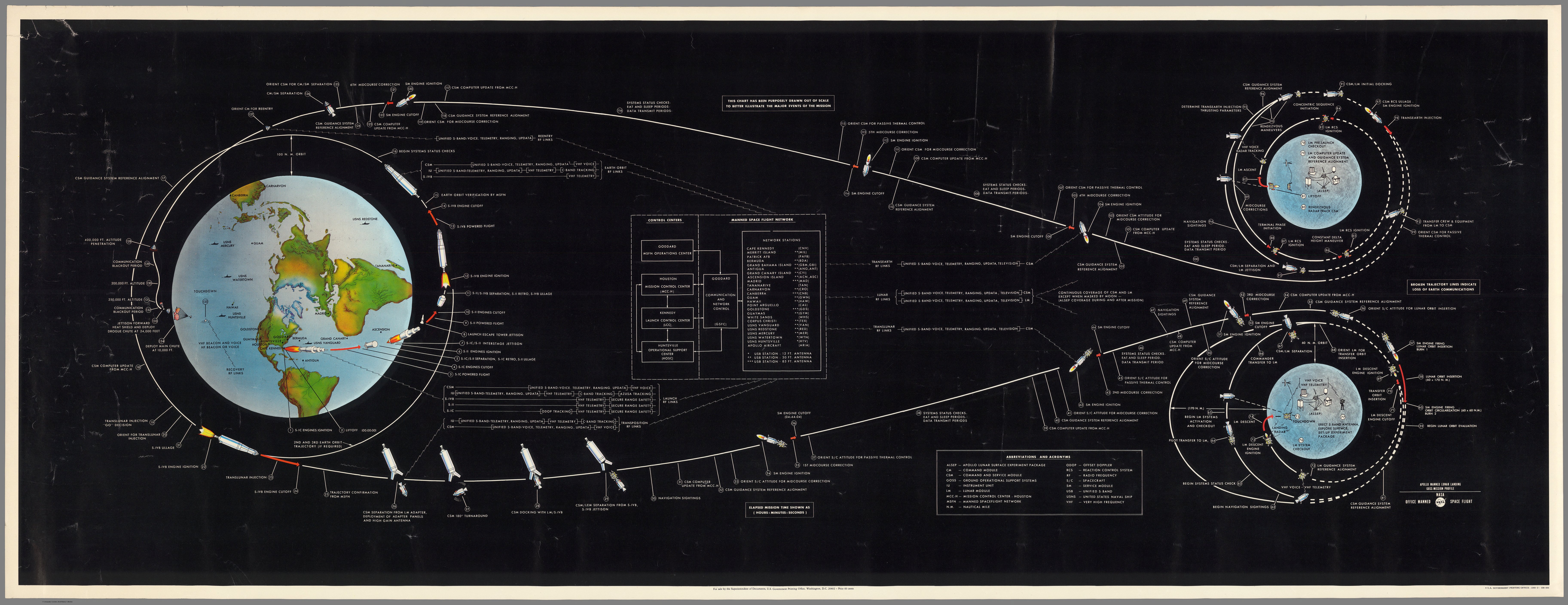 This poster illustrates the Apollo mission trajectories, made possible by the Moon’s close proximity to us. Newton’s law of universal gravitation, despite the fact that it’s been superseded by Einstein’s general relativity, is still so good at being approximately true on most Solar System scales that it encapsulates all the physics we need to travel from Earth to the Moon, orbit it, land on its surface (if we desire), and return. Isaac Newton did, indeed, do most of the driving.
Credit: NASA
This poster illustrates the Apollo mission trajectories, made possible by the Moon’s close proximity to us. Newton’s law of universal gravitation, despite the fact that it’s been superseded by Einstein’s general relativity, is still so good at being approximately true on most Solar System scales that it encapsulates all the physics we need to travel from Earth to the Moon, orbit it, land on its surface (if we desire), and return. Isaac Newton did, indeed, do most of the driving.
Credit: NASA
For the Artemis II mission, the story was a little bit different. Because the launch vehicle was able to impart less energy, overall, to the spacecraft, as compared with the Apollo program and the Saturn V rocket, the capsule was unable to achieve the same large initial velocity that the Lunar Orbiter and Lunar Landing Module were able to achieve in the Apollo era. Although it’s theoretically possible to launch several tons of material directly to the Moon with the rocket used, that wasn’t the path taken by Artemis II.
So how, then, did the Artemis II astronauts actually reach the Moon, if their launch vehicle couldn’t impart the same initial speeds to the payload that the Apollo program’s launch vehicle could?
That’s the first of three major factors contributing to the Artemis II astronauts breaking the human distance record from Earth: a trans-lunar injection burn, taking advantage of gravity and its initial ellipsoidal, medium-Earth orbit trajectory. Artemis II, like many spacecraft whose destinations lie beyond low-Earth orbit, timed its on-board rockets to coincide when it made its closest fly-by of a massive body — in this case, the Earth — maximizing its orbital change for a minimal amount of fuel, raising the orbit of the spacecraft itself in the process. This method of using a planet’s gravity to add to the “kick” provided by a thruster can either cause the spacecraft to lose momentum (in the case of the Mariner missions to Mercury, the MESSENGER mission, or the Parker Solar Probe mission), or it can boost spacecraft to greater momentum, as in the case of the Artemis II mission.
As you can see from the above animation, based on actual ephemeris data collected by NASA as opposed to a predicted trajectory, it isn’t just the effects of Earth’s gravity that affected the trajectory of the Artemis II mission. In addition, the Moon (and the Moon’s gravity) plays a key role in the spacecraft’s safe return to Earth. If the spacecraft had been launched in a slightly different direction — a direction where the Moon wasn’t going to be encountering it — the spacecraft would have kept departing away from Earth, farther and farther, until the Earth’s gravity eventually pulled it back, making its orbit a long, narrow ellipse: similar to a long-period comet’s orbit around the Sun.
Fortunately, we calculated and executed our trajectories properly, and the Moon encountered the spacecraft exactly as we needed it to in order to safely bring the Artemis II astronauts back on a return path, where they’ll encounter Earth’s atmosphere at the expected speed and angle for a successful re-entry. But the Moon doesn’t orbit the Earth at a constant distance; its orbit is quite elliptical. In fact, the Moon, at its most extreme closest approach (perigee) to Earth, comes within 356,375 km (221,442 miles) of our planet, while at its farthest distance (apogee), extends as far as 406,707 km (252,716 miles) from Earth.
 In any orbital system governed by gravity, such as the Earth-Moon system, the less massive body doesn’t trace out a circular path, but rather an elliptical one, where the more massive body behaves as one focus of that ellipse. In the case of the Earth-Moon system, closest approach, known generally as periapsis, is defined by perigee, typically varying between 356000 and 370000 km, while the most distant separation, generally apoapsis but specifically apogee for this system, ranges from 404000 to just under 407000 km.
Credit: Whidou/Wikimedia Commons
In any orbital system governed by gravity, such as the Earth-Moon system, the less massive body doesn’t trace out a circular path, but rather an elliptical one, where the more massive body behaves as one focus of that ellipse. In the case of the Earth-Moon system, closest approach, known generally as periapsis, is defined by perigee, typically varying between 356000 and 370000 km, while the most distant separation, generally apoapsis but specifically apogee for this system, ranges from 404000 to just under 407000 km.
Credit: Whidou/Wikimedia Commons
During the Apollo era, the Moon was never at its absolute most distant when astronauts were either in orbit around it or on the surface. For the nine Apollo missions, here are the Earth-Moon distances during the times when humans were in the vicinity of the Moon.
- Apollo 8: December 24, 1968, distance = 379,640 km.
- Apollo 10: May 21, 1969, distance = 403,828 km. (Close to apogee!)
- Apollo 11: July 20, 1969, distance = 385,951 km.
- Apollo 12: November 19, 1969, distance = 376,292 km.
- Apollo 13: April 14, 1970, distance = 405,323 km. (The longstanding record.)
- Apollo 14: February 5, 1971, distance = 386,462 km.
- Apollo 15: July 30, 1971, distance = 401,535 km.
- Apollo 16: April 20, 1972, distance = 382,416 km.
- Apollo 17: December 11, 1972, distance = 385,484 km.
Those are the figures for the Earth-Moon distances during the Apollo era, and quite clearly, humans went farther from Earth when they visited the Moon closer to apogee (Apollo 10, 13, and 15), as opposed to closer to perigee.
For the Artemis II mission, which flew by the Moon 54 years after the end of the Apollo program on April 6, 2026, the Moon was at a distance of 405,468 km from Earth: a greater distance than was achieved — albeit only slightly — during any of the Apollo-era missions.
This marks the second reason why the Artemis II mission took humans farther than the Apollo missions ever did: because we happened to choose a time and date for the mission that corresponded to encountering the Moon coinciding with apogee, and a more severe apogee, than in any of our prior trips.
 The Moon, backlit by the Sun during a solar eclipse, is photographed by NASA’s Orion spacecraft on April 6, 2026, during the Artemis II mission. Orion is visible in the foreground on the left. Earth is reflecting sunlight at the left edge of the Moon, which is slightly brighter than the rest of the disk. The bright spot visible just below the Moon’s bottom right edge is Saturn. Beyond that, the bright spot at the right edge of the image is Mars.
Credit: NASA
The Moon, backlit by the Sun during a solar eclipse, is photographed by NASA’s Orion spacecraft on April 6, 2026, during the Artemis II mission. Orion is visible in the foreground on the left. Earth is reflecting sunlight at the left edge of the Moon, which is slightly brighter than the rest of the disk. The bright spot visible just below the Moon’s bottom right edge is Saturn. Beyond that, the bright spot at the right edge of the image is Mars.
Credit: NASA
But the Artemis II astronauts weren’t at a distance from Earth that corresponds to the apogee distance; they were farther than that: even more distant. In fact, the astronauts were more distant than even the most distant apogee that the Earth-Moon system has ever experienced in terms of separation and distance from Earth!
How is that even possible?
Because of the third factor: how close to, or far from, the Moon the spacecraft comes during its flight path. Remember: Apollo 8 and Apollo 10 were humanity’s first trip to the Moon, and the goal was not to do a flyby only, but to insert the spacecraft into lunar orbit and to serve as “dress rehearsals” for the eventual Moon landing. Instead of just flying past the far side of the Moon once, Apollo 8 orbited the Moon ten times and Apollo 10 orbited an impressive thirty-one times!
Meanwhile, Apollo 11, 12, 14, 15, 16, and 17 didn’t just reach the Moon, but landed on it. (And, specifically, all landed on the near side of the Moon: the side that always faces, and is closest to, Earth.)
The reason Apollo 13 set the distance record from the Apollo isn’t only because the Moon was closer to a more severe apogee when it arrived, but because Apollo 13 used what’s called a free-return trajectory — the same as Artemis II — passing several thousand kilometers away, and more distant, from the far side of the Moon.
 Unlike all the other Apollo missions that occurred, Apollo 13 swung by the Moon on a free-return trajectory, traveling approximately 6400 km (4000 miles) farther than the far side of the Moon, instead of orbiting and/or landing on the Moon like all the other crewed Apollo missions.
Credit: NASA/Apollo 13/Project Apollo Archive
Unlike all the other Apollo missions that occurred, Apollo 13 swung by the Moon on a free-return trajectory, traveling approximately 6400 km (4000 miles) farther than the far side of the Moon, instead of orbiting and/or landing on the Moon like all the other crewed Apollo missions.
Credit: NASA/Apollo 13/Project Apollo Archive
The Artemis II mission was never designed to be a clone of the Apollo missions, of course. This mission was specifically designed not to enter lunar orbit, not to come close to the lunar surface, and certainly not to prepare for a landing on it. Instead, it was designed to safely bring astronauts to the vicinity of the Moon and to safely return them: that was the goal. However, if we put all three of those pieces of information together:
- the fact that, despite a less energetic rocket, overall, the Artemis II mission received an assist from the gravity of the Earth to perform a trans-lunar injection maneuver,
- the fact that the Moon was at apogee, and at a more distant apogee than was achieved during any of the prior (nine, Apollo-era) trips to the Moon, when Artemis II arrived,
- and the fact that, like only Apollo 13 before it, Artemis II followed a free-return trajectory, where “Isaac Newton is doing most of the driving,” rather than an inserted trajectory that remains closer to the lunar surface,
that is sufficient to explain why the Artemis II mission was able to take humans farther from Earth than ever before. If we had chosen to launch in a different window, when the Moon wasn’t at apogee, we wouldn’t have broken that record. If we hadn’t followed a free-return trajectory, but instead chose to insert the spacecraft into low lunar orbit, we wouldn’t have broken the record. And if we hadn’t performed the trans-lunar injection burn when the Orion capsule passed close to Earth in the fashion that we did, then the Artemis II astronauts wouldn’t have even been able to reach the Moon, much less break the all-time distance record.
 Earth sets at 6:41 p.m. EDT, April 6, 2026, over the Moon’s curved limb in this photo captured by the Artemis II crew during their journey around the far side of the Moon. Orientale basin is perched on the edge of the visible lunar surface. Hertzsprung Basin appears as two subtle concentric rings, which are interrupted by Vavilov, a younger crater superimposed over the older structure. The lines of indentations are secondary crater chains formed by ejecta from the massive impact that created Orientale. The dark portion of Earth is experiencing nighttime. On Earth’s day side, swirling clouds are visible over the Australia and Oceania region.
Credit: NASA
Earth sets at 6:41 p.m. EDT, April 6, 2026, over the Moon’s curved limb in this photo captured by the Artemis II crew during their journey around the far side of the Moon. Orientale basin is perched on the edge of the visible lunar surface. Hertzsprung Basin appears as two subtle concentric rings, which are interrupted by Vavilov, a younger crater superimposed over the older structure. The lines of indentations are secondary crater chains formed by ejecta from the massive impact that created Orientale. The dark portion of Earth is experiencing nighttime. On Earth’s day side, swirling clouds are visible over the Australia and Oceania region.
Credit: NASA
It’s worth pointing out that there is no reason to think that this record represents some sort of limit on what we can achieve in any way. We could send humans out toward the L2 Lagrange point; it would just take them much longer to return, and they wouldn’t be protected from the radiation hazards of space like they are in low-Earth orbit. We could send them out toward other planets, asteroids, or more distant heavenly bodies, but that would either require a different launch vehicle or a very long-term flight, where again, they’d lack protection from the hazards of space. Or we could even launch them out of the Solar System with a sufficient set of true gravity assists with massive bodies that the spacecraft was never gravitationally bound to, but then they’d never return.
But it was a combination of modern rocket technology, a carefully planned launch and flight that involved a gravitational assist from Earth to perform a trans-lunar injection burn (where this flight plan also explains why it took longer for the Artemis II astronauts to reach the Moon than the Apollo astronauts required), and the decision to make a lunar flyby on a free-return trajectory, rather than an injection into lunar orbit, that all contributed to this record-breaking feat. Here in 2026, it’s important to take every opportunity we can to remind ourselves that we truly are one world — and still the only inhabited world we know of — where every accomplishment made by human civilization is an achievement for us all.
Send in your Ask Ethan questions to startswithabang at gmail dot com!
-
Science and TechHistory and SocietyAstrophysicsAstronomySpace Exploration
Theoretical astrophysicist and science writer
Full Profile Monthly Issue
March 2026
The Roots of Resilience
In this monthly issue, we look at resilience not as a buzzword or a self-help prescription, but as a property — one that shows up, or doesn’t, at every scale.
2 videos
14 articles
Monthly Issue
March 2026
The Roots of Resilience
In this monthly issue, we look at resilience not as a buzzword or a self-help prescription, but as a property — one that shows up, or doesn’t, at every scale.
2 videos
14 articles

Related Content
Starts With A BangTo alien eyes, Earth looks deceptively peaceful
As the world teeters on the brink of nuclear war, distant, advanced civilizations would never know it. Earth appears peaceful from far away.
by Ethan Siegel Starts With A Bang
Something special is happening in space right now
As humanity journeys to the Moon for the first time since 1972, can we rediscover our shared responsibilities: to the world and each other?
by Ethan Siegel Starts With A Bang
The 4 ways science confirms the Moon landings were real
Even though no human has stepped foot on the Moon's surface in 50 years, the evidence of our presence there remains unambiguous.
by Ethan Siegel Starts With A Bang
Only these 6 spacecraft will ever escape the Solar System
No human has ever left the Solar System, and only six already-launched spacecraft will ever exit it. Will Voyager 1 remain the most distant?
by Ethan Siegel Learn from the world's biggest thinkers.
-
Videos
- Latest
- The Big Think Interview
-
Columns
- Mini Philosophy
- Starts with a Bang
- Big Think Books
- The Long Game
- Strange Maps
- 13.8
- The Well
- Rethinking Possible
-
Sections
- Philosophy
- Mind & Behavior
- Science & Tech
- Business
- History & Society
-
Classes
- Class Library
-
Subscribe
- Membership
- Free Newsletters
-
Partner
- Big Think+ Learning
- Creative Studio
- Advertise with Us
- Events
-
More
- About
- Careers
- Contact
- Privacy Policy
- Terms of Sale
- Accessibility