Friday, April 10, 2026: The latest updates on the Artemis II mission as the crew prepare for a perilous reentry to Earth following a 10-day journey around the moon.
News By Patrick Pester, Brandon Specktor, Kenna Hughes-Castleberry, Ben Turner last updated 11 April 2026 1 Comment Join the conversationWhen you purchase through links on our site, we may earn an affiliate commission. Here’s how it works.
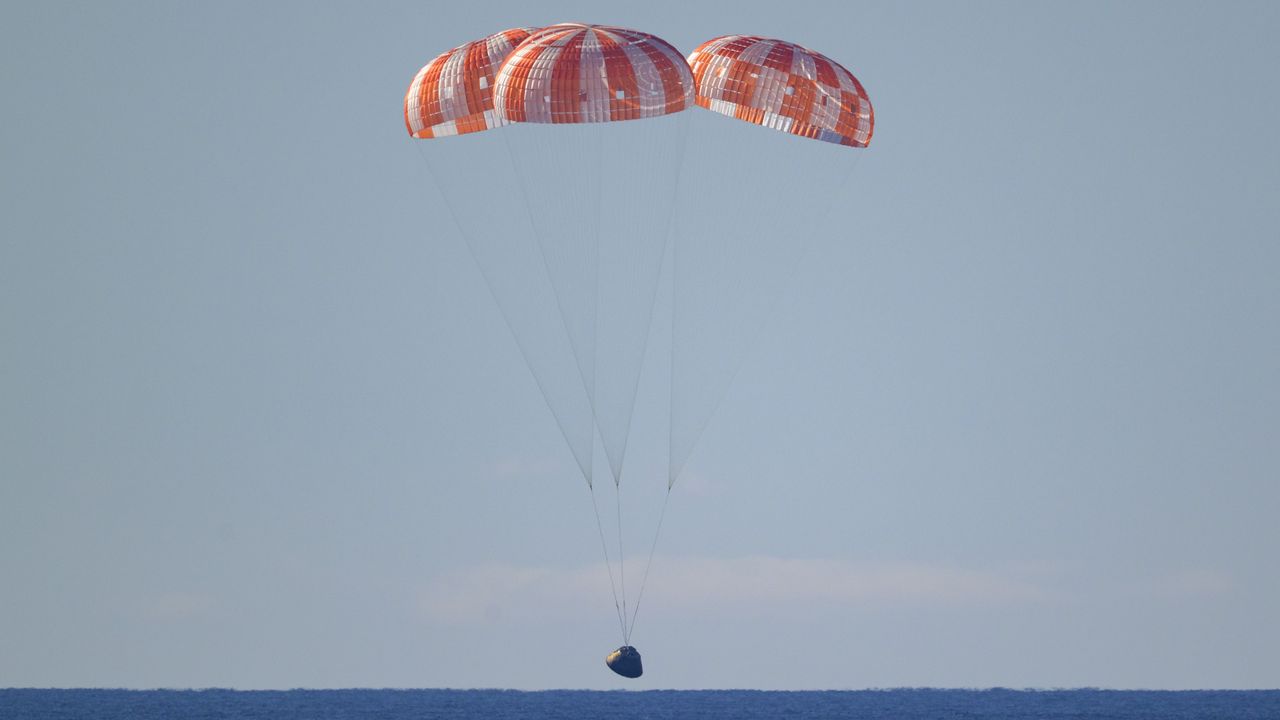
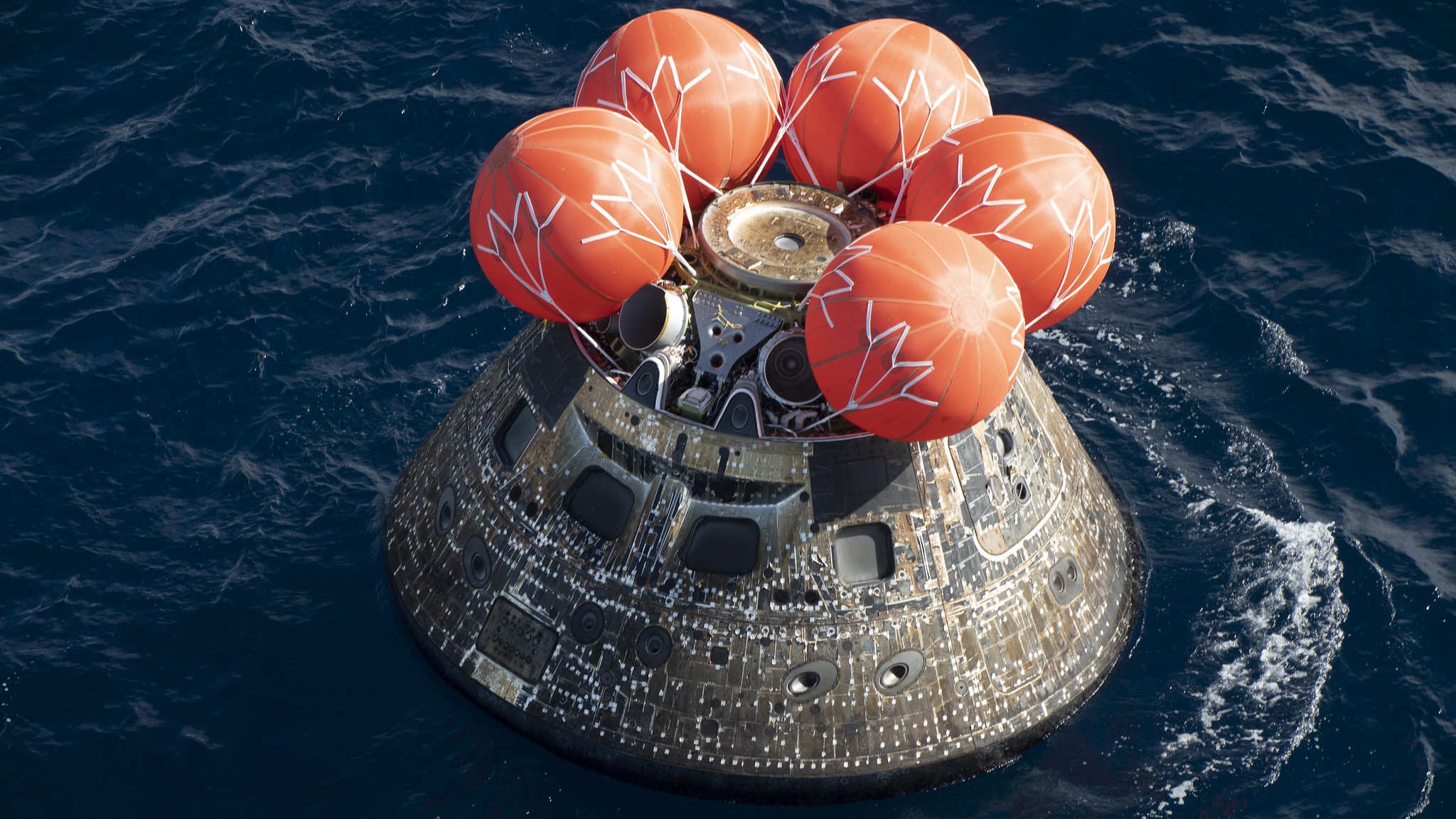
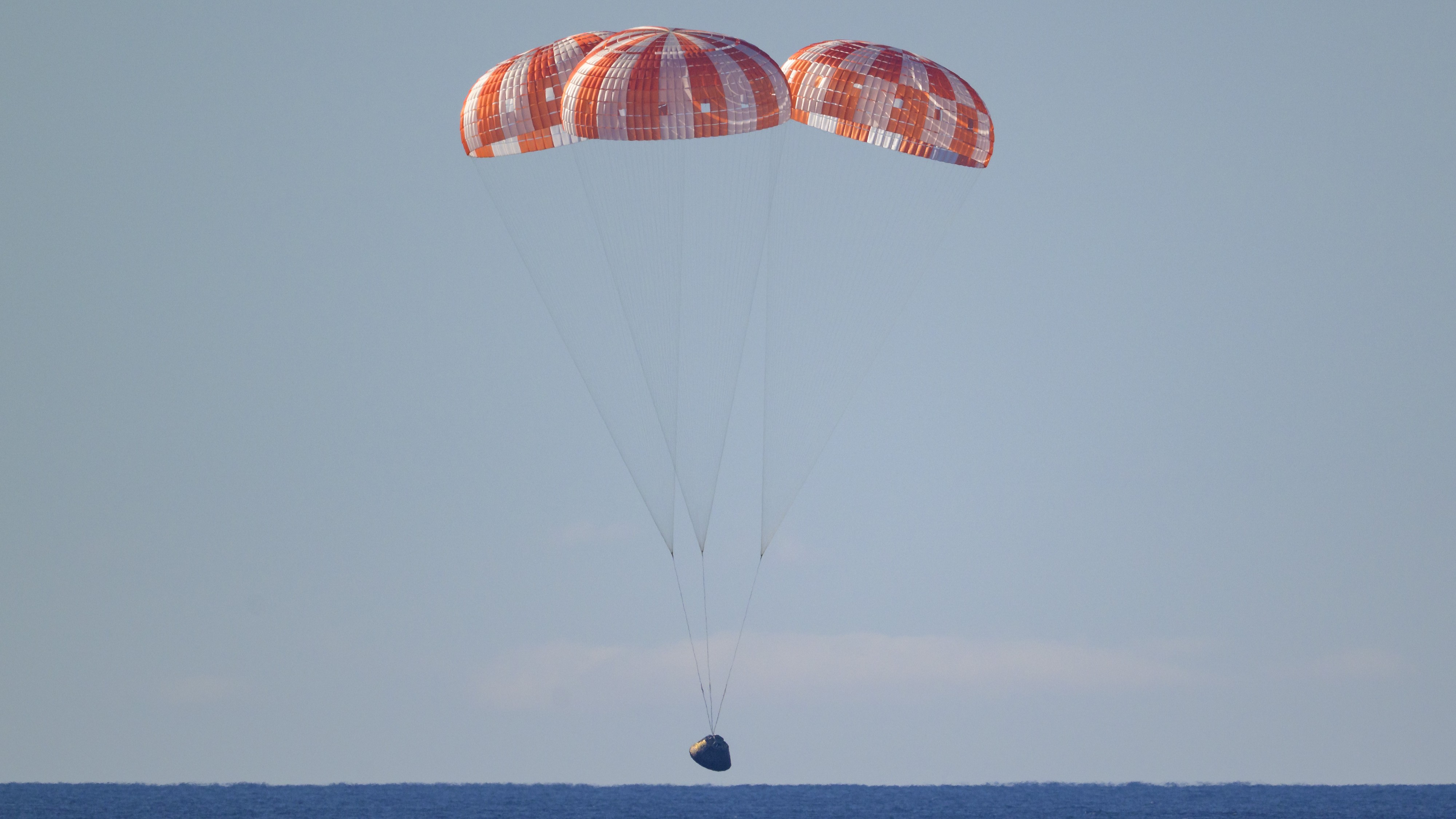 Artemis II's Orion capsule floats down to the Pacific Ocean.
(Image credit: © NASA/Bill Ingalls)
Artemis II's Orion capsule floats down to the Pacific Ocean.
(Image credit: © NASA/Bill Ingalls)
Here's the latest on the final stage of the Artemis II mission:
- The Orion capsule Integrity has splashed down safely in the Pacific Ocean at 8:07 p.m. EDT.
- Artemis II mission commander Reid Wiseman has confirmed that all four astronuats are in good shape.
- NASA has powered down the spacecraft ahead of U.S. Navy recovery team approach.
That reentry though
A post shared by Live Science (@live_science)
A photo posted by on
 Ben TurnerActing Trending News Editor
2026-04-11T00:53:57.982Z
Ben TurnerActing Trending News Editor
2026-04-11T00:53:57.982Z
Post-splashdown news conference at NASA Johnson Space Center
NASA is set to hold a press conference at Johnson Space Center in Houston at 10:30 p.m. EDT to answer the public's questions about the splashdown, crew status and what's next for the Artemis program. According to NASA: "Details on the astronauts’ return to Houston will be shared later."
NASA has already announced its plans for Artemis III in 2027, a crewed mission which will land on the moon. Beyond this, the agency also plans to build a $20 billion lunar base to pave the way for a long-term human presence on the moon.
2026-04-11T00:41:17.981Z"The vehicle is in excellent shape"
 Kenna Hughes-CastleberryContent Manager
2026-04-11T00:34:33.697Z
Kenna Hughes-CastleberryContent Manager
2026-04-11T00:34:33.697Z
Integrity has been powered down
2026-04-11T00:30:44.070Z"I'm still at a loss for words"
2026-04-11T00:26:57.707ZThe recovery team is standing by
2026-04-11T00:21:32.793Z"We hear them, but it does not appear that they hear us."
2026-04-11T00:16:15.315ZIntegrity is now powering down
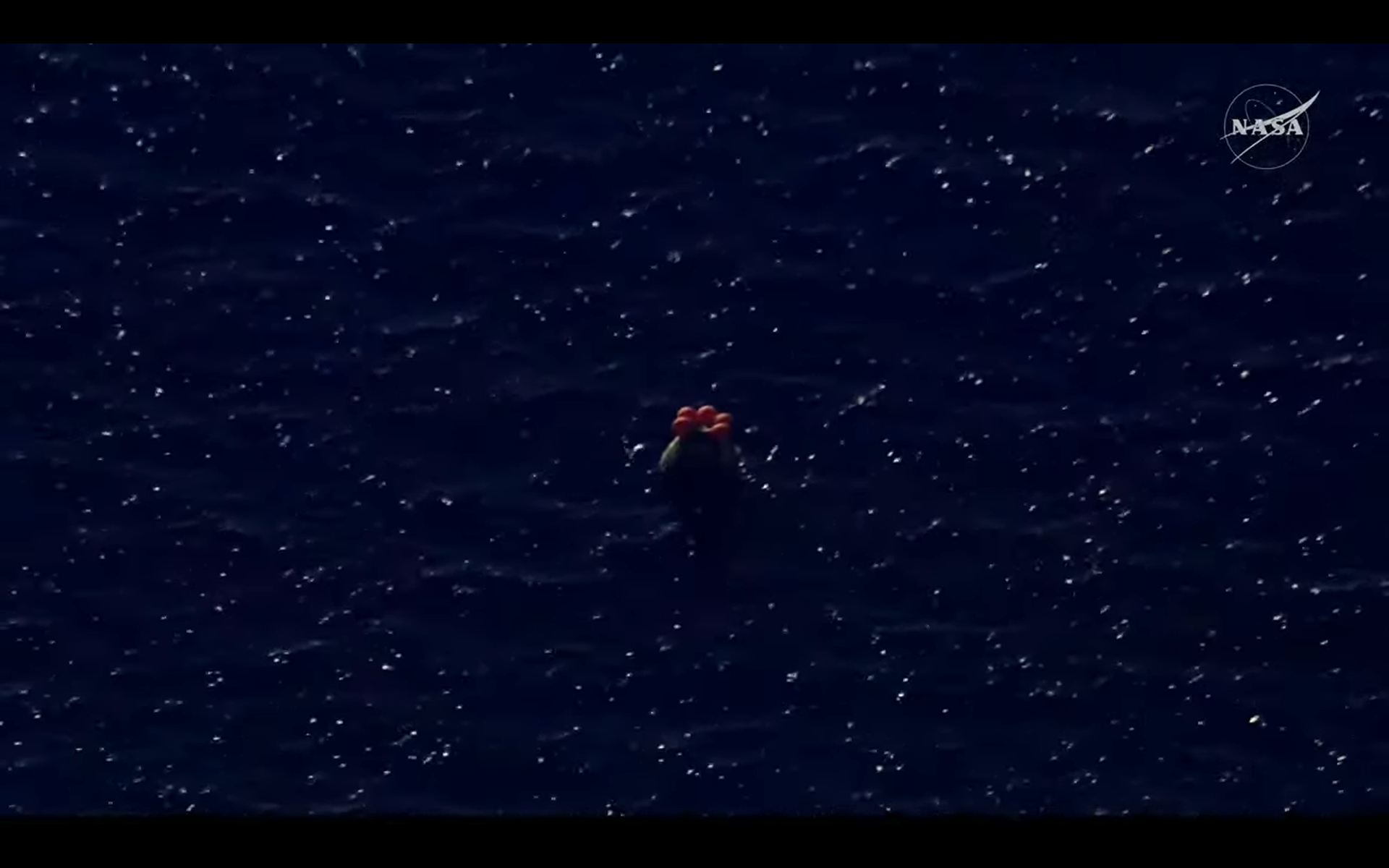
NASA is now beginning to power down Integrity so that the U.S. Navy recovery team can safely approach.
Ben TurnerActing Trending News Editor
2026-04-11T00:10:25.799Z
Navy recovery begins
This will be the astronauts’ first exposure to Earth’s gravity in more than 9 days, so they may feel a little weak and wobbly at first as they find their “land legs.”
When everyone feels ready, the astronauts will be lifted one by one into a pair of waiting Navy helicopters. Next, they’ll all fly to the USS Murtha transport dock ship to receive a more comprehensive medical exam.
 Brandon SpecktorSpace and Physics Editor
2026-04-11T00:08:08.686Z
Brandon SpecktorSpace and Physics Editor
2026-04-11T00:08:08.686Z
Splashdown!
 Patrick PesterTrending News Writer
2026-04-11T00:06:22.501Z
Patrick PesterTrending News Writer
2026-04-11T00:06:22.501Z
Main chutes deployed
Ben TurnerActing Trending News Editor
2026-04-11T00:04:34.859Z
Drogues deployed
2026-04-11T00:03:55.682Z"We have you loud and clear"
Patrick PesterTrending News Writer
2026-04-11T00:02:46.633Z
Cheers in mission control
Ben TurnerActing Trending News Editor
2026-04-11T00:01:35.610Z
Communications restored as parachutes begin to deploy
After these parachutes come the three main parachutes, each weighing 300 pounds. Those three parachutes will slow Orion down to a gentle 19 mph (31 kph) as it hits the ocean.
Patrick PesterTrending News Writer
2026-04-10T23:56:32.702Z
Hushed quiet in mission control
Ben TurnerActing Trending News Editor
2026-04-10T23:55:47.101Z
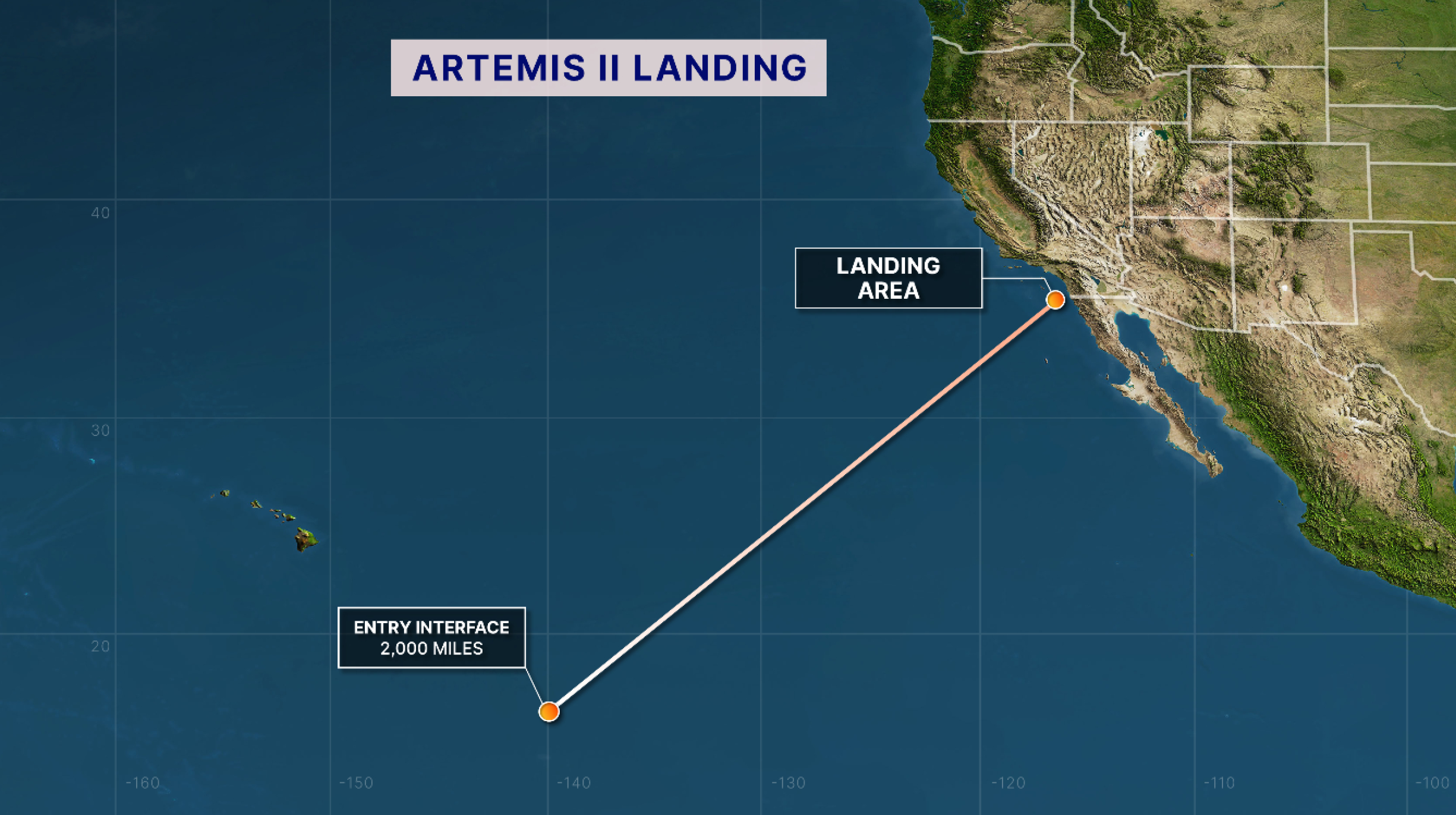
Where are they reentering?
Here's a nice graphic of the parachute sequence and where the crew will eventually end up, assuming all goes to plan — which it looks like it is.
Millions now tuning in
2026-04-10T23:55:01.165ZCommunications blackout
2026-04-10T23:54:01.404ZOrion hits the Earth's atmosphere
NASA's planned 6-minute communications blackout with the astronauts, and the test of Artemis II's heat shield will soon begin.
Patrick PesterTrending News Writer
2026-04-10T23:45:44.334Z
Why is the Integrity crew capsule doing 180 degree rolls?
This is not only to safely clear any debris that may have been produced from the separation from the service module but it also helps to reorient the capsule to meet Earth's atmosphere with the right face.
Kenna Hughes-CastleberryContent Manager
2026-04-10T23:43:40.637Z
"It looks a little smaller than yesterday"
Ben TurnerActing Trending News Editor
2026-04-10T23:37:47.968Z
Burn complete
Artemis II, you are coming home.
2026-04-10T23:35:51.103ZRaise that burn
The burn will last for 18 seconds. This is the final burn of the mission. Orion's ultimate test is about to begin.
Patrick PesterTrending News Writer
2026-04-10T23:34:36.023Z
Orion is coming in hot, so how hot will it get?
So how hot is Orion getting? According to NASA, the spacecraft is heating up to 5,000 degrees Fahrenheit or 2,800 degrees Celsius. That's a big number to think about so we've made a few common comparisons
It's about half as hot as our sun
It's about 10 times hotter than your home oven (around 500 degrees Fahrenheit).
More than twice as hot as lava (around 2,200 degrees Fahrenheit)
Around the same heat as a welding torch (6,000 degrees Fahrenheit).
2026-04-10T23:34:08.647ZCrew module separation complete
2026-04-10T23:33:13.750ZAll quiet in mission control
2026-04-10T23:22:40.111ZNASA sends GPS signal to Integrity
2026-04-10T23:20:42.839ZHow are heat shields made?
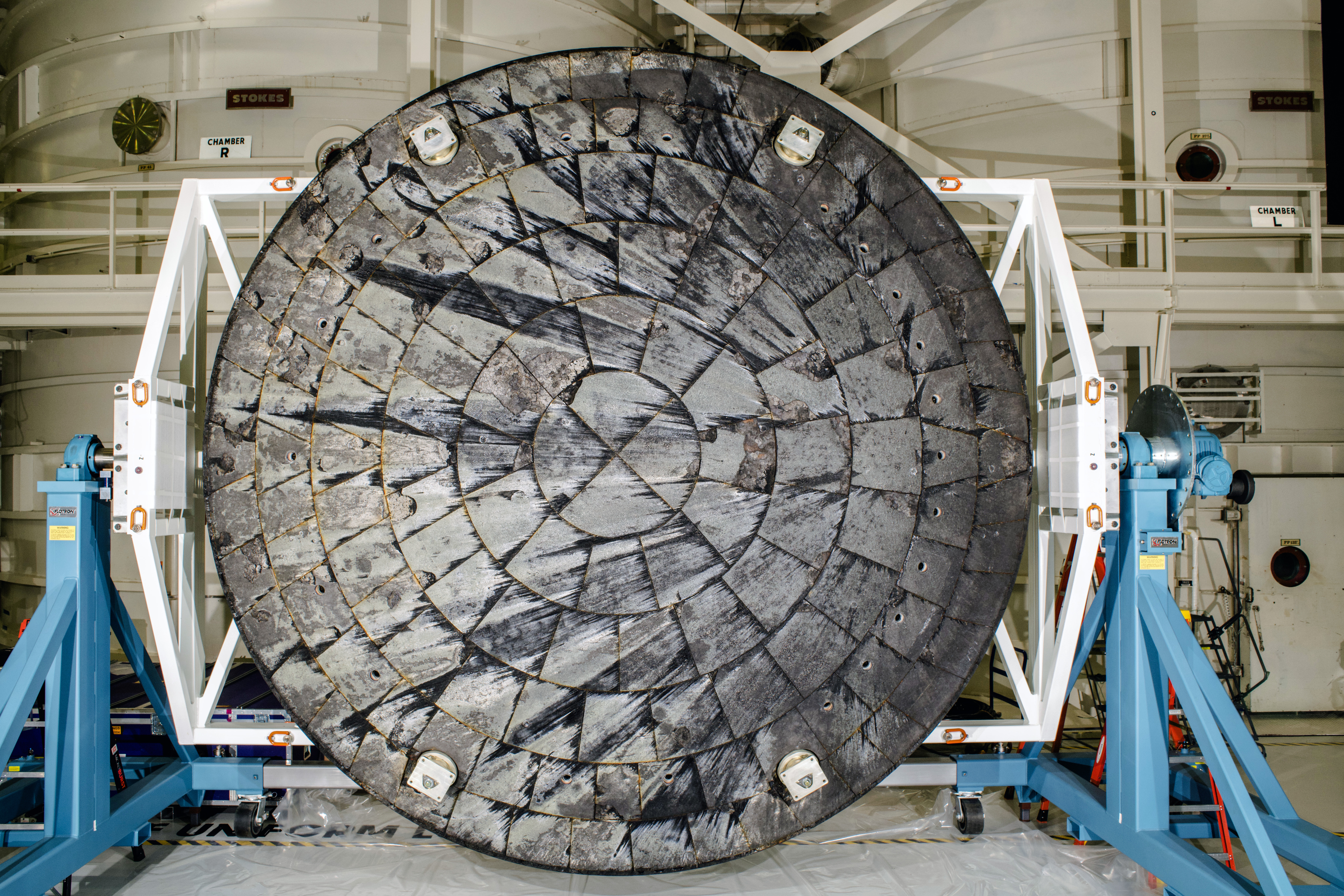
The main reason why a spacecraft doesn't get burned up upon reentry is due to its heat shield.
So what makes this shield so special? For one thing, it's designed to carry heat away from the spacecraft during reentry. Orion's heat shield is around 16.5 feet in diameter and built around a titanium skeleton with a composite carbon-fiber skin that gives it shape and structural strength.
On top of that structure, engineers attach blocks of Avcoat, an ablative material derived from the one used on Apollo. Rather than trying to resist all the heat, the Avcoat works by ablating, meaning it chars, breaks down and carries heat away as it wears away.
So, if all goes according to plan, the Avcoat erodes gradually during the re-entry process. NASA says that this process helps keep the cabin crew far cooler on the other side of the heat shield. The Avcoat layer, made of 186 blocks, can withstand around 5,000 degrees Fahrenheit, according to NASA.
2026-04-10T23:07:02.505ZOne hour till splashdown!
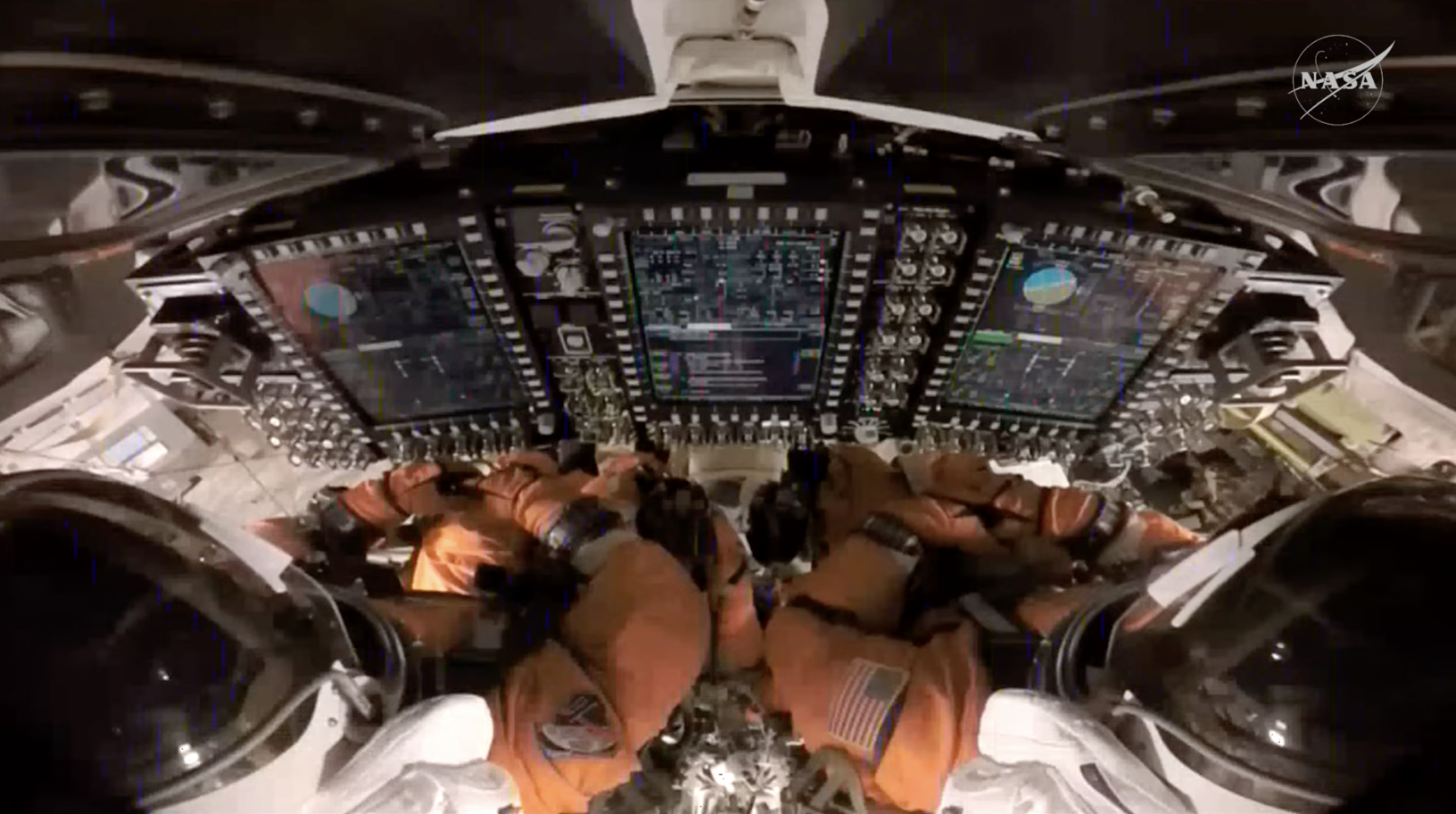
If you're just joining us here at Live Science we are exactly 1 hour away from the scheduled Artemis II splashdown estimated at 7:07 PDT or 9:07 EDT. The Orion capsule will land in the Pacific Ocean just off the coast of San Diego.
Stay tuned as we continue covering this story.
2026-04-10T22:58:50.443ZNASA expects Orion to splashdown upright
When it hits Earth's atmosphere, the Orion capsule will be traveling at a mind-boggling 11 km/s (40,000 km/h) speed, around 40 times faster than a passenger jet. That fast descent will be in brief radio silence, as an electrically conductive plasma will surround the craft, blocking all communications between it and ground control for around six minutes.
According to NASA's mission commentator, Rob Navias, NASA expects the Orion spacecraft to land upright in the Pacific ocean off the coast of San Diego.
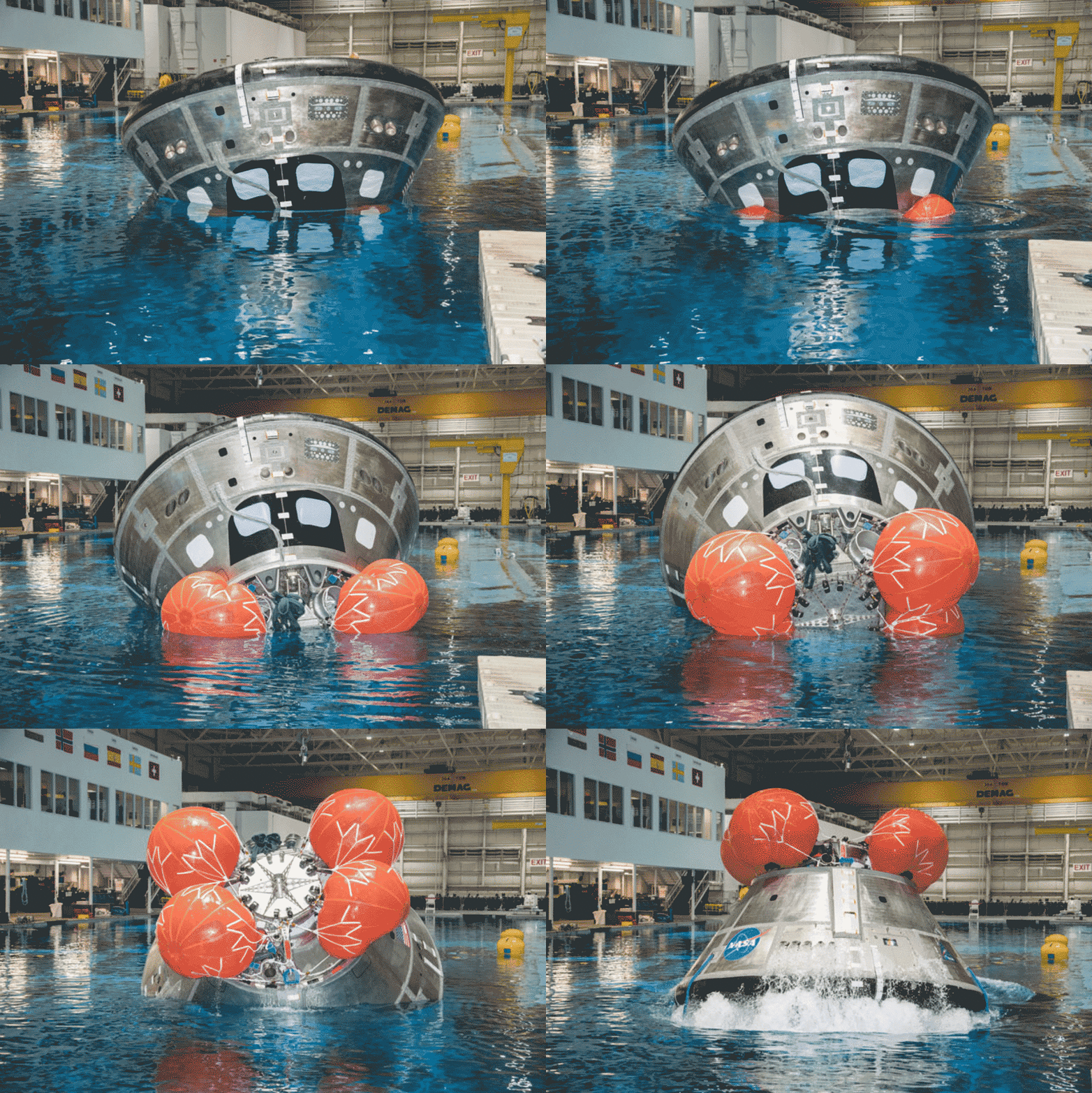
However, there still is a chance Orion could land inverted into the ocean. If that happens, Orion won't stay upside down for long. The capsule is fitted with something called the Crew Module Uprighting System (CMUS), which was originally installed before Artemis I in 2022. The CMUS is essentially five giant airbags mounted to the top of the capsule. If Orion splashes down inverted, or rolls into a bad position thanks to rough ocean waves, the CMUS inflates and rotates the spacecraft back to its proper position, where the crew can exit through the side hatch.
NASA says the uprighting system takes less than four minutes to flip the capsule and can keep Orion upright and stable for at least 24 hours in the ocean if needed. Not only does the capsule need to be upright for communications to work, but it's also safer for the astronauts.
Kenna Hughes-CastleberryContent Manager
2026-04-10T22:46:00.669Z
34 minutes that will define the mission

Artemis II and its astronauts have almost completed a historic spaceflight around the moon.
But today, this 10-day mission will be defined by just 34 minutes. That's the length of time between Orion's crew module separating from its service module, exposing Artemis II's much-discussed heat shield, and Orion splashing down in the Pacific Ocean.
Separation will occur at 7:33 p.m EDT. Four minutes later, Orion will make its final burn of the mission; a raise burn to refine its trajectory and hit a line that will reduce stress on the heat shield. Of course, the heat shield will still have to repel temperatures of 5,000 degrees Fahrenheit (2,800 degrees Celsius), which is about half as hot as those on the surface of the sun.
At 7:53 p.m., Orion will reach 400,000 feet above the Earth. Traveling at almost 35 times the speed of sound, the astronauts inside the capsule are expected to pull up to 3.9 Gs. This is when NASA's planned 6-minute communications blackout with the astronauts begins — plasma will build up around the capsule and block communications.
For 10 minutes, the astronauts will race toward Earth at a blistering pace.
Then, at 8:03 p.m., at 22,000 feet above Earth, the parachutes will deploy. The capsule will quickly decelerate, reducing in speed to less than 136 mph. From here, the capsule will continue to decelerate to just 19 mph, floating down to Earth to hit the Pacific Ocean at 8:07 p.m.
If all goes to plan, 34 minutes, and the Artemis II mission will end in triumph.
Patrick PesterTrending News Writer
2026-04-10T22:38:34.377Z
How many G's will the astronauts experience?
So what does that mean for the astronauts? Experts calculate that the crew is about to feel up to 3.9 Gs during re-entry, or about four times the usual weight of gravity.
In other words, the astronauts' bodies will feel almost four times heavier than before they left Earth. Talking will feel heavier, breathing will be difficult, and they will not want to move. This will probably feel even more extreme for them given that they've been experiencing weightlessness for the past 10 days.
That G-force is a sign the spacecraft is doing its job, as reentry is all about shedding tons of speed in a safe way, using drag from the atmosphere as a type of brake.
Unfortunately, the price of braking is heat and G-force.
2026-04-10T22:31:37.147ZNASA+ Coverage kicks off
NASA+ is NASA's attempt to make space coverage work more like modern media — built for on-demand viewing instead of waiting for broadcast TV. The agency introduced the service in 2023 as a new home for live launch coverage, original video series, kids' programming, Spanish-language content and news.
Netflix will also be streaming NASA+'s livestream of the splashdown, scheduled to land at approximately 8 p.m. EDT/5 p.m. PDT.
Kenna Hughes-CastleberryContent Manager
2026-04-10T21:55:26.610Z
Not a record-breaking return after all?
If the team's calculations are right, that should put the Artemis II crew 130 mph behind the top speed of Apollo 10's 24,791 mph return.
2026-04-10T21:47:39.260ZSuited up
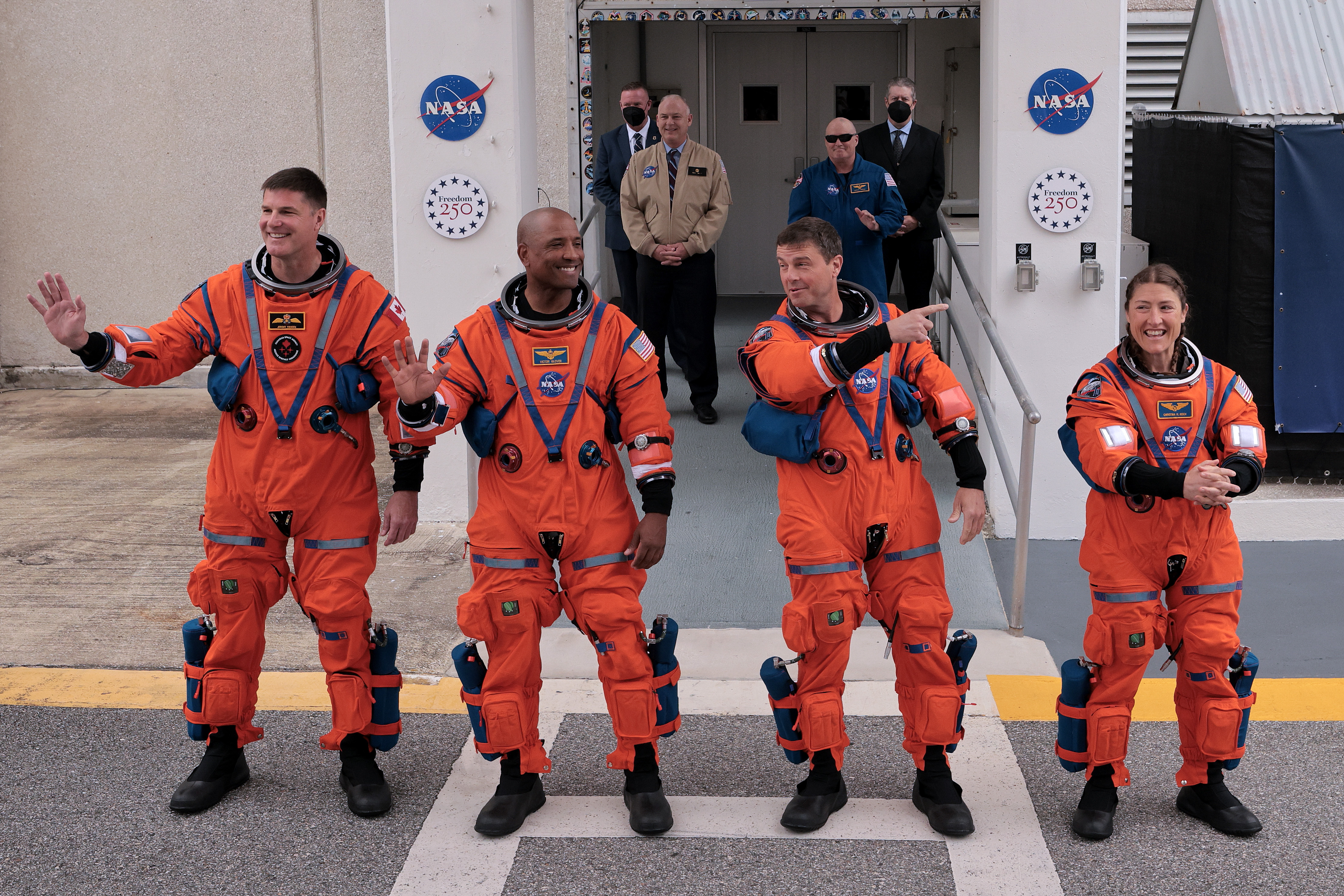
The crew are now suited up aboard the Orion capsule, all set to return as they left.
Ben TurnerActing Trending News Editor
2026-04-10T21:44:31.219Z
Leak check complete
The Artemis II astronauts have just had their suits checked for leaks. NASA's mission commentator, Rob Navias, tells us the suits passed – no leaks!
Patrick PesterTrending News Writer
2026-04-10T21:42:41.811Z
Hardly a pale blue dot anymore
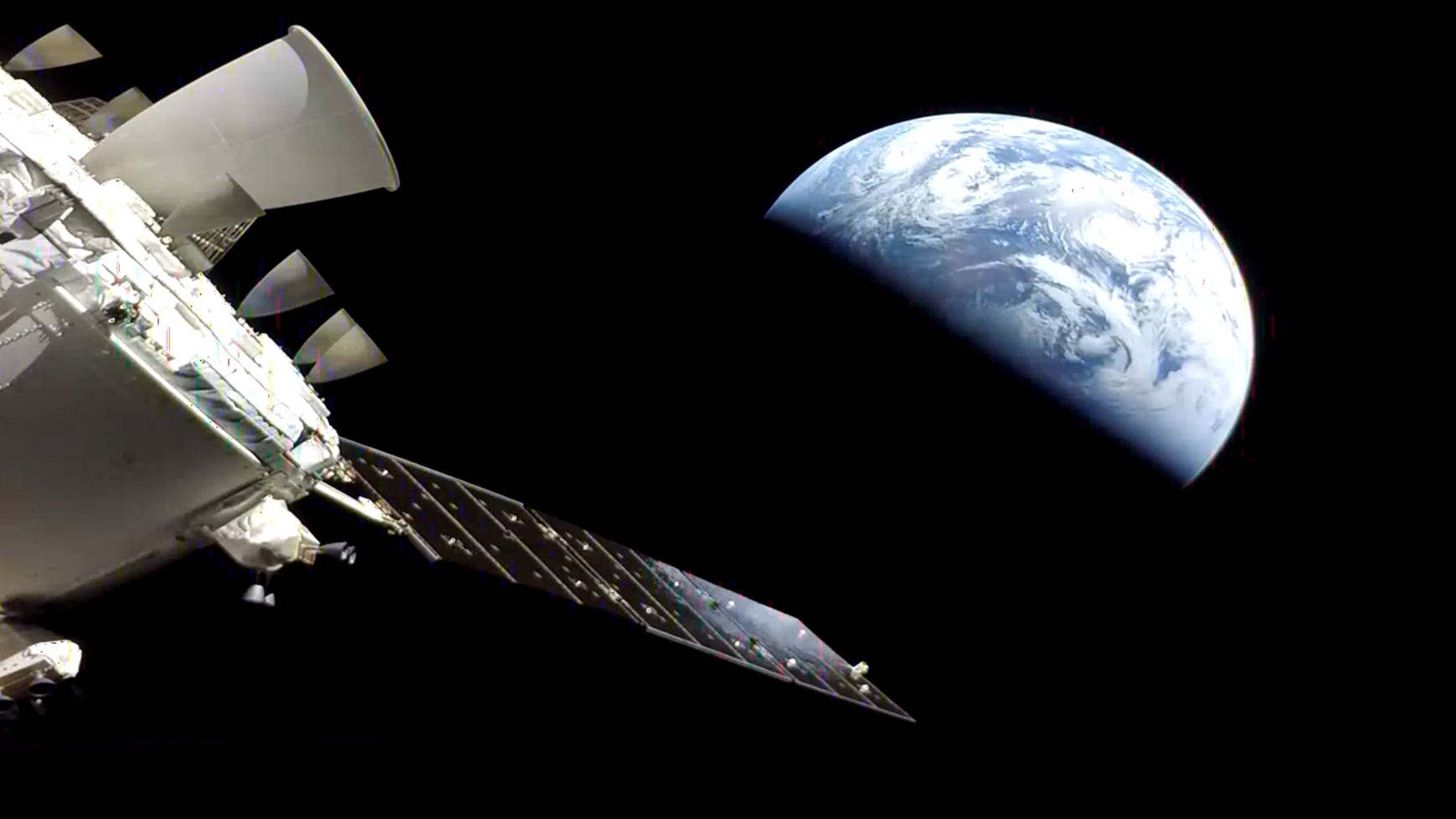
Earth is no longer looking quite so small or fragile as it did over the past week from the Orion capsule.
Things will only heat up from here.
Ben TurnerActing Trending News Editor
2026-04-10T21:37:51.767Z
Recovery practice makes recovery perfect

The Artemis astronauts aren’t the only ones who have prepared extensively for today’s reentry: The U.S. Navy’s dive medical team, which will recover the astronauts from their capsule after splashdown, have been hard at work preparing too.
To simulate a real recovery at sea, NASA made a full-scale mockup of the Orion capsule for the Navy to deploy into the water earlier this year. Using speedboats and aircraft, the team ran through the day’s procedures on the fake spacecraft multiple times.
According to one Navy team member on Reddit, the Artemis astronauts even signed the inside of the mockup capsule. Now that’s attention to detail!
Brandon SpecktorSpace and Physics Editor
2026-04-10T21:31:17.211Z
Crew working through reentry checklist as they prepare for a bumpy landing
This means stowing loose gear, securing checklists, packing away any personal items, and making sure anything that could float, shift or bump around during reentry is locked down.
The Artemis II descent is going to happen about 40 times faster than a passenger jet and will be way, way bumpier. This means that anything that's loose could become a hazard when Orion starts shaking during re-entry and then hits the ocean.
The crew also has to prepare themselves for reentry by configuring their seats and getting into their entry suits. This way, by the time Orion enters the Earth's atmosphere, everything is tucked away and the crew are buckled in for their historic descent.
2026-04-10T21:15:34.185ZWhat does it take to get a crater named on the moon?

There were a lot of emotional moments during the Artemis II mission, but the biggest tear-jerker for us was when Canadian Space Agency astronaut Jeremy Hansen suggested a lunar crater be named after fellow Artemis astronaut Reid Weisman's late wife Carroll.
"It's a bright spot on the moon. And we would like to call it 'Carroll,'" Hansen said, holding back tears.
Here is a labeled image so you can see the craters more clearly! pic.twitter.com/H2dHIdKXcvApril 7, 2026
But how does a crater on the moon actually get named? Well, it's more complicated than just making a suggestion, even if it's coming from an astronaut breaking a number of major lunar records.
The International Astronomical Union (IAU) is the governing body in charge of accepting and publishing official names for space objects like moons, asteroids, comets and even craters, and NASA will formally submit the proposals after the mission is completed. The Paris-based non-governmental organization's criteria can be summarized as follows:
The person the astronomical object is named after has made some serious scientific contributions, preferably to astronomy.
The person has been deceased for at least three years before the crater name becomes official.
It can't be the same name as other lunar craters or structures
Other crater names include Aristoteles (after astronomer Aristotle), Tycho (after astronomer Tycho Brahe), Shackleton (after explorer Ernest Shackleton) and Dryden (after former NASA Director Hugh Latimer Dryden). There are also craters named after crew members from the Apollo 8 mission, and to honor the lives lost in the Apollo 1, Challenger and Columbia disasters.
So, if Carroll is accepted as a crater name, it will become another entry in the history books in this historic Artemis II mission.
Kenna Hughes-CastleberryContent Manager
2026-04-10T21:11:54.349Z
"I remember that class"
"I remember that class in November of 2023 in building five on the third floor," Wiseman replies. "Thank you very much."
The astronauts have a lot to remember.
2026-04-10T21:04:45.793ZThree hours to splashdown: Where we're at so far
"Just want to say how proud of you we are," Zac said. "It takes courage and grit and freedom to chase the unknown. It's the purest kind of American spirit. Millions back home are looking up and feeling more inspired because of you. Keep flying strong. Keep flying safe. Can't wait to welcome you home."
"What a great way to start the day, Houston," said Artemis II commander Reid Wiseman. "Courage and grit. That'll stick with me and it should stick with all of you all day long."
At 1:50 p.m, Orion began cabin configuration for re-entry and then at 2:53 p.m. we had the third and final return trajectory correction burn. The 8-second burn tweaked Orion's trajectory, ensuring the crew maintains a precise course for their reentry.
NASA's mission commentator, Rob Navias, reminded us at the time that this third return trajectory correction burn and upcoming crew module raised burn are final amendments to Orion's angle of reentry, designed to minimize impacts upon the heat shield.
You can read more about Artemis II's faulty heat shield in my Q&A with space expert Ed Macaulay. Check out the full story here.
What else has happened? Well, the crew stowed the collapsable contingency urinal (CCU) — a container used on Artemis II after the notorious malfunction of their space toilet.
"We feel that's unaccessible now," Koch said after the stowing. "And we'd like to keep it in that config."
Wiseman and Glover have snapped some nice photos of Earth on their phones, which NASA would like copies on their return — as would we. And the pair shared a quick fist bump to celebrate some successful late-stage checks.
You're joining us just after the pesky mission toilet got deactivated, so things are looking up from here. Or down depending on your perspective.
2026-04-10T21:01:38.182ZToilet deactivated
Returning to Earth means deactivating your space toilet. The Orion toilet has been firmly in the spotlight for this mission, having previously malfunctioned.
Earlier, the crew stowed the collapsable contingency urinal (CCU), or the containers the crew used after said malfunction.
2026-04-10T20:58:37.781ZAnd then there's Mars

The U.S. and China aren't planning to stop their space-faring activities at the moon. Both countries want to send humans to Mars. Their progress towards this ambitious goal will hinge on what they are able to achieve on the moon.
However, China is likely to pull ahead in one Martian race: Sample return.
China's Tianwen-3 sample return mission aims to be the first to collect rocks from the Red Planet. The mission is scheduled to launch in 2028 and return to Earth in 2031.
Meanwhile, NASA's Mars Sample Return program was effectively cancelled in January as part of Congress-approved spending cuts.
Patrick PesterTrending News Writer
2026-04-10T20:51:00.016Z
NASA is also facing some steep cuts
A similar budget announced last year was defeated by Congress, but it nonetheless places NASA Administrator Jared Isaacman in the unenviable position of having to both defend these cuts while drumming up investment for a NASA moon base and a nuclear propulsion reactor to Mars.
Ben TurnerActing Trending News Editor
2026-04-10T20:42:41.690Z
Or China could land on the moon first

But, of course, there's a strong possibility that China gets there first.
China is threatening to overtake the U.S. as the leader in space exploration in the "new space race." Both countries are planning to establish a presence on the moon, and while NASA's current lunar landings schedule will put its astronauts there ahead of China's taikonauts, there's no guarantee the U.S. will get its people on the moon first.
NASA plans to put humans on the lunar surface twice in 2028 as part of the Artemis IV and Artemis V missions. China, on the other hand, wants to land its own astronauts on the moon before 2030, which is at most two years after NASA.
It's worth keeping in mind that the Artemis program has been fraught with delays. NASA was originally targeting a moon landing in 2024. That landing still hasn't happened, and any further delays could see the U.S. and China shooting for the lunar surface in the same year. Of course, Artemis II demonstrates that NASA is still capable of sending humans to the moon, something China has yet to achieve.
China wants to send humans to the moon in its Mengzhou spacecraft, taken into space on a Long March 10 rocket. Another rocket is then supposed to transport China's Lanyue lunar lander to the moon on a separate flight, before rendezvousing with Mengzhou around the moon, Nature reported.
The China Manned Spaceflight Agency has carried out several uncrewed tests of its Mengzhou spacecraft, and has plans to test it again during an uncrewed trip to China's Tiangong space station later this year. Full details of China's lunar landing plans have not yet been made public.
2026-04-10T20:37:08.568ZWhat's next for the Artemis program?

Even as we near splashdown, Artemis II is far from over yet. NASA still needs to go through all of the data collected during the mission and reveal all of its findings.
However, NASA will soon switch focus to its future Artemis missions.
Artemis III is up next. NASA recently announced a sweeping overhaul of the Artemis program, which will see Artemis III test the docking capabilities of the Orion crew capsule with a lunar lander in Earth orbit in 2027.
Artemis III was originally supposed to be the first crewed lunar landing mission. However, NASA is now targeting Artemis IV and Artemis V for moon landing missions, both scheduled for 2028. Artemis V is also supposed to lay the foundations for NASA's permanent lunar base.
2026-04-10T20:20:15.916ZWhat do engineers learn from a returned spacecraft?
They will inspect the heat shield to see how it handled the extreme temperatures of reentry. Engineers will also look at scorch marks, wear patterns, seals, parachute hardware and other structural components of the capsule to compare the real results against ground testing.
The inside of the capsule can also give some insights for future missions. Engineers will review how seats, restraints, storage displays and onboard systems performed during the bumpiest parts of the re-entry. This enables designers to continually improve the crew quarters.
All of these findings get written up in post-landing reports for mission planners and engineers to use for future missions.
Kenna Hughes-CastleberryContent Manager
2026-04-10T20:16:42.338Z
A quick fist bump
Fist bump! 👊 The Artemis II crew is now under 35,000 miles from Earth. The astronauts are preparing the spacecraft for reentry and the weather is looking good for splashdown. pic.twitter.com/jYNlo0xoNuApril 10, 2026
Ben TurnerActing Trending News Editor
2026-04-10T20:04:44.969Z
Recovery operations are underway

We just got a view of some of the helicopters that will assist in the Artemis II recovery later today. NASA is using the USS John P. Murtha, a massive transport dock ship, for its recovery operations.
NASA and the U.S. military will use helicopters to retrieve the crew from inside the Orion capsule, which will be floating in the water, and fly them to the USS John P. Murtha.
2026-04-10T19:59:33.022ZHow to watch the splashdown
NASA's broadcast will also be available to watch through a variety of streaming services, including Netflix, Amazon Prime, Apple TV, HBO Max, Discovery+, Peacock and Roku, as well as NASA's own streaming platform, NASA+.
The "Crew Comes Home" broadcast begins at 6:30 p.m. EDT, but you can tune into NASA's live mission coverage now — that's what we're watching — to see the Earth slowly get larger from Orion's perspective and keep up with any crew or mission updates.
Patrick PesterTrending News Writer
2026-04-10T19:58:15.468Z
Why do spacecraft still land in the ocean?
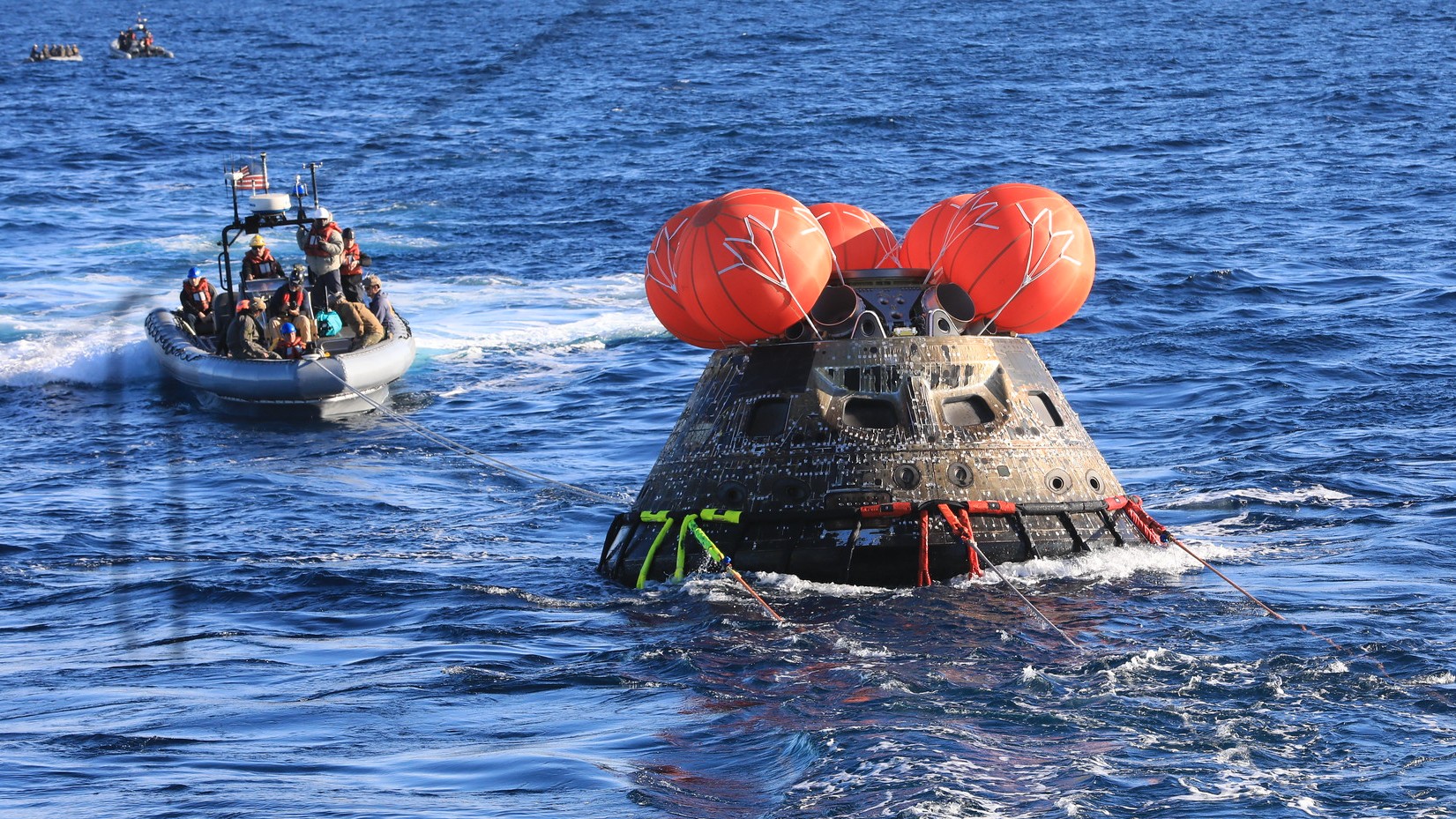
Even with modern technology like reusable rockets and autonomous docking, many spacecraft still come back to Earth the old-fashioned way: splash landing in the ocean.
This is because the water is a bit more forgivable than landing on a hard surface.
A capsule goes through a punishing experience when reentering Earth's atmosphere, placing it under extreme heat and intense pressures.
Water can help absorb some of the impact of landing, which is especially useful for blunt-bodied capsules like Orion that are designed to descend under parachutes rather than glide down like an airplane.
Landing in the ocean also gives mission planners far more room to work with, as they don't have to try to steer the capsule from accidentally landing in a populated area.
Ocean landings make sense in general because most missions return over vast stretches of water anyway. Rather than trying to steer a spacecraft toward a small runway or remote desert area, teams can aim for a broad zone and position rescue ships nearby.
Kenna Hughes-CastleberryContent Manager
2026-04-10T19:51:10.992Z
The storm to come
A reminder that we're currently watching NASA's live mission coverage, along with more than 220,000 other people on YouTube.
NASA's "Crew Comes Home" broadcast begins at 6:30 p.m. EDT on YouTube and a variety of streaming services.
The final stages of descent will begin at 7:30 p.m. EDT when Orion's crew module separates from the service module. It'll be not long after this, that Orion's heat shield will face a significant test.
Patrick PesterTrending News Writer
2026-04-10T19:26:12.944Z
Just how fast will Orion be moving?
- It's about 24 times faster than a speeding bullet
- It's about 32 times the speed of sound (767 mph)
- It's about 400 miles a minute. So you could get from New York City to Washington, D.C. in under a minute. You could travel across the continental US in 7 minutes and run the New York Marathon in under four seconds at this speed.
- You could circle the Earth in about 1 hour. The circumference of the Earth is about 24,901 miles so it would be a little over an hour to see the whole planet.
Needless to say, it's quite fast!
Kenna Hughes-CastleberryContent Manager
2026-04-10T19:11:54.775Z
"We're going to need a copy of that photo"
We're going to need a copy, too, Wiseman.
Patrick PesterTrending News Writer
2026-04-10T19:06:09.131Z
Returning from the moon is much harder than doing it from the International Space Station. Here's why.
Capsules coming from the moon return at a speed of around 25,000 mph (40,000 km/h), which is about 7,500 mph faster than the 17,500 mph (28,000 km/h) speed of those returning from the ISS.
That higher speed makes reentry around two times hotter than an ISS return, making the descent harsher on crew and capsule. Because of this, lunar capsules have to be built with more robust heat shields to withstand the higher temperatures.
2026-04-10T19:01:10.585ZWhen was the last splashdown before Artemis II?
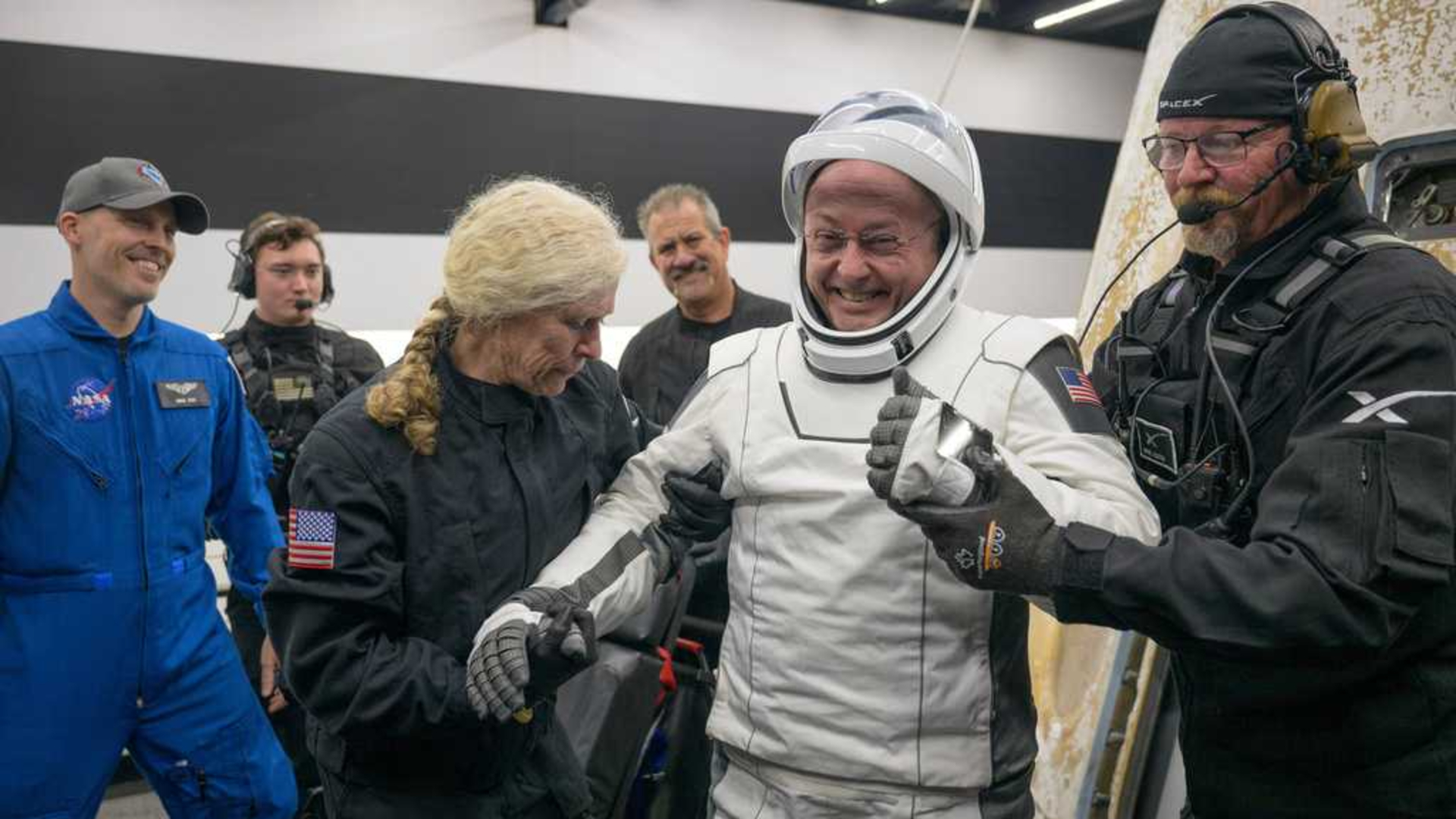
It was actually only a couple of months ago, when SpaceX's Crew-11 returned early from the International Space Station (ISS) on January 15, 2026 due to a medical emergency.
The unknown medical episode was experienced by astronaut Michael Fincke. According to Fincke, the episode happened on January 7, after he had been preparing for a spacewalk.
He said he couldn't talk, felt no pain, and that the event lasted about 20 minutes. Doctors have reportedly ruled out a heart attack, but the exact cause is still unclear.
Kenna Hughes-CastleberryContent Manager
2026-04-10T18:54:56.829Z
Burn, Orion, burn
Patrick PesterTrending News Writer
2026-04-10T18:52:26.220Z
"It is yet another spectacular view"
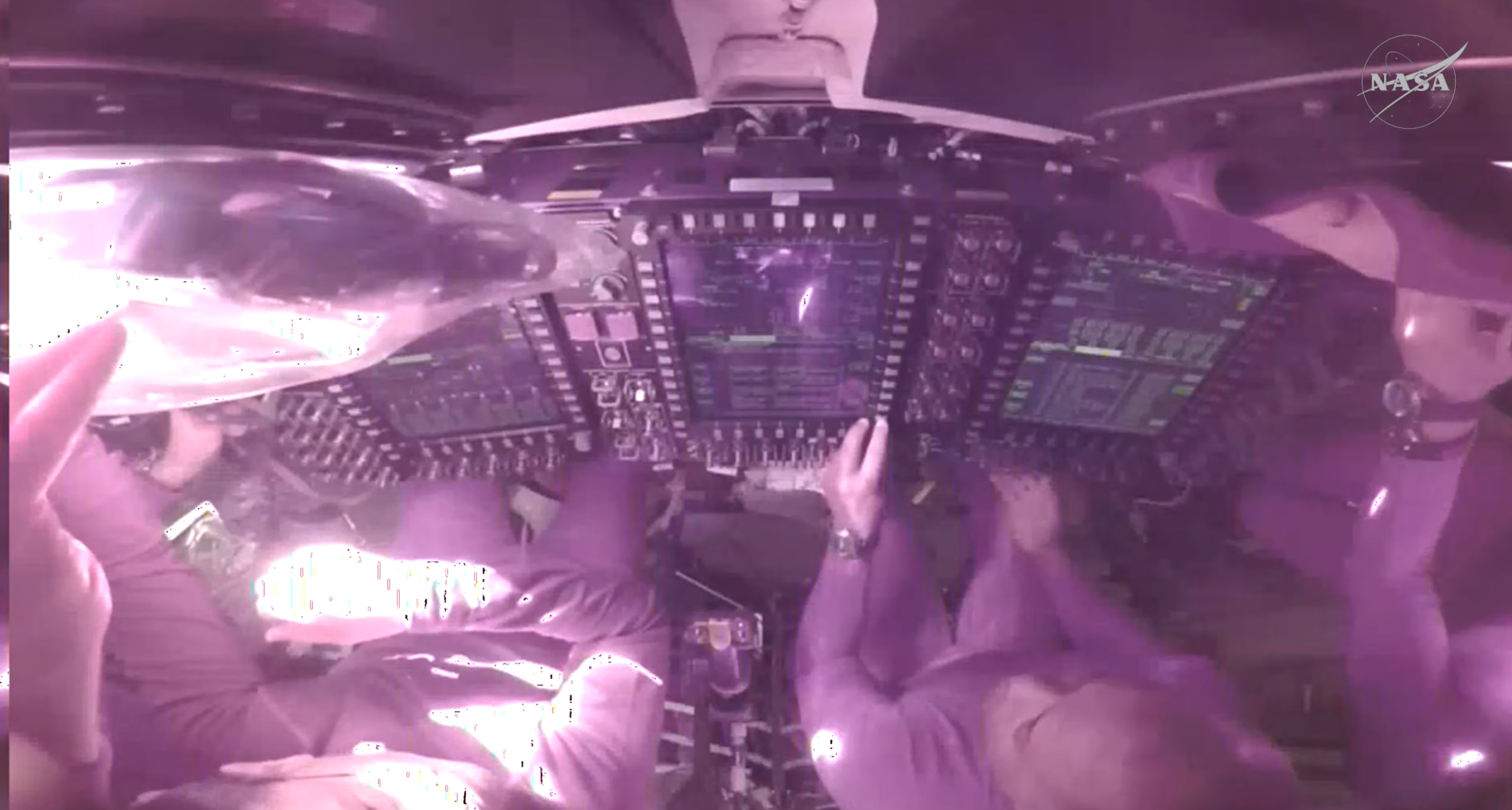
That's commander Reid Wiseman speaking, as sunlight streams into the Orion cockpit after the spacecraft assumed the orientation for burn.
Ben TurnerActing Trending News Editor
2026-04-10T18:46:38.094Z
Get ready for burn
NASA's mission commentator, Rob Navias, just reminded us that this third return trajectory correction burn and the subsequent crew module raised burn are final amendments to Orion's angle of reentry, designed to minimize impacts upon the heat shield.
You can read more about Artemis II's faulty heat shield in my Q&A with space expert Ed Macaulay. Check out the full story here.
2026-04-10T18:40:01.665ZIdeal weather conditions
As NASA's mission commentator Rob Navias puts it, "Knots not an issue."
Okay, that's enough poor jokes for now. Joke time is over.
2026-04-10T18:38:38.905ZJoke time
It wanted to see the mooooooon!
Editor's note: The Artemis II crew are not cows.
Patrick PesterTrending News Writer
2026-04-10T18:37:26.144Z
What technique is NASA using for a safe reentry?
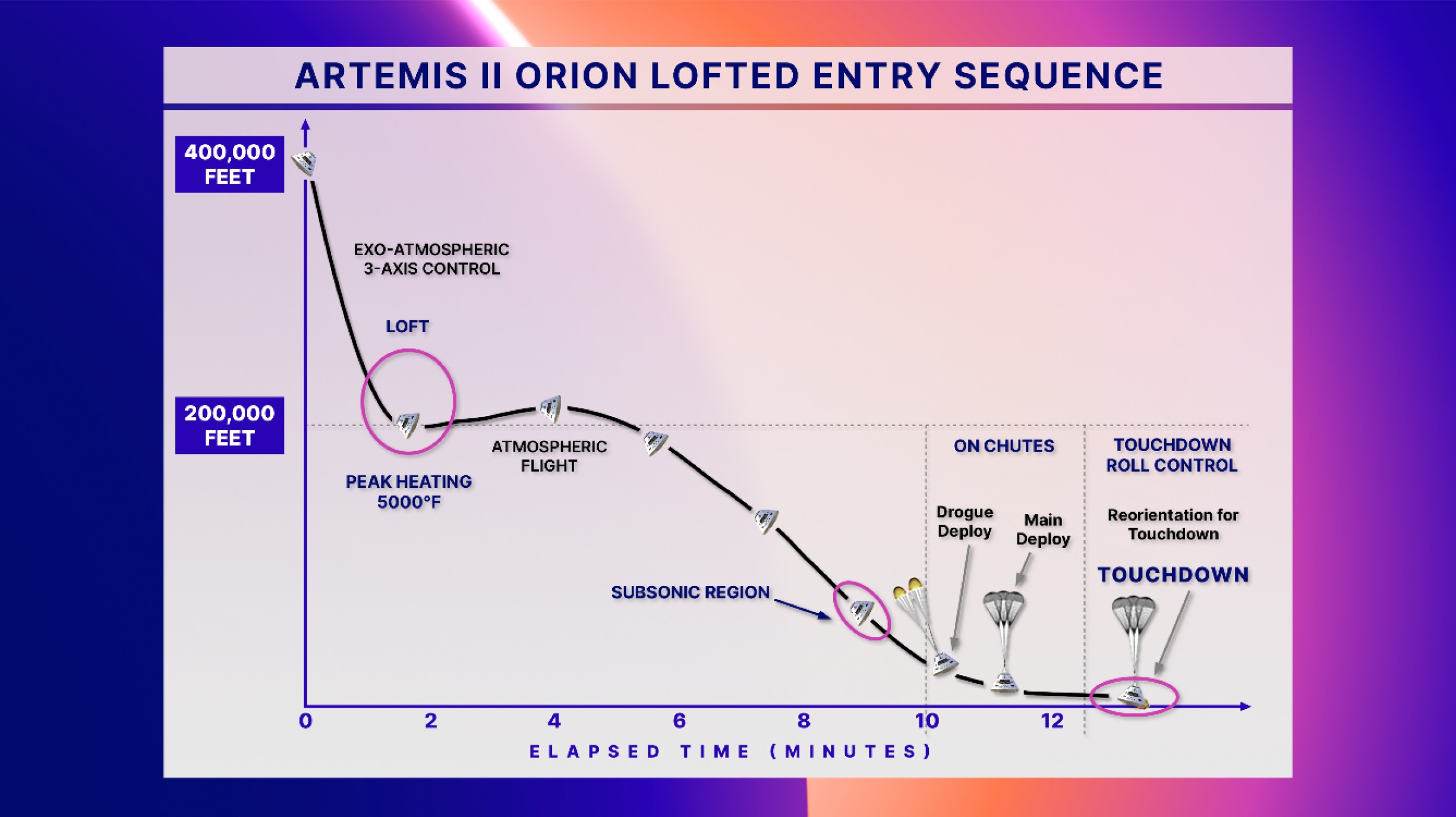
Besides liftoff, Orion's trip back to Earth will be the most dramatic aspect of Artemis II. After looping around the moon, the spacecraft will slam back into Earth's atmosphere at 25,000 miles per hour (40,000 kilometers per hour).
This means the positioning of the craft needs to be ultra-precise — come in too steep and the vehicle faces punishing heat and pressure; but come in too shallow and it can skip away from the atmosphere.
What's worse is that the gas around the spacecraft gets so hot it turns into electrically conductive plasma, which blocks communications between the craft and ground control, essentially forcing the astronauts to endure a bumpy, scary ride in radio silence for about six minutes. During this reentry, the four astronauts will go from experiencing weightlessness to up to 3.9Gs.
NASA has said that Orion's heat shield must protect the spacecraft from temperatures of around 5,000 degrees Fahrenheit (2,7000 degrees Celsius) during reentry. However, experts are concerned about the integrity of the heat shield, as it's similar to the one used in the Artemis I mission, and that shield cracked during re-entry.
NASA used a skip reentry technique with Artemis I, which has the capsule dip into the upper atmosphere and slow down using drag before bouncing up again, a technique that is supposed to be smoother for astronauts.
However, due to the shield concerns, NASA plans on a more lofted direct entry, sending Orion straight into the atmosphere for a steady, controlled return to the Pacific Ocean.
"If we stick to the new reentry path that NASA has planned, then this heat shield will be safe to fly," Wiseman said.
Kenna Hughes-CastleberryContent Manager
2026-04-10T18:19:56.950Z
The astronauts just got a little confused over Excel file names
With this and Koch's difficulties getting a Bluetooth device to pair after liftoff, it's nice to see these incredibly well-trained astronauts struggling with the same issues as us mere mortals.
The burn conference has concluded.
Patrick PesterTrending News Writer
2026-04-10T18:10:51.494Z
Who will be picking up the astronauts?
Christina Koch will be hoisted from the capsule first, then Jeremy Hansen, then Victor Glover and then finally Reid Wiseman. Both Koch and Hansen will ride in the first helicopter and Glover and Wiseman in the second, according to NASA's ongoing livestream.
Kenna Hughes-CastleberryContent Manager
2026-04-10T18:08:15.902Z
A view of the crew
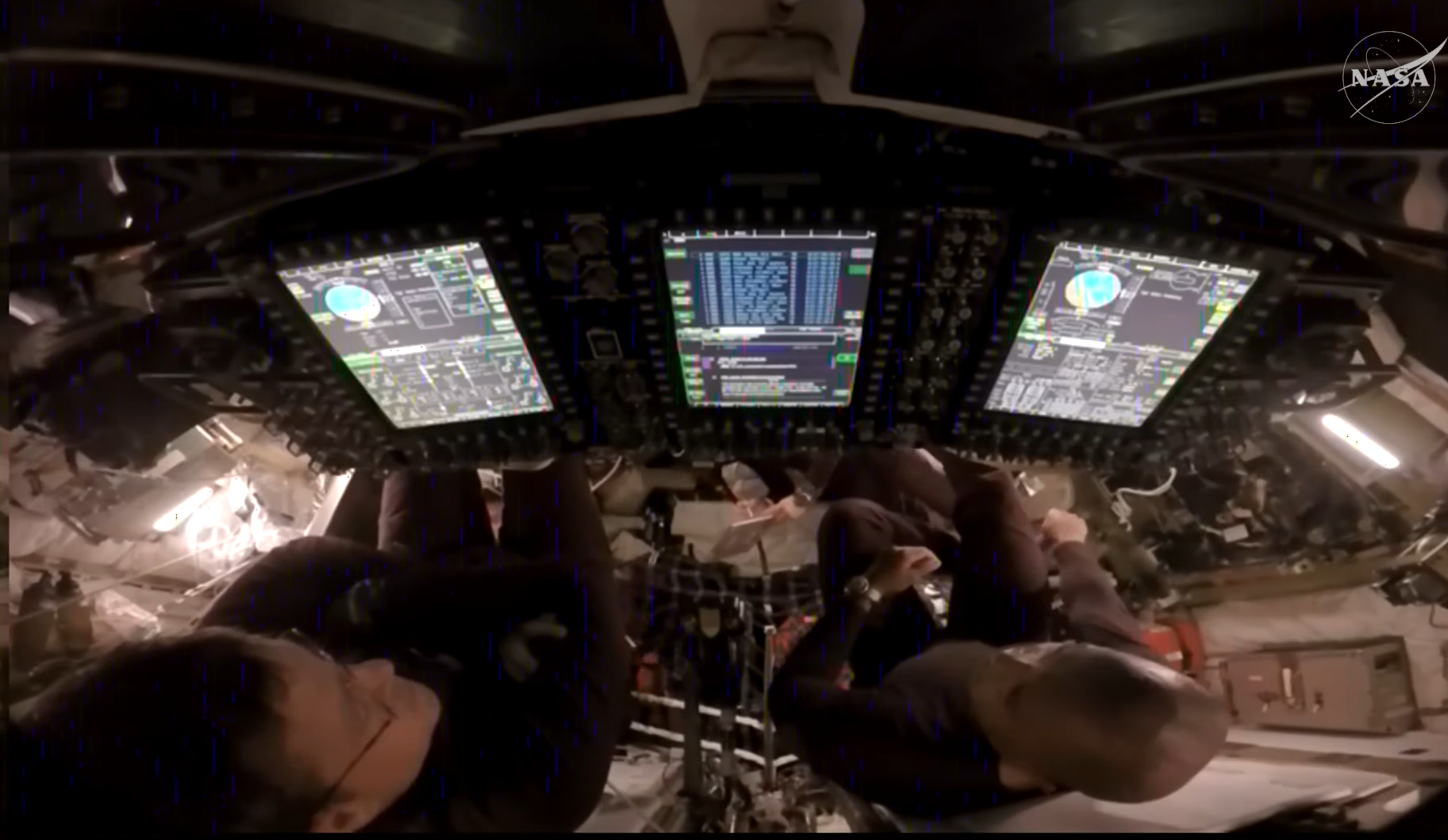
Here's our first glimpse of the crew from inside Orion's cockpit today, with commander Reid Wiseman and pilot Victor Glover reviewing timeline parameters and some of the systems status boards on the flight deck.
Ben TurnerActing Trending News Editor
2026-04-10T18:06:08.652Z
Oops
2026-04-10T17:45:24.895ZBurn coming up
Patrick PesterTrending News Writer
2026-04-10T17:44:21.886Z
Did they really see green on the moon?
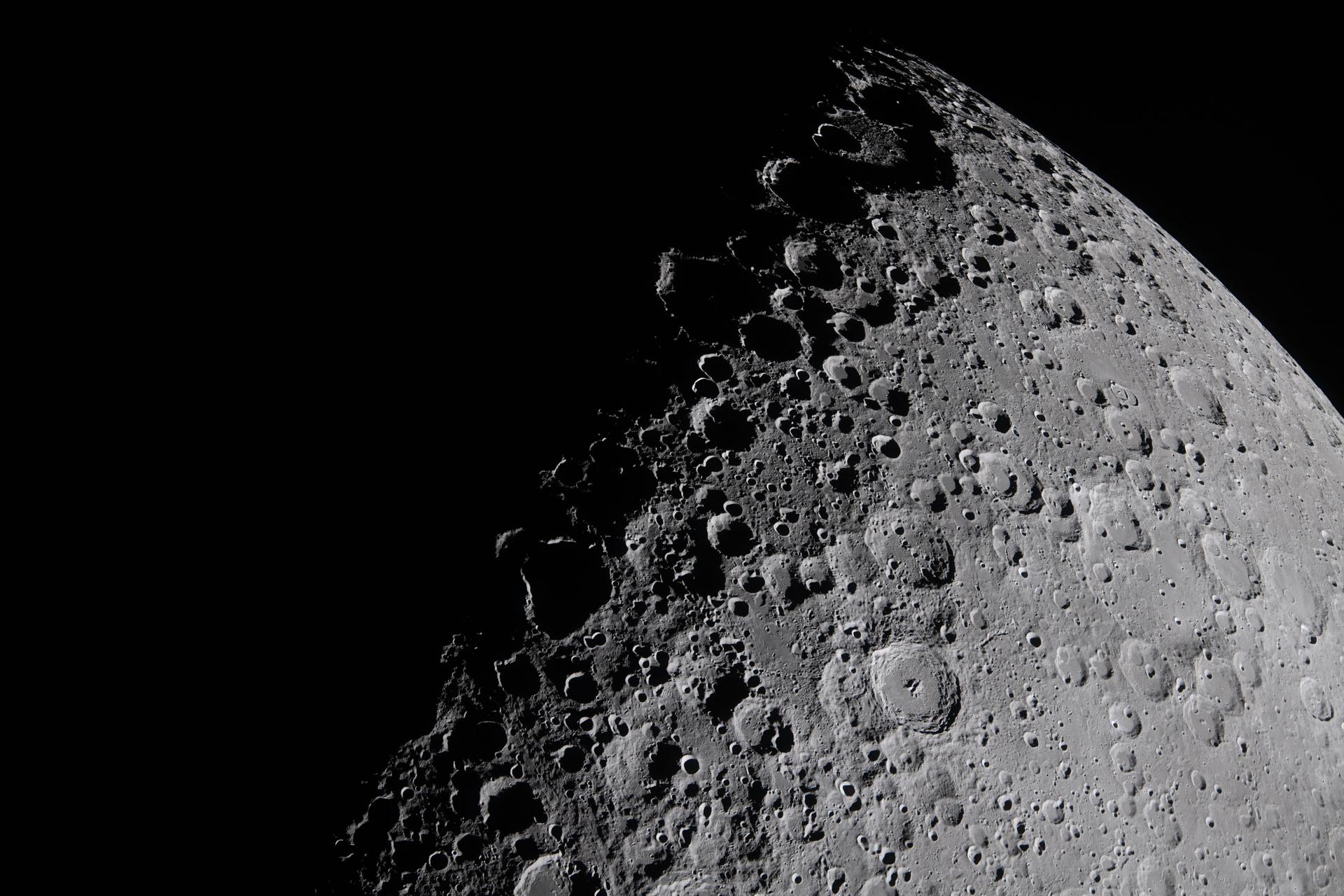
During a 7-hour lunar flyby earlier this week, Artemis II crewmembers called out their observations of the moon’s surface while simultaneously photographing it — giving members of the science team back on Earth a minute-by-minute account of the rare research expedition.
Several observations already stand out, according to Gordon Osinski, a crater specialist and lunar geologist who helped train the Artemis II astronauts on what to look for.
Besides seeing at least five impact flashes — bright bursts of light from space rocks pummelling the lunar surface — the crew also reported seeing patches of green and brown colorations on the moon.
"We do know there is color on the lunar surface," Osinski told Live Science contributor Elizabeth Howell in an interview.
What those patches signify, geologically, needs further investigation when the crew arrives home.
But this much is clear, Osinski said: The human eye is more sensitive to color than the cameras on board Artemis II, underscoring the importance of sending trained humans on scientific space missions rather than just relying on machines.
Read the full story here.
Brandon SpecktorSpace and Physics Editor
2026-04-10T17:38:51.547Z
Here wee go
One of them involves the stowing of the collapsable contingency urinal (CCU) — a container used on Artemis II after the notorious malfunction of their space toilet.
Christina Koch has told Mahaffey that the CCU is now stowed and sealed inside two ziploc bags.
"We feel that's unaccessible now," Koch said. "And we'd like to keep it in that config."
2026-04-10T17:25:29.996ZMoonshots
Image 1 of 6 The Earth sets as the Artemis II crew disappear behind the dark side of the moon.(Image credit: NASA)
 Wisps of light from the sun's corona and Earth's shine appear around the lunar disc as the Artemis II crew drift in totality behind its dark side.(Image credit: NASA)
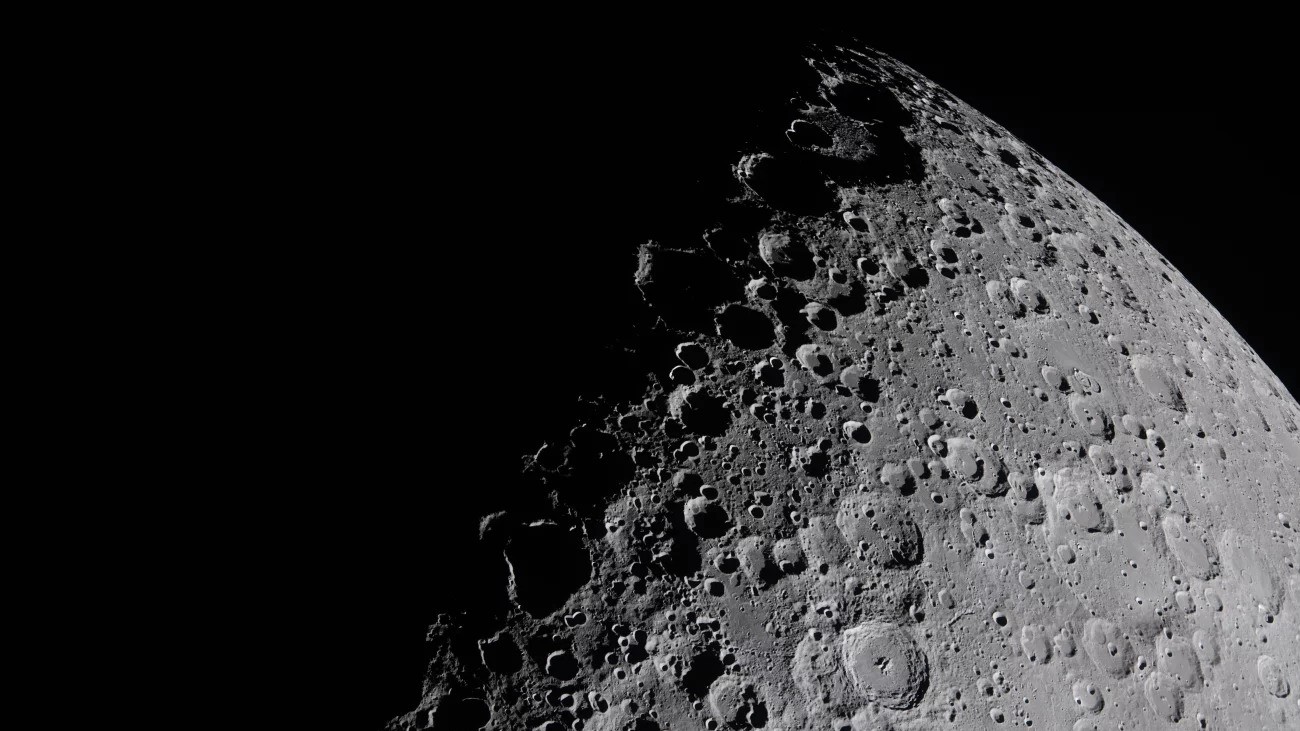 Low-angle sunlight casts long shadows near the moon's terminator line — the division between lunar day and night.(Image credit: NASA)
 Half of the far side of the moon in total solar eclipse. (Image credit: NASA)At the 10 o’clock position of the Orientale basin, the two small craters that the Artemis II crew suggested be named Integrity and Carroll are visible(Image credit: NASA)
 "Earthset". The Earth disappears as the Artemis II crew dip behind the moon's far side. (Image credit: NASA)
If you want to take a closer look, or learn about these shots in more detail, check out my story on them here.
Ben TurnerActing Trending News Editor
2026-04-10T17:11:38.307Z
Artemis II's trajectory was modeled off Apollo 13's

There's something delightfully poetic about how Artemis, the twin sister of Apollo in Greek mythology, is on a trajectory modeled after the Apollo 13 mission.
The path around the moon and back to Earth is a free-return path, meaning the Orion spacecraft uses both the moon's and Earth's natural orbits to maximize efficiency.
And that's not just to save fuel — this is the same basic lifesaving geometry that helped Apollo 13 make it home after an on-board explosion sent its mission very off-script (we have this mission to thank for the phrase "Houston, we have a problem").
That means that if anything had gone wrong with Artemis II's thrusters, it would have been much less of a problem, Houston.
Kenna Hughes-CastleberryContent Manager
2026-04-10T17:02:50.598Z
Where we're at so far
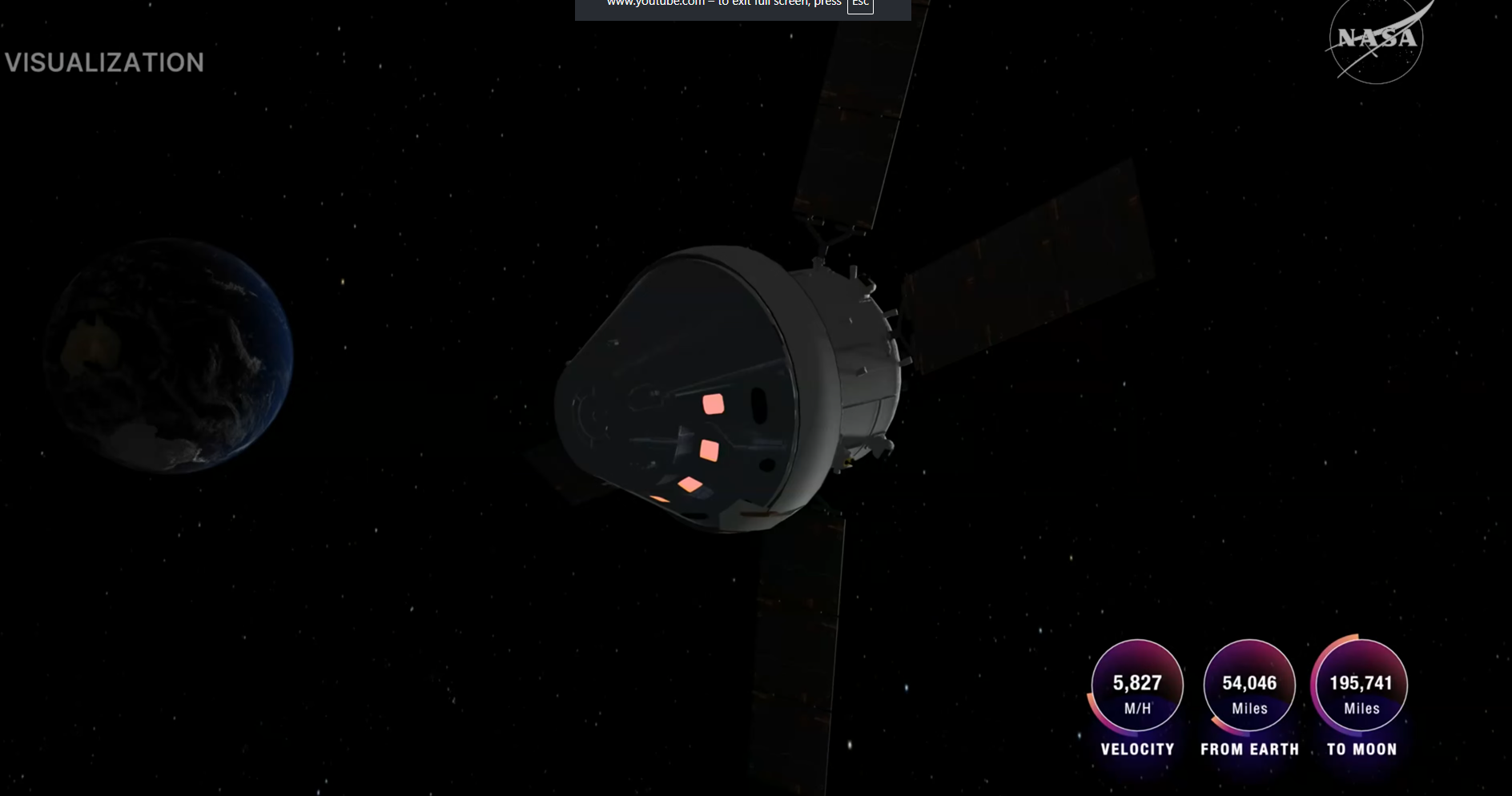
Rob Navias back with another fetching telemetry visualization for the Orion capsule Integrity.
From launch to splashdown, the mission will have logged a total distance of 694,481 miles (1,117,659 kilometers), Navias noted.
Ben TurnerActing Trending News Editor
2026-04-10T16:47:48.150Z
'Reasons to be confident' about heat shield
Yesterday, I reported on the issue with Orion's heat shield. The heat shield will be essential for bringing the astronauts home safely today, but some experts are concerned about how it will perform.
NASA used essentially the same heat shield for the uncrewed Artemis I mission in 2022, and that one suffered much more than expected. As a result, the space agency has opted to adjust the reentry path for Artemis II to mitigate risks to the heat shield.
To learn a bit more about how the shield will hold up today, I spoke with Ed Macaulay, a lecturer in physics and data science at Queen Mary University of London who recently wrote about heat shield safety concerns in The Conversation. You can read the interview here.
Patrick PesterTrending News Writer
2026-04-10T16:39:13.449Z
How can the crew steer to the landing site?
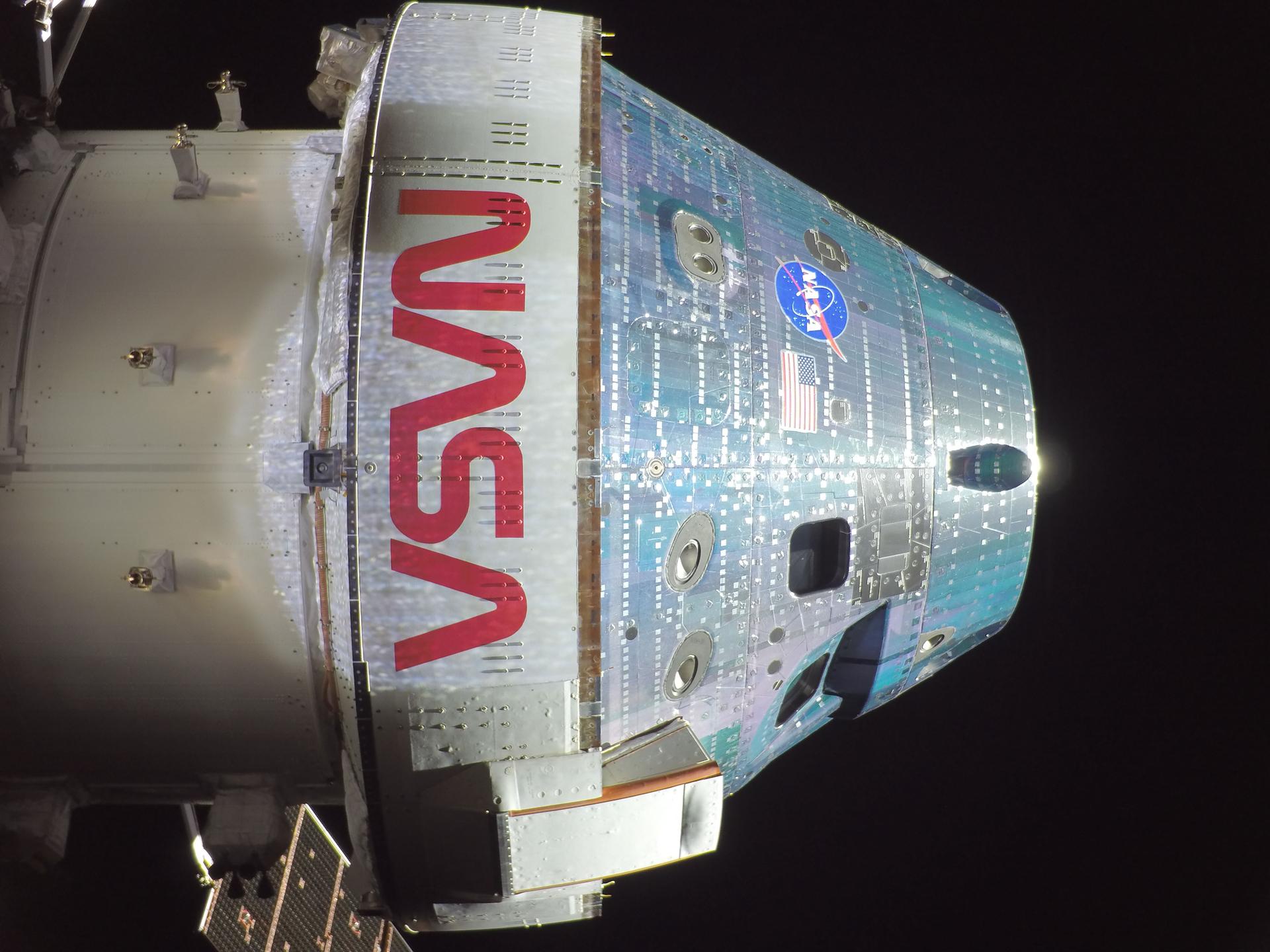
As Orion falls back to Earth, the crew is not flying the capsule the same way a pilot would fly an airplane.
Instead, the spacecraft uses a combination of onboard guidance and thrusters to control where it lands. The crew can monitor the process and step in if needed, but most of the work for landing is done by the spacecraft's guidance and control system. Small thrusters can help orient Orion during re-entry, making sure the heat shield stays properly positioned and the capsule follows the right path down to Earth.
According to NASA,when Orion hits the upper atmosphere just over Hawaii at around 7:37 p.m EDT, it will begin the final trajectory‑adjustment burn that fine-tunes its position to follow the proper flight path.
After that, the spacecraft will begin a series of roll maneuvers to safely separate itself from the other falling hardware due to the service module separating only moments earlier. It's at this point that Orion will reach that maximum velocity of 23,864 mph (38,405 kph).
Kenna Hughes-CastleberryContent Manager
2026-04-10T16:33:52.630Z
"The stage is set"
Meanwhile, in the flight control room, a shift handover is taking place, with entry controllers led by flight director Rick Henfling stepping in.
"The vehicle is in great shape, and the weather in the splashdown zone couldn't be better," Navias added. "Winds are forecast to be 10 knots at splashdown. Wave heights less than four feet, and the wave periodics against the capsule as it bobs in the Pacific Ocean [will be] about 17 seconds.
"We are expecting a few broken and scattered clouds, but that is not an issue," he concluded. "Integrity is coming home through the law of orbital mechanics."
Ben TurnerActing Trending News Editor
2026-04-10T16:16:54.182Z
Where are the Artemis II crew landing?
If you live near San Diego, California, you could consider waving at Orion as it hurtles toward the Pacific Ocean at the crazy fast speed of 11 km/s (40,000 km/h) or 24,606 mph.
According to NASA, the splashdown is scheduled for 8:07 p.m. EDT (0007 GMT on April 11), with the capsule landing around 2,000 miles (3,200 kilometers) southwest of San Diego.
This is generally the same landing site as the 2022 Artemis I mission and a strategic choice for NASA, as the area hosts a naval base for the Pacific Fleet Surface Navy. And it will be a Navy ship (the USS John Murtha from Naval Base San Diego) which has the privilege of picking up the four astronauts after they land back on Earth.
Kenna Hughes-CastleberryContent Manager
2026-04-10T15:47:30.630Z
Rise and shine, Integrity
Live - Run To The Water - YouTube Watch On
And then the Zac Brown Band:
Free - YouTube Watch On
With a special pre-recorded message from Zac from the Zac Brown Band: "Just want to say how proud of you we are. It takes courage and grit and freedom to chase the unknown. It's the purest kind of American spirit. Millions back home are looking up and feeling more inspired because of you. Keep flying strong. Keep flying safe. Can't wait to welcome you home."
"What a great way to start the day, Houston," said Artemis II commander Reid Wiseman. "Courage and grit. That'll stick with me and it should stick with all of you all day long."
"We got it loud and clear, Integrity," said mission control. "Can't wait to see you run to the water. See you soon. Good morning."
Ben TurnerActing Trending News Editor
2026-04-10T15:23:03.690Z
What's next on the Artemis playlist?
Kenna Hughes-CastleberryContent Manager
2026-04-10T15:15:01.487Z
It's nearly wake-up time
2026-04-10T14:37:12.638ZThe view from Integrity
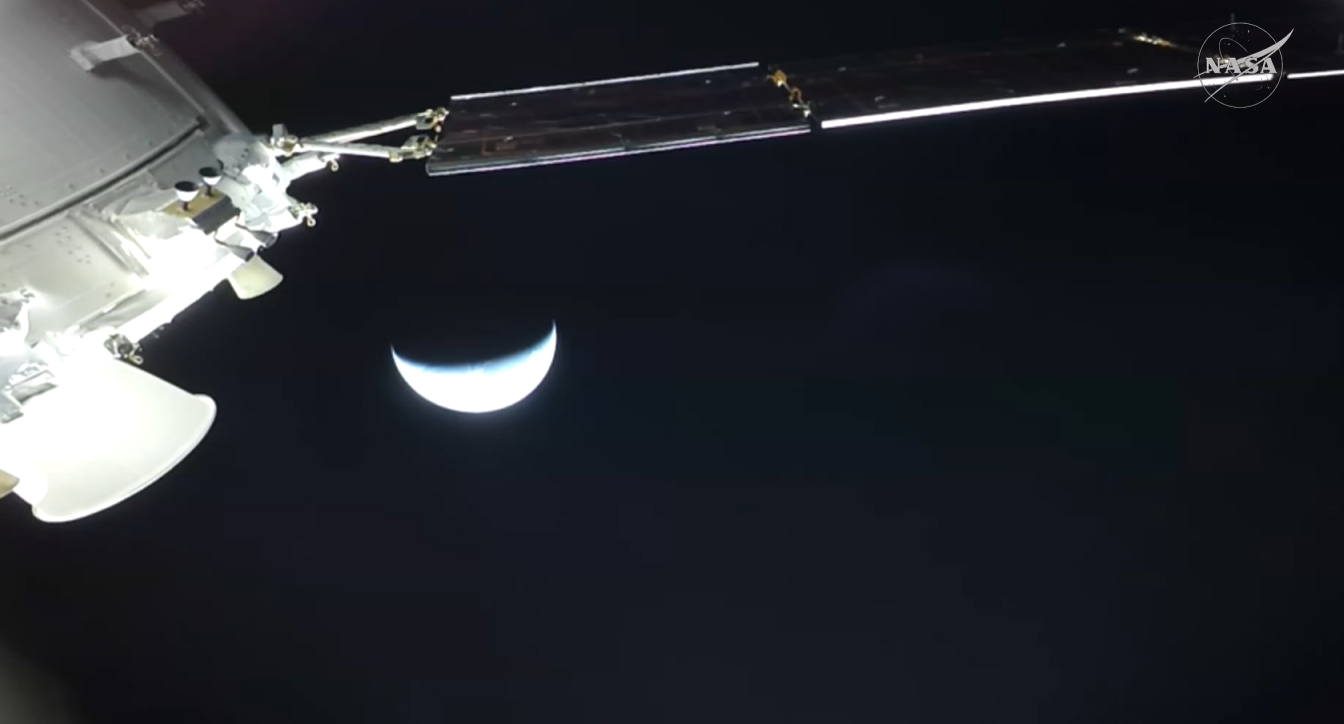
And here's the view from Integrity's solar array wing camera.
"The Earth will grow larger and larger in the field of view as we continue to move throughout the day," Navias said.
Yeah, we get that bit, Rob.
2026-04-10T14:34:21.300ZNASA coverage begins
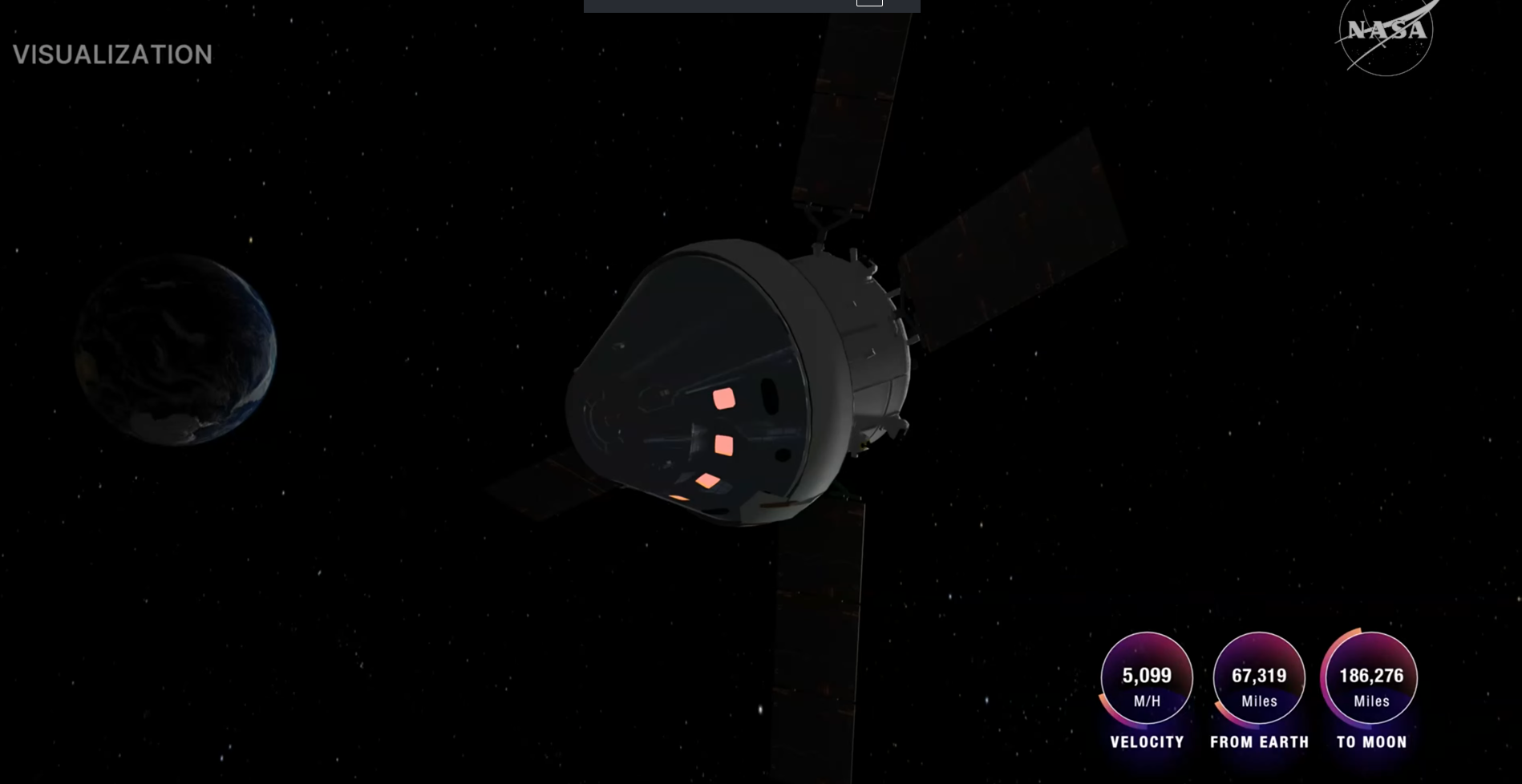
Rob Navias has appeared on NASA's livestream to kick off the agency's live coverage of the landing, and has also shared a handy visualization of where Orion is currently at.
"As you can see from this computer generated graphic based on real time telemetry, we are currently just 67,000 miles from the Earth," Navias said. "We passed the halfway mark last night between the Earth and the Moon, and are 186,000 miles from the moon as we close in on the planet Earth."
2026-04-10T14:02:03.236ZWhat does it feel like to disappear behind the moon?

The "overview effect," is a term invented by the science philosopher Frank White to describe the shift in perspective humans feel when they see Earth from space — especially how small and vulnerable our patch of cosmic oasis appears against the uninhabitable and vast backdrop that surrounds it.
When asked what it felt like to disappear behind the moon and lose radio contact with Earth, Artemis II pilot Victor Glover expressed a similar sentiment.
"I took a brief moment to say a short prayer of gratitude for being sent on this mission and trusted with bringing back scientifically relevant information," Glover said. "And I also just felt like I was hoping that people looked up and were watching to see when we came back into communication, and that maybe there was a chance that folks would feel a sense of togetherness."
"We have a moment of silence whenever something solemn [occurs] that requires reverence, or someone that we love has passed away, but maybe we could call it a moment of togetherness," he added. "And really was hoping that while we were waiting to get back in contact, that people could just feel that sense of togetherness, that we were all a crew on spaceship Earth."
2026-04-10T13:41:59.796ZArtemis II — The Movie?

During the same in-flight news conference, the astronauts were also asked who they would want to play them in a movie.
"We've thought a little about the movie, and I think that's way out of our pay grade," Reid Wiseman said. "But one thing we do know for sure is that this guy [pointing at Canadian Space Agency astronaut Jeremy Hansen] is gonna be played by Buzz Lightyear. 100%. No doubt."
I can see the likeness. But Wiseman knows Buzz Lightyear isn't a real guy, right? Or what are they hiding from us?
2026-04-10T13:26:38.000ZThe crew's final reflections on their mission
A post shared by KARE 11 (@kare11)
A photo posted by on
While we can't exactly give you the inside story on the contents of the crews' dreams right now, we can at least tell you some of their reflections upon their historic journey before they went to bed.
When asked what they would tell their younger selves about what they're doing right now, Christina Koch recalled a family vacation she took to Kennedy Space Centre at age 10.
"If I could have told that little girl who took home a picture of Earthrise, and hung it in her room, that she would eventually launch from that same place, to see that same view, I'm pretty sure she would not believe it," Koch said. "But even though I still can't believe it, and she certainly wouldn't believe it, she chased that dream, and it ended up happening."
"It's such an honour to hear that we've inspired, that's truly one of the top things we ever wanted to do," she concluded.
2026-04-10T13:18:42.149ZWhat are the Artemis II astronauts doing right now?
3:05 a.m.: Crew sleep begins
11:35 a.m.: Flight Day 10 crew wakeup
1:50 p.m.: Orion cabin configuration for re-entry begins
2:53 p.m.: Return trajectory correction burn
6:30 p.m.: NASA+ coverage begins
7:33 p.m.: Crew module and service module separation
7:37 p.m.: Crew module raise burn
7:53 p.m.: Entry interface
8:07 p.m.: Splashdown in the Pacific Ocean
10:30 p.m.: Post-splashdown news conference at NASA Johnson Space Center
Ben TurnerActing Trending News Editor
2026-04-10T13:07:17.860Z
What time is splashdown?
Patrick PesterTrending News Writer
2026-04-10T11:52:35.061Z
So what about the parachutes?

The heat shield's durability is certainly the big question today, but what about those parachutes Ben just mentioned?
The Orion spacecraft is fitted with 11 total parachutes, all deployed in a very specific sequence to slow, stabilize and safely lower the capsule into the ocean. They includes three forward bay cover parachutes, two drogue parachutes, three pilot parachutes and three main parachutes.
The most iconic of these are the three main parachutes, which span 116 feet (35 meters) in diameter, weigh 300 pounds (136 kilograms) and consist of 10,000 square feet of fabric each.
Reentry will see the crew enter into a six-minute radio blackout caused by a buildup of superhot plasma surrounding the capsule. After this, NASA will first deploy the two drogue parachutes at an alitude of around 6.7 kilometers (22,000 feet). Then, at around 1.8 km (6,000 ft), the three main chutes will be released, slowing the Orion capsule to a leisurely 20 mile per hour (32 kilometers per hour) descent to splashdown.
Kenna Hughes-CastleberryContent Manager
2026-04-10T11:39:55.917Z
Feeling the heat
The speed at which the Artemis II crew will return to Earth is set to be record-breaking — hitting the top of the atmosphere at around 25,000 miles per hour (40,000 kilometers per hour).
To dissipate all that energy and arrive at a much more reasonable 20 mph (32 kph) splashdown in the Pacific Ocean off San Diego, the Orion capsule will use two key pieces of technology: parachutes and a heat shield.
Artemis II's heat shield is designed to protect the crew and slow their capsule by heating up to temperatures of around 2,800 degrees Celsius (5,000 degrees Fahrenheit). Yet it has a problem: It is almost exactly the same as Artemis I's heat shield, and that infamously cracked upon reentry.
That will make this coming stage of the mission among the most dangerous.
But while they have confessed to harboring "irrational" doubts, NASA officials have said they're not worried. Why? Check out Patrick's story here for the full answer.
2026-04-10T11:30:53.908ZWhat goes up

Good morning, science fans! We're back to cover the nail-biting final stage of the Artemis II mission, which has seen a four-astronaut crew embark on a 685,000-mile (1.1 million kilometers) 10-day journey around the moon and back.
The crew — consisting of commander Reid Wiseman, pilot Victor Glover, and mission specialists Christina Koch and Jeremy Hansen — have captivated millions around the world with their voyage, beaming back stunning images, scientific insights, laughter and some tears as they made history and laid the groundwork for humanity's return to the moon.
Now all they have to do is return home safely.
With their reentry at record-breaking speeds through Earth's atmosphere just hours away, Live Science will be following every moment of this perilous finale to their journey, bringing you breaking updates and expert commentary. Let's see them home.
Ben TurnerActing Trending News Editor
View More
You must confirm your public display name before commenting
Please logout and then login again, you will then be prompted to enter your display name.
Logout LATEST ARTICLES- 1There are 'reasons to be confident' about faulty Artemis II heat shield ahead of 25,000 mph reentry, space expert Ed Macaulay says
- 2The moon is green and brown? Why scientists are already excited about Artemis II's historic lunar photos
- 3'I've seen the movies. What a horrible way to die': What it's like to be sucked into a tornado and survive
- 4'More questions than answers': Experts baffled by Alaskan mammal-eating orcas spotted near Seattle
- 5Changing 'just one DNA letter' in female mice triggers growth of male genitalia