- Search What are you curious about? Popular SearchesCritical thinkingPhilosophyEmotional IntelligenceFree Will Latest Videos Latest Articles
-
Topics
Philosophy
- Ethics
- Religion
- Flourishing
- Knowledge
- Philosophy of Science
- Philosophy of Art
- Language
- Political Theory
- Identity
- Meaning & Purpose
Science & Tech
- Physics
- Biology
- Aerospace
- Health
- Geology
- Computing
- Engineering
- Energy
- Biotechnology
- Astronomy
Mind & Behavior
- Psychology
- Neuroscience
- Decision-Making
- Mental Health
- Consciousness
- Emotional Intelligence
- Personality
- Relationships
- Parenting
Business
- Entrepreneurship
- Leadership
- Finance
- Marketing
- Innovation
- Strategy
- Management
- Artificial Intelligence
- Startups
- Economics
History & Society
- History
- Literature
- Art
- Music
- Film
- Progress
- Culture
- Sociology
- Policy
- Geopolitics
- Latest
-
Videos
Latest Videos
 The physiology of dreams, explained by 2 scientists
with
Patrick McNamara
The physiology of dreams, explained by 2 scientists
with
Patrick McNamara
 Reboot your mind for flow, unanxiousness, and resilience
with
Steven Kotler
Reboot your mind for flow, unanxiousness, and resilience
with
Steven Kotler
 The science behind the strangest biological phenomena
with
David J. Linden
The science behind the strangest biological phenomena
with
David J. Linden
 This isn’t a trip, it’s the most challenging therapy session of your life
with
Rachel Yehuda
This isn’t a trip, it’s the most challenging therapy session of your life
with
Rachel Yehuda
 The hidden reason smart people stop growing
with
Robert Herjavec
The hidden reason smart people stop growing
with
Robert Herjavec
 The neuroscience behind synesthesia
with
Richard E. Cytowic
See All
The neuroscience behind synesthesia
with
Richard E. Cytowic
See All
-
Columns
 Mini Philosophy
A philosophy column for personal reflection.
Mini Philosophy
A philosophy column for personal reflection.
 Starts With A Bang
An astrophysics column on big questions and our universe.
Starts With A Bang
An astrophysics column on big questions and our universe.
 Books
A literature column to feed your curiosity.
Books
A literature column to feed your curiosity.
 The Long Game
A business column on long-term thinking.
The Long Game
A business column on long-term thinking.
 Strange Maps
A geography column on history and society.
Strange Maps
A geography column on history and society.
 The Well
A collection of essays and videos on life’s biggest questions.
The Well
A collection of essays and videos on life’s biggest questions.
 13.8
A column at the intersection of science and culture.
13.8
A column at the intersection of science and culture.
-
Classes
Featured Classes
 Members
6 videos
How to Become Antifragile
Tal Ben-Shahar
Positive psychologist
Members
6 videos
How to Become Antifragile
Tal Ben-Shahar
Positive psychologist
 Members
7 videos
Understanding Trauma
Bessel van der Kolk
Psychiatrist and neuroscientist
Members
7 videos
Understanding Trauma
Bessel van der Kolk
Psychiatrist and neuroscientist
 Members
9 videos
The 6 Disciplines of Strategic Thinking
Michael Watkins
Professor of Leadership and Organizational Change, IMD Business School, and Author, “The Six Disciplines of Strategic Thinking”
Members
9 videos
The 6 Disciplines of Strategic Thinking
Michael Watkins
Professor of Leadership and Organizational Change, IMD Business School, and Author, “The Six Disciplines of Strategic Thinking”
 Members
12 videos
Radical Respect at Work
Kim Scott
Co-Founder, Radical Candor, and Author, Radical Respect: How to Work Together Better
Members
12 videos
Radical Respect at Work
Kim Scott
Co-Founder, Radical Candor, and Author, Radical Respect: How to Work Together Better
 Members
8 videos
How to Think Like a Spy
Andrew Bustamante
Former CIA Operative and Founder, Everyday Spy
Members
8 videos
How to Think Like a Spy
Andrew Bustamante
Former CIA Operative and Founder, Everyday Spy
 Members
7 videos
Managing the Voice in Your Head
Ethan Kross
Professor of Psychology and Management & Organizations; Author, University of Michigan
Browse
Members
7 videos
Managing the Voice in Your Head
Ethan Kross
Professor of Psychology and Management & Organizations; Author, University of Michigan
Browse
-
More
- Newsletters
- Monthly Issues
- Events
- Big Think+ Learning
- Creative Studio
- Advertise with Us
- About
- Careers
- View our Twitter (X) feed View our Youtube channel View our Instagram feed View our Substack feed View our Spotify feed
-
My account
- My Classes
- My Account
- My List
- BT+ for my Business
- Early Releases
- Sign Out
- Membership
- Latest
-
Topics
Back
Philosophy
Science & Tech
Mind & Behavior
Business
History & Society
-
Videos
Back
Latest Videos
The physiology of dreams, explained by 2 scientists
Have you ever woken up after a dream and thought to yourself, “That made absolutely no sense”? According to modern...
Reboot your mind for flow, unanxiousness, and resilience
“We can use neuroscience and tools from psychology to learn how to take advantage of anxiety.” From Zen Buddhism to...
The science behind the strangest biological phenomena
Neuroscientist David Linden sheds light on the biology behind phenomena that medicine has long struggled to explain, from voodoo death...
This isn’t a trip, it’s the most challenging therapy session of your life
Rachel Yehuda, a leading PTSD researcher, has spent her career uncovering the way that trauma can leave impressions on our...
The hidden reason smart people stop growing
Shark Tank’s Robert Herjavec breaks down why the traditional idea of mentorship is not only outdated, but actively getting in...
The neuroscience behind synesthesia
Neurologist Richard Cytowic has spent decades studying synesthesia, the phenomenon where one sense involuntarily triggers another.
 The real lesson from the first time globalization died
Archaeologist Eric Cline has spent his career forensically reconstructing why the Bronze Age collapsed, and the answer is far stranger...
The real lesson from the first time globalization died
Archaeologist Eric Cline has spent his career forensically reconstructing why the Bronze Age collapsed, and the answer is far stranger...
 The collapse that accidentally built the modern world
Historian Eric Cline illuminates the 400-year period following ancient collapse that shaped the modern world.
The collapse that accidentally built the modern world
Historian Eric Cline illuminates the 400-year period following ancient collapse that shaped the modern world.
-
Columns
Back
Columns
Mini Philosophy
A philosophy column for personal reflection.
Starts With A Bang
An astrophysics column on big questions and our universe.
Books
A literature column to feed your curiosity.
The Long Game
A business column on long-term thinking.
Strange Maps
A geography column on history and society.
The Well
A collection of essays and videos on life’s biggest questions.
13.8
A column at the intersection of science and culture.
-
Classes
Back
Featured Classes
Members
6 videos
How to Become Antifragile
Tal Ben-Shahar
Positive psychologist
Members
7 videos
Understanding Trauma
Bessel van der Kolk
Psychiatrist and neuroscientist
Members
9 videos
The 6 Disciplines of Strategic Thinking
Michael Watkins
Professor of Leadership and Organizational Change, IMD Business School, and Author, “The Six Disciplines of Strategic Thinking”
Members
12 videos
Radical Respect at Work
Kim Scott
Co-Founder, Radical Candor, and Author, Radical Respect: How to Work Together Better
Members
8 videos
How to Think Like a Spy
Andrew Bustamante
Former CIA Operative and Founder, Everyday Spy
Members
7 videos
Managing the Voice in Your Head
Ethan Kross
Professor of Psychology and Management & Organizations; Author, University of Michigan
- My Account Back
- Sign In
- Membership
- More Back
Known as the "past hypothesis" problem, the Universe's initially low entropy has long puzzled scientists. Now, cosmic inflation solves it.
by Ethan Siegel April 9, 2026 From a pre-existing state, inflation predicts that a series of universes will be spawned as inflation continues, with each one being completely disconnected from every other one, separated by more inflating space. One of these "bubbles," where inflation ended, gave birth to our Universe some 13.8 billion years ago, with a very low entropy density, but without ever violating the 2nd law of thermodynamics.
Credit: Nicolle Rager Fuller
Key Takeaways- No matter what we do, at any point or moment in the Universe, the total amount of entropy within our cosmos always increases.
- All forms of order and life can feed off of the energy extracted from those processes that increase entropy, creating pockets of order as we move from a low-entropy state to a higher-entropy one.
- So how, then, did the Universe begin from such a low entropy state at the start of the hot Big Bang? Cosmic inflation holds the answer.

An astrophysics column on big questions and our universe.
Get our free newsletter on Substack-
Science and TechAstrophysicsUniverse ExpansionBig Bang TheoryBlack Hole
Right now, at this very moment, the total amount of entropy contained within the observable Universe is greater than it’s ever been before. Tomorrow’s entropy will be even greater still, while yesterday, the entropy wasn’t quite as great as it is today. With each passing moment, inevitably, the Universe inches closer to its seemingly inevitable maximum entropy state known as the “heat death” of the Universe: a situation where all the particles and fields have reached their lowest-energy, equilibrium state, and no further energy can be extracted to perform work, or any other useful, order-creating tasks.
The reason for the inevitable increase in entropy is as simple as it is inevitable: the second law of thermodynamics. It states that the entropy of a closed-and-isolated, self-contained system can only increase or, in the ideal case, stay the same over time; it can never go down. It has a preferred direction for time: forward, as systems always tend toward greater (or even maximal) entropy over time. Commonly thought of as “disorder,” it seems to take our Universe toward a more chaotic state over time.
So how, then, did we — very ordered beings — emerge from this chaos? And if entropy has always been increasing, how did the Universe begin with an entropy that’s so much smaller than it is today? That’s the key behind a philosophical conundrum known as the past hypothesis puzzle. While philosophers may lose sleep over it, physicists don’t have to, because cosmic inflation solves it. Here’s how.
 In the earliest stages of the hot Big Bang, there were no bound structures that could form, only a “primordial soup” of matter particles, antimatter particles, and bosons like the photon. This hot, dense, and rapidly expanding state represents the most extreme conditions ever achieved in the Universe, but they were fleeting: the Universe quickly cools off.
Credit: Brookhaven National Labs/RHIC
In the earliest stages of the hot Big Bang, there were no bound structures that could form, only a “primordial soup” of matter particles, antimatter particles, and bosons like the photon. This hot, dense, and rapidly expanding state represents the most extreme conditions ever achieved in the Universe, but they were fleeting: the Universe quickly cools off.
Credit: Brookhaven National Labs/RHIC
There’s a common misconception that entropy, at a fundamental level, is synonymous with the concept of disorder. The two concepts may have similarities, but it’s important to recognize that they’re not identical. Take a room full of particles, for instance, where half of the particles are cold (low in kinetic energy, moving slowly, with a long timescale in between collisions) and half of the particles are hot (high in kinetic energy, moving rapidly, with short timescales separating successive collisions). You can imagine that you have two possible setups:
- one where all the cold particles are shunted to one half of the room while the hot particles are kept on the other half of the room,
- and one where the room isn’t divided into halves, but where the hot and cold particles are freely permitted to mix together.
The first case is, in fact, the lower entropy case, while the second represents the higher-entropy case. But this isn’t because “one is more ordered and one is more disordered,” but rather because in the first case there are fewer ways to arrange your particles to achieve this particular state, and in the second case, there are greater numbers of ways to arrange your particles so that this state is achieved.
If you had particles separated into hot-and-cold halves and removed the divider, they’d spontaneously mix together, producing a uniform-temperature state across all particles in short order. But if you have mixed-together particles of all temperatures and speeds, they would pretty much never separate themselves into a “hot half” and a “cold half.” It’s just too statistically unlikely: there are too many particles, too many collisions, and too much randomness.
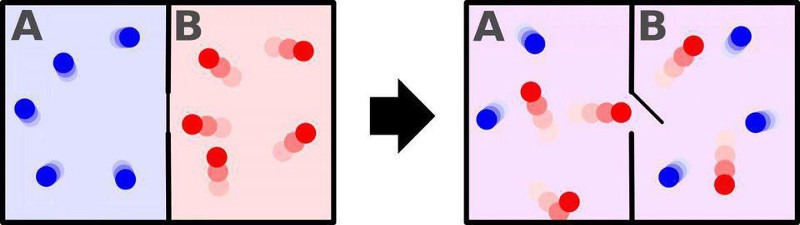 A system set up in the initial conditions on the left and allowed to evolve will have less entropy if the door remains closed (left) than if the door is opened (right). If the particles are allowed to mix, there are more ways to arrange twice as many particles at the same equilibrium temperature than there are to arrange half of those particles, each, at two different temperatures, resulting in a much greater entropy for the system at right than the one at left.
Credit: Htkym & Dhollm/Wikimedia Commons
A system set up in the initial conditions on the left and allowed to evolve will have less entropy if the door remains closed (left) than if the door is opened (right). If the particles are allowed to mix, there are more ways to arrange twice as many particles at the same equilibrium temperature than there are to arrange half of those particles, each, at two different temperatures, resulting in a much greater entropy for the system at right than the one at left.
Credit: Htkym & Dhollm/Wikimedia Commons
But there’s something else that can occur if you begin with the lower-entropy state (hot particles on one side of a divider and cold particles on the other side) and then allow it to spontaneously transition to a higher-entropy state: work, a form of energy, can not only be extracted, but that energy can then be put to use. Whenever you have a gradient — from high temperatures/energies/speeds to lower ones, for example — that’s a form of potential energy that, as it gets turned into the energy of motion, can be used to accomplish certain tasks, whether it’s heating water, generating steam, turning a turbine, generating electricity, powering a mill, or any other example you can think of.
The very act of extracting energy from those gradients and feeding off of it, in some variety, is what fuels all biological processes at their core. The Universe, by starting off hot and dense some 13.8 billion years ago, and then expanding, cooling, and gravitating ever since, has been able to produce all sorts of ordered systems:
- galaxies,
- stars,
- heavy elements,
- stellar systems,
- planets,
- organic molecules,
- and even living organisms,
by feeding off of the released energy from processes where entropy, overall, increases.
 A wine glass, when vibrated at the right frequency, will shatter. This is a process that dramatically increases the entropy of the system and is thermodynamically favorable. The reverse process, of shards of glass reassembling themselves into a whole, uncracked glass, is so unlikely that it never occurs spontaneously in practice. However, if the motion of the individual shards, as they fly apart, were exactly reversed, they would indeed fly back together and, at least for an instant, successfully reassemble the wine glass. Time reversal symmetry is exact in Newtonian physics, but it is not obeyed in thermodynamics.
Credit: BBC Worldwide/GIPHY
A wine glass, when vibrated at the right frequency, will shatter. This is a process that dramatically increases the entropy of the system and is thermodynamically favorable. The reverse process, of shards of glass reassembling themselves into a whole, uncracked glass, is so unlikely that it never occurs spontaneously in practice. However, if the motion of the individual shards, as they fly apart, were exactly reversed, they would indeed fly back together and, at least for an instant, successfully reassemble the wine glass. Time reversal symmetry is exact in Newtonian physics, but it is not obeyed in thermodynamics.
Credit: BBC Worldwide/GIPHY
This isn’t merely a qualitative statement. Based on the known particle content of the Universe and the size of the observable Universe — determined by the properties of the hot Big Bang and the fundamental constants of the Universe, including the speed of light — we can express the entropy of the Universe (S) in terms of Boltzmann’s constant, kB. At the start of the Big Bang, radiation was the dominant form of entropy, and the total entropy of the observable Universe was S ~ 10⁸⁸ kB. Although that might seem like a “big number,” we have to remember something important: things are not “big” or “small” objectively, but rather can only be quantified as large or small relative to something else.
Today, for example, the entropy of the observable Universe is much greater than it was at the start of the hot Big Bang: about a quadrillion times as large. A responsible estimate places it somewhere around S ~ 10¹⁰³kB, where most of today’s entropy is in the form of black holes, defined by their Bekenstein-Hawking entropy.
In fact, if we calculated only the entropy of the Milky Way and all the stars, gas, planets, life forms, and black holes present within it, we’d find that the entropy of the Milky Way was dominated by our galaxy’s largest supermassive black hole, Sagittarius A*, with an entropy of S ~ 10⁹¹ kB all on its own. In terms of entropy, our one meagre supermassive black hole defeats the entropy of the entire observable Universe, combined, from 13.8 billion years ago!
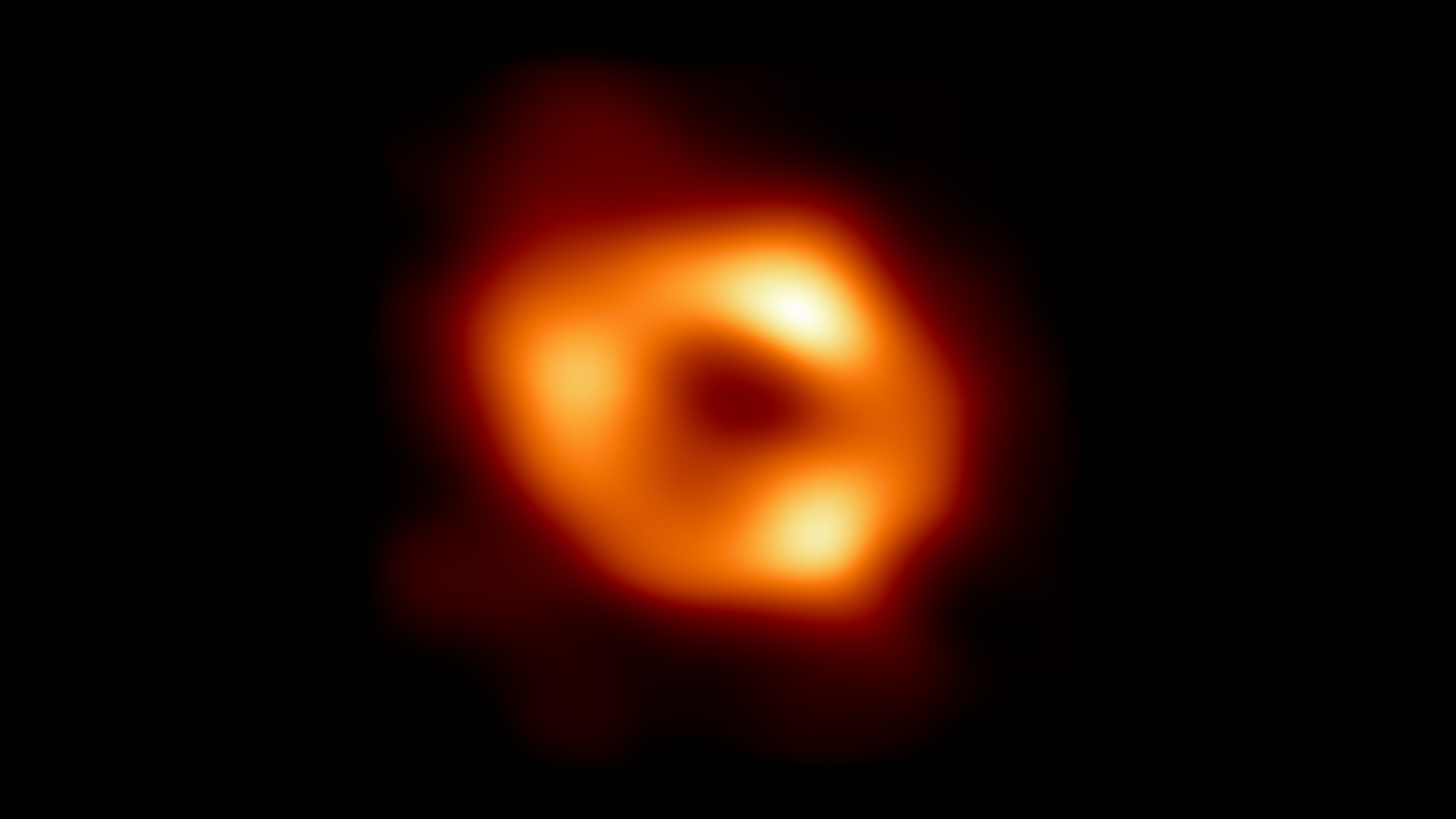 This is the first image of Sgr A*, the supermassive black hole at the center of our galaxy. It’s the first direct visual evidence of the presence of this black hole. It was captured by the Event Horizon Telescope (EHT), an array which linked together eight existing radio observatories across the planet to form a single “Earth-sized” virtual telescope. Its measured mass of 4.3 million solar masses places it among the smallest supermassive black holes of all, and it possesses an entropy of ~10^91 k_B, or about 1000 times as much entropy as was contained in the observable Universe some 13.8 billion years ago.
Credit: Event Horizon Telescope collaboration
This is the first image of Sgr A*, the supermassive black hole at the center of our galaxy. It’s the first direct visual evidence of the presence of this black hole. It was captured by the Event Horizon Telescope (EHT), an array which linked together eight existing radio observatories across the planet to form a single “Earth-sized” virtual telescope. Its measured mass of 4.3 million solar masses places it among the smallest supermassive black holes of all, and it possesses an entropy of ~10^91 k_B, or about 1000 times as much entropy as was contained in the observable Universe some 13.8 billion years ago.
Credit: Event Horizon Telescope collaboration
As we continue to move forward in time, entropy continues to increase. Over not only billions but over the coming trillions, quadrillions, and quintillions of years ahead of us (and more), the Universe will:
- complete its nuclear fusion reactions inside the cores of stars,
- settle down into bound galaxy groups eternally separated by the ever-expanding Universe,
- expel gas and dust into the intergalactic medium,
- gravitationally eject planets, clumps of mass, and stellar remnants,
- create large numbers of black holes that will eventually grow to possess a maximum-valued mass,
- and then Hawking radiation takes over, leading to black hole decay.
After perhaps 10¹⁰³ years go by, the Universe will reach its maximal entropy value of around S = 10¹²³ kB, or a factor of 100 quintillion greater than the entropy today. As even the most supermassive black holes will inevitably decay into radiation, the entropy will remain largely constant during that process, only increasing slightly. However, during the occurrence of those evaporation events, there will be no more useful energy left to extract.
With the decay of the final black hole in the Universe, there will only be a cold, low-energy bath of radiation permeating the cosmos, occasionally coming across a bound, degenerate, stable object like an atomic nucleus or another lonely, fundamental particle. With no further energy left to extract, and no less-common set of arrangements of particles that will spontaneously arise, the Universe will reach a state known as a heat death: a state of maximum entropy given the particles that exist.
 When a black hole either forms with a very low mass, or evaporates sufficiently so that only a small amount of mass remains, quantum effects arising from the curved spacetime near the event horizon will cause the black hole to rapidly decay via Hawking radiation. The lower the mass of the black hole, the more rapid the decay is, until the evaporation completes in one last “burst” of energetic radiation. The longest-lived black holes will be the most massive, with decay timescales exceeding 10^100 years.
Credit: ortega-pictures/Pixabay
When a black hole either forms with a very low mass, or evaporates sufficiently so that only a small amount of mass remains, quantum effects arising from the curved spacetime near the event horizon will cause the black hole to rapidly decay via Hawking radiation. The lower the mass of the black hole, the more rapid the decay is, until the evaporation completes in one last “burst” of energetic radiation. The longest-lived black holes will be the most massive, with decay timescales exceeding 10^100 years.
Credit: ortega-pictures/Pixabay
That, in terms of entropy at least, is what the history of our Universe looks like. After starting from a hot, dense, nearly uniform, energetic, particle-and-antiparticle-filled state with a finite and measurable amount of entropy in it, the Universe:
- expands,
- cools,
- gravitates,
- forms structure on a variety of scales,
- which leads to processes that become wildly complex,
- leading to star systems, planets, biological activity, and life,
- and then it all decays away,
leading to a maximum entropy state from which no further energy can be extracted. All told, from the Big Bang until the eventual heat death, the entropy of our Universe increases by a factor of ~10³⁵, or 100 decillion: the same as the number of atoms it takes to compose the bodies of approximately 10 million human beings.
But here’s where the big question regarding the past hypothesis comes in: if each passing moment brings along with it an increase in entropy, and the entropy of the Universe has always been increasing, and the second law of thermodynamics dictates that entropy must always increase (or remain the same) and can never decrease, then how did our Universe initially start off in such a low-entropy state to begin with?
The answer, perhaps surprisingly, has been known theoretically for more than 40 years: cosmic inflation.
 Exponential expansion, which takes place during inflation, is so powerful because it is relentless. With every ~10^-35 seconds (or so) that passes, the volume of any particular region of space doubles in each direction, causing any particles or radiation to dilute and causing any curvature to quickly become indistinguishable from flat. After only a few hundred doubling times, or ~10^-32 seconds, a fluctuation that was initially smaller than the Planck scale would now be stretched to be larger than the presently observable Universe.
Credit: E. Siegel (L); Ned Wright’s Cosmology Tutorial (R)
Exponential expansion, which takes place during inflation, is so powerful because it is relentless. With every ~10^-35 seconds (or so) that passes, the volume of any particular region of space doubles in each direction, causing any particles or radiation to dilute and causing any curvature to quickly become indistinguishable from flat. After only a few hundred doubling times, or ~10^-32 seconds, a fluctuation that was initially smaller than the Planck scale would now be stretched to be larger than the presently observable Universe.
Credit: E. Siegel (L); Ned Wright’s Cosmology Tutorial (R)
You might think of cosmic inflation in different terms, as either:
- the reason the Big Bang occurred,
- the additional, now-verified hypothesis of what came before and set up the conditions that the Big Bang was born with,
- or as the theory that removed the notion of the “Big Bang singularity” from the notion of the hot, dense, expanding state we identify as the Big Bang.
(All are correct in their own ways.) But inflation, although it’s a not-particularly well-appreciated feature of it, by its very nature forces the Universe to be born in a low entropy state, regardless of the conditions from which inflation arose. And even more remarkably, it never once violates the second law of thermodynamics, allowing entropy to never decrease during the process.
How does this occur?
The simplest way to explain it is to introduce two concepts to you that you likely have already heard of, but perhaps don’t have a sufficient appreciation of. The first is the difference between entropy (the total amount you’ll find) and entropy density (the total amount you’ll find in a given volume of space), which sounds easy enough. But the second requires a little bit of an explanation: the concept of adiabatic expansion. Adiabatic expansion is an important property in thermodynamics, in engines, in astrophysical gases and plasmas, and also in the expanding Universe.
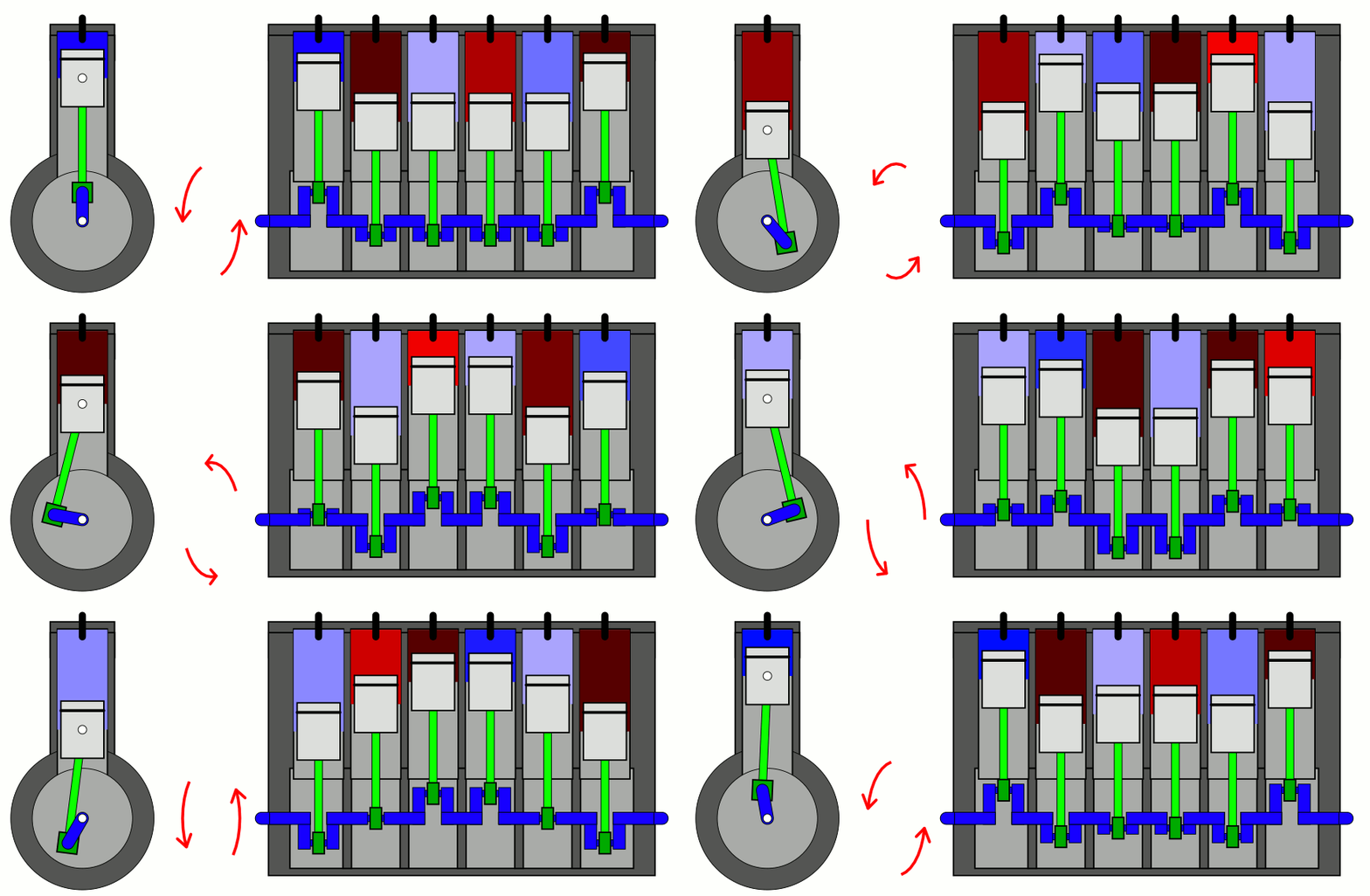 This schematic of an engine shows how the rapid compression of air due to a piston’s motion, adiabatic compression, leads to increased temperatures and, if there’s enough of a fuel/air mixture inside the compressing piston, ignition followed by combustion, which causes the chamber to re-expand. This is the fundamental principle behind an internal combustion engine.
Credit: MichaelFrey/Wikimedia Commons
This schematic of an engine shows how the rapid compression of air due to a piston’s motion, adiabatic compression, leads to increased temperatures and, if there’s enough of a fuel/air mixture inside the compressing piston, ignition followed by combustion, which causes the chamber to re-expand. This is the fundamental principle behind an internal combustion engine.
Credit: MichaelFrey/Wikimedia Commons
You might remember — going all the way back to when you first learned chemistry in High School — that a sealed container full of gas will have certain properties inside of it that are fixed, like the number of particles inside, and other properties that can vary, like the pressure, temperature, or volume of the gas inside that container. Depending on how you change one or more of those properties, the others will change in response in a variety of interesting ways.
- You can increase or decrease the volume of the container while holding the pressure constant, resulting in a temperature change that obeys Charles’s Law: an example of isobaric expansion or contraction.
- You can increase or decrease the pressure of the container while keeping the volume constant, resulting in a temperature change: an example of isovolumetric changes.
- You can keep the temperature constant while slowly either increasing or decreasing the volume, resulting in a pressure change that obeys Boyle’s law: an isothermal change.
But if you take a confined gas and either very rapidly expand it or very rapidly compress it, all three of those factors — pressure, volume, and temperature alike — will all change. This type of change is known as an adiabatic change, where adiabatic expansion leads to rapid cooling and adiabatic contraction leads to rapid heating, where the latter is how pistons work. No heat is exchanged between the outside environment and the internal system, but there is a key quantity that remains constant during adiabatic expansion or contraction: entropy. In fact, “isentropic,” or constant entropy, is a synonym for adiabatic, as long as the system obeys time-reversal symmetry as well.
 This diagram shows, to scale, how spacetime evolves/expands in equal time increments if your Universe is dominated by matter, radiation, or the energy inherent to space itself (i.e., during inflation or dark energy dominance). The bottom-most scenario corresponds to exponential expansion via both dark energy (today) and inflation (at early times). Note that visualizing the expansion as either ‘the existing space stretching’ or ‘the creation of new space’ won’t suffice in all instances.
Credit: E. Siegel/Beyond the Galaxy
This diagram shows, to scale, how spacetime evolves/expands in equal time increments if your Universe is dominated by matter, radiation, or the energy inherent to space itself (i.e., during inflation or dark energy dominance). The bottom-most scenario corresponds to exponential expansion via both dark energy (today) and inflation (at early times). Note that visualizing the expansion as either ‘the existing space stretching’ or ‘the creation of new space’ won’t suffice in all instances.
Credit: E. Siegel/Beyond the Galaxy
During cosmic inflation, some portion of the Universe begins expanding in a rapid, constant fashion, resulting in an exponentially-expanding behavior of that region of space. In one “doubling time,” which is typically a fraction of a decillionth of a second, the length, width, and depth (i.e., all three spatial dimensions) all double in size, increasing the volume by a factor of 8. After a second “doubling time,” they all double again, increasing the original volume by a factor of 64. With each doubling time that passes, the length, width, and depth of the volume of expanding space all double in size, and then double again with the next “doubling interval” that elapses.
After 10 doubling times go by, the patch of Universe that’s undergone inflation has increased in volume by more than a factor of a billion. After 100 doubling times, its volume has increased by a factor of something like ~10⁹⁰. And after 1000 doubling times, its volume has increased by a great enough amount that it would have taken a Planck-sized volume, the smallest volume that makes physical sense in a quantum Universe, and stretched it to well beyond the size of the visible Universe.
Yet all the while, the entropy within that volume — because the Universe expands adiabatically, or equivalently, isentropically — remains constant. In other words, the total entropy doesn’t decrease during this inflationary period, but owing to the enormous increase in volume, the entropy density drops exponentially. This ensures that, when inflation ends, the majority of entropy in the volume of the Universe that becomes our observable Universe comes from the end of inflation and the onset of the hot Big Bang. Whatever entropy pre-existed in the Universe during inflation, or prior to it, is rendered wholly irrelevant.
 The analogy of a ball sliding over a high surface is when inflation persists, while the structure crumbling and releasing energy represents the conversion of energy into particles, which occurs at the end of inflation. This transformation — from inflationary energy into matter and radiation — represents an abrupt change in the expansion and properties of the Universe, as well as a tremendous increase in entropy wherever inflation ends.
Credit: E. Siegel/Beyond the Galaxy
The analogy of a ball sliding over a high surface is when inflation persists, while the structure crumbling and releasing energy represents the conversion of energy into particles, which occurs at the end of inflation. This transformation — from inflationary energy into matter and radiation — represents an abrupt change in the expansion and properties of the Universe, as well as a tremendous increase in entropy wherever inflation ends.
Credit: E. Siegel/Beyond the Galaxy
In other words, the solution to the problem of the past hypothesis puzzle, or why the Universe possessed a low-entropy state at the start of the hot Big Bang, is because the Universe underwent a period of cosmic inflation. The rapid, relentless, exponential expansion of the Universe took whatever entropy might have pre-existed within a specific region of space — occupying a certain volume of space — and inflated that volume to tremendous quantities.
Even though entropy was conserved (or possibly even increased very, very slightly), the entropy density plummets, as near-constant entropy in an exponentially expanding volume translates to having the entropy in any specific, well-defined volume of space becoming exponentially suppressed. That’s why, if you accept the evidence in favor of cosmic inflation, where that evidence is very, very strong, you no longer have a “past hypothesis” problem. The Universe is simply born with the amount of entropy that the transition from an inflationary state to a hot Big Bang state, a process known as cosmic reheating, imprints upon it.
The Universe was born in a low-entropy state because inflation caused the entropy density to plummet, and only after that did the hot Big Bang occur. Then, as expected, from that initial value, the Universe’s entropy has been forever increasing from that point onward. As long as you remember that entropy is not entropy density, and that inflating any volume while keeping the entropy constant necessarily results in a very small entropy density in the aftermath of that inflationary period, you’ll never be confused by the past hypothesis puzzle again.
This article was first published in November of 2022. It was updated in April of 2026.
-
Science and TechAstrophysicsUniverse ExpansionBig Bang TheoryBlack Hole
Theoretical astrophysicist and science writer
Full Profile Monthly Issue
March 2026
The Roots of Resilience
In this monthly issue, we look at resilience not as a buzzword or a self-help prescription, but as a property — one that shows up, or doesn’t, at every scale.
2 videos
14 articles
Monthly Issue
March 2026
The Roots of Resilience
In this monthly issue, we look at resilience not as a buzzword or a self-help prescription, but as a property — one that shows up, or doesn’t, at every scale.
2 videos
14 articles

Related Content
Starts With A BangSurprise: the Big Bang isn’t the beginning of the universe anymore
We used to think the Big Bang meant the universe began from a singularity. Nearly 100 years later, we're not so sure.
by Ethan Siegel Starts With A Bang
5 consensus ideas in astronomy that might soon be overturned
From black holes to dark energy to chances for life in the Universe, our cosmic journey to understand it all is just getting started.
by Ethan Siegel Starts With A Bang
The Big Bang doesn’t mean what it used to
As we gain new knowledge, our scientific picture of how the Universe works must evolve. This is a feature of the Big Bang, not a bug.
by Ethan Siegel Starts With A Bang
ANITA did see weird particles, but not parallel Universes
The ANITA experiment found cosmic rays shooting out of Antarctica. One interpretation claims "parallel Universes," but is that right?
by Ethan Siegel Learn from the world's biggest thinkers.
-
Videos
- Latest
- The Big Think Interview
-
Columns
- Mini Philosophy
- Starts with a Bang
- Big Think Books
- The Long Game
- Strange Maps
- 13.8
- The Well
- Rethinking Possible
-
Sections
- Philosophy
- Mind & Behavior
- Science & Tech
- Business
- History & Society
-
Classes
- Class Library
-
Subscribe
- Membership
- Free Newsletters
-
Partner
- Big Think+ Learning
- Creative Studio
- Advertise with Us
- Events
-
More
- About
- Careers
- Contact
- Privacy Policy
- Terms of Sale
- Accessibility