- Search What are you curious about? Popular SearchesCritical thinkingPhilosophyEmotional IntelligenceFree Will Latest Videos Latest Articles
-
Topics
Philosophy
- Ethics
- Religion
- Flourishing
- Knowledge
- Philosophy of Science
- Philosophy of Art
- Language
- Political Theory
- Identity
- Meaning & Purpose
Science & Tech
- Physics
- Biology
- Aerospace
- Health
- Geology
- Computing
- Engineering
- Energy
- Biotechnology
- Astronomy
Mind & Behavior
- Psychology
- Neuroscience
- Decision-Making
- Mental Health
- Consciousness
- Emotional Intelligence
- Personality
- Relationships
- Parenting
Business
- Entrepreneurship
- Leadership
- Finance
- Marketing
- Innovation
- Strategy
- Management
- Artificial Intelligence
- Startups
- Economics
History & Society
- History
- Literature
- Art
- Music
- Film
- Progress
- Culture
- Sociology
- Policy
- Geopolitics
- Latest
-
Videos
Latest Videos
 Reboot your mind for flow, unanxiousness, and resilience
with
Steven Kotler
Reboot your mind for flow, unanxiousness, and resilience
with
Steven Kotler
 This isn’t a trip, it’s the most challenging therapy session of your life
with
Rachel Yehuda
This isn’t a trip, it’s the most challenging therapy session of your life
with
Rachel Yehuda
 The science behind the strangest biological phenomena
with
David J. Linden
The science behind the strangest biological phenomena
with
David J. Linden
 The hidden reason smart people stop growing
with
Robert Herjavec
The hidden reason smart people stop growing
with
Robert Herjavec
 The neuroscience behind synesthesia
with
Richard E. Cytowic
The neuroscience behind synesthesia
with
Richard E. Cytowic
 The real lesson from the first time globalization died
with
Eric Cline
See All
The real lesson from the first time globalization died
with
Eric Cline
See All
-
Columns
 Mini Philosophy
A philosophy column for personal reflection.
Mini Philosophy
A philosophy column for personal reflection.
 Starts With A Bang
An astrophysics column on big questions and our universe.
Starts With A Bang
An astrophysics column on big questions and our universe.
 Books
A literature column to feed your curiosity.
Books
A literature column to feed your curiosity.
 The Long Game
A business column on long-term thinking.
The Long Game
A business column on long-term thinking.
 Strange Maps
A geography column on history and society.
Strange Maps
A geography column on history and society.
 The Well
A collection of essays and videos on life’s biggest questions.
The Well
A collection of essays and videos on life’s biggest questions.
 13.8
A column at the intersection of science and culture.
13.8
A column at the intersection of science and culture.
-
Classes
Featured Classes
 Members
6 videos
How to Become Antifragile
Tal Ben-Shahar
Positive psychologist
Members
6 videos
How to Become Antifragile
Tal Ben-Shahar
Positive psychologist
 Members
7 videos
Understanding Trauma
Bessel van der Kolk
Psychiatrist and neuroscientist
Members
7 videos
Understanding Trauma
Bessel van der Kolk
Psychiatrist and neuroscientist
 Members
9 videos
The 6 Disciplines of Strategic Thinking
Michael Watkins
Professor of Leadership and Organizational Change, IMD Business School, and Author, “The Six Disciplines of Strategic Thinking”
Members
9 videos
The 6 Disciplines of Strategic Thinking
Michael Watkins
Professor of Leadership and Organizational Change, IMD Business School, and Author, “The Six Disciplines of Strategic Thinking”
 Members
12 videos
Radical Respect at Work
Kim Scott
Co-Founder, Radical Candor, and Author, Radical Respect: How to Work Together Better
Members
12 videos
Radical Respect at Work
Kim Scott
Co-Founder, Radical Candor, and Author, Radical Respect: How to Work Together Better
 Members
8 videos
How to Think Like a Spy
Andrew Bustamante
Former CIA Operative and Founder, Everyday Spy
Members
8 videos
How to Think Like a Spy
Andrew Bustamante
Former CIA Operative and Founder, Everyday Spy
 Members
7 videos
Managing the Voice in Your Head
Ethan Kross
Professor of Psychology and Management & Organizations; Author, University of Michigan
Browse
Members
7 videos
Managing the Voice in Your Head
Ethan Kross
Professor of Psychology and Management & Organizations; Author, University of Michigan
Browse
-
More
- Newsletters
- Monthly Issues
- Events
- Big Think+ Learning
- Creative Studio
- Advertise with Us
- About
- Careers
- View our Twitter (X) feed View our Youtube channel View our Instagram feed View our Substack feed View our Spotify feed
-
My account
- My Classes
- My Account
- My List
- BT+ for my Business
- Early Releases
- Sign Out
- Membership
- Latest
-
Topics
Back
Philosophy
Science & Tech
Mind & Behavior
Business
History & Society
-
Videos
Back
Latest Videos
Reboot your mind for flow, unanxiousness, and resilience
“We can use neuroscience and tools from psychology to learn how to take advantage of anxiety.” From Zen Buddhism to...
This isn’t a trip, it’s the most challenging therapy session of your life
Rachel Yehuda, a leading PTSD researcher, has spent her career uncovering the way that trauma can leave impressions on our...
The science behind the strangest biological phenomena
Neuroscientist David Linden sheds light on the biology behind phenomena that medicine has long struggled to explain, from voodoo death...
The hidden reason smart people stop growing
Shark Tank’s Robert Herjavec breaks down why the traditional idea of mentorship is not only outdated, but actively getting in...
The neuroscience behind synesthesia
Neurologist Richard Cytowic has spent decades studying synesthesia, the phenomenon where one sense involuntarily triggers another.
The real lesson from the first time globalization died
Archaeologist Eric Cline has spent his career forensically reconstructing why the Bronze Age collapsed, and the answer is far stranger...
 The collapse that accidentally built the modern world
Historian Eric Cline illuminates the 400-year period following ancient collapse that shaped the modern world.
The collapse that accidentally built the modern world
Historian Eric Cline illuminates the 400-year period following ancient collapse that shaped the modern world.
 Why modern physics is forcing us to rethink existence
NASA astronomer Michelle Thaller makes the case that quantum entanglement may be the underlying fabric from which spacetime itself emerges.
Why modern physics is forcing us to rethink existence
NASA astronomer Michelle Thaller makes the case that quantum entanglement may be the underlying fabric from which spacetime itself emerges.
-
Columns
Back
Columns
Mini Philosophy
A philosophy column for personal reflection.
Starts With A Bang
An astrophysics column on big questions and our universe.
Books
A literature column to feed your curiosity.
The Long Game
A business column on long-term thinking.
Strange Maps
A geography column on history and society.
The Well
A collection of essays and videos on life’s biggest questions.
13.8
A column at the intersection of science and culture.
-
Classes
Back
Featured Classes
Members
6 videos
How to Become Antifragile
Tal Ben-Shahar
Positive psychologist
Members
7 videos
Understanding Trauma
Bessel van der Kolk
Psychiatrist and neuroscientist
Members
9 videos
The 6 Disciplines of Strategic Thinking
Michael Watkins
Professor of Leadership and Organizational Change, IMD Business School, and Author, “The Six Disciplines of Strategic Thinking”
Members
12 videos
Radical Respect at Work
Kim Scott
Co-Founder, Radical Candor, and Author, Radical Respect: How to Work Together Better
Members
8 videos
How to Think Like a Spy
Andrew Bustamante
Former CIA Operative and Founder, Everyday Spy
Members
7 videos
Managing the Voice in Your Head
Ethan Kross
Professor of Psychology and Management & Organizations; Author, University of Michigan
- My Account Back
- Sign In
- Membership
- More Back
As the world teeters on the brink of nuclear war, distant, advanced civilizations would never know it. Earth appears peaceful from far away.
by Ethan Siegel April 8, 2026 This photograph shows the first view, with human eyes, of the Earth rising over the limb of the Moon, taken mere minutes after the original Earthrise photo (in black-and-white) was snapped. The discovery of the Earth from space, with human eyes, remains one of the most iconic achievements in our species’ history. Apollo 8, which occurred during December of 1968, was one of the essential precursor missions to a successful Moon landing. This photo is arguably the most environmentally impactful one ever taken.
Credit: NASA/Apollo 8
Key Takeaways- Here in 2026, the threat of nuclear weapons exploding on Earth is the highest it’s ever been since the fall of the Soviet Union, and many of us here on Earth can palpably feel that threat.
- But an observer from space, even with remarkable, futuristic equipment, might never know the dangers we’re placing ourselves in until it’s far too late to intervene.
- If we’re at such a precious point in our development, the answer to “why is no one coming to save us?” might simply be “because they don’t know the predicament we’re in,” and astrophysics explains why.

An astrophysics column on big questions and our universe.
Get our free newsletter on Substack-
Science and TechAstronomyUniverse ExpansionSpace ExplorationAstrobiology
Of all the planets, star systems, and galaxies we’ve ever discovered, the only one that displays any yet-detected signals of life is right here: planet Earth which orbits the Sun right here in our own Milky Way. While there are:
- hundreds of known planetary bodies in our own Solar System,
- more than 6000 known exoplanets detected so far,
- approximately 400 billion stars located within the Milky Way,
- and trillions of galaxies within the observable Universe,
each one of them only represents a chance for life and living beings here in 2026. At present, only Earth, of all the known worlds, and only our Solar System, out of the 2 × 10²¹ stars suspected to exist in the visible Universe, has been demonstrated to have living organisms thriving upon it.
But any world that’s home to life is also, inevitably, going to be home to death as well. Earth may be the only known planet with life on it, but it’s also the only known planet with war, conflict, and murder on it as well. From up close, these tensions are palpable, and their effects on the creatures inhabiting our world can be profound, from humans to animals to every organism in every ecological system in the world. But from afar, the Earth looks deceptively peaceful. Moreover, the farther away you go, the more peaceful our planet appears. At greater and greater distances, the reality of the destruction that we’ve often inflicted on one another — and on ourselves — fades away.
Here’s a look at how a more distant perspective changes what one is capable of seeing occurring on our world.
 This image, taken from the International Space Station by astronaut Karen Nyberg in 2013, shows the two largest islands on the southern part of the Mascarene Plateau: Réunion, in the foreground, and Mauritius, partially covered by clouds. The lights are due to artificial lighting around the islands: installed by humans. To see an individual human on Earth from the altitude of the ISS, a telescope the size of Hubble would be needed.Credit: NASA/Karen Nyberg
The longest sustained presence of humans in space, ever, is showcased in the above image: taken from the International Space Station. From November 2, 2000, up through the present day here in April of 2026. For over 25 continuous years, humans have been orbiting the Earth from hundreds of kilometers up: above the majority of our atmosphere, with the ability to look and see whatever portion of our planet we’re currently flying over from a top-down perspective.

From this height, no individual humans can be seen. Only the collective glow of cities, the eruptions of volcanoes, the strikes of lightning bolts, and large-scale wildfires appear to human eyes.
With advanced, high-resolution cameras, of course, we can see details that are far greater: farmland, the effects of tornadoes, the color of an individual house’s roof, and the location of objects to a precision of less than a single meter. The effects of combat or even a localized trail of destruction can easily be pulled out with modern technology: enabling our successes in global satellite imagery. However, if we go to greater and greater distances, our world — often rife with violence — appears much more stable and peaceful.
 This image, of the Earth as seen from Artemis II after the gravity assist swung the spacecraft past the Earth before its journey to the Moon, showcases the overexposed night side of Earth. The planet Venus shines off to the right, the Zodiacal light diffusely glows alongside it, and the two polar aurorae can be seen at the upper-right and lower-left of the image. This unusual view of our planet was taken by a human: the first time the full disk of the Earth was seen with human eyes since 1972.
Credit: NASA
This image, of the Earth as seen from Artemis II after the gravity assist swung the spacecraft past the Earth before its journey to the Moon, showcases the overexposed night side of Earth. The planet Venus shines off to the right, the Zodiacal light diffusely glows alongside it, and the two polar aurorae can be seen at the upper-right and lower-left of the image. This unusual view of our planet was taken by a human: the first time the full disk of the Earth was seen with human eyes since 1972.
Credit: NASA
As we travel to greater and greater distances — and remember, with Artemis II’s recent fly-by of the Moon, they traveled the farthest that any human has ever traveled from Earth — the Earth’s angular size drops, its apparent brightness falls off, and in order to resolve the same size features, a larger telescope is required. From the great distances that humans have achieved, first in the Apollo era and once again now here in the 21st century, national borders and boundaries are all but invisible. Only clouds, continents, glaciers, icecaps, oceans, and other very large-scale, bright features can be resolved.
One can always envision the construction of an arbitrarily large, powerful telescope: one that would enable you to see detailed features on Earth from any distance imaginable. However, practicality issues always emerge whenever you’re imagining any device made of matter: there are physical limits to the size, stability, and precisions that are obtainable with physical systems.
From these great distances of thousands, tens of thousands, or hundreds of thousands of kilometers, a telescope the size of JWST, the largest space telescope ever launched, would only be able to detect brief flashes of luminous energy outputs, like the detonations of nuclear devices, for a brief moment, and only if they occurred on Earth’s night side at that.
 This narrow-angle color image of the Earth, dubbed ‘Pale Blue Dot’, is a part of the first ever ‘portrait’ of the solar system taken by Voyager 1. The spacecraft acquired a total of 60 frames for a mosaic of the solar system from a distance of more than 6 billion km from Earth and about 32 degrees above the ecliptic. From Voyager’s great distance Earth is a mere point of light, less than the size of a picture element even in the narrow-angle camera. Earth was a crescent only 0.12 pixel in size. Coincidentally, Earth lies right in the center of one of the scattered light rays resulting from taking the image so close to the sun. This blown-up image of the Earth was taken through three color filters — violet, blue, and green — and recombined to produce the color image. The background features in the image are artifacts resulting from the magnification.Credit: NASA/Voyager 1
At even greater distances, such as the maximum distance spacecraft have ever traveled from Earth and still looked back to successfully image it, the Earth appears as no more than a single pixel: impossible to resolve. But hope is not gone for detecting our impacts on the planet, or from searching for our impacts on the world and its atmosphere and surface. The same science that goes into investigating the properties of exoplanets can indeed be applied to Earth from afar, and even a single pixel encodes a wealth of information.
For instance, simply by observing the light from Earth and breaking it up into its component wavelengths spectroscopically, we could:
- infer the chemical composition of our atmosphere,
- detect the percentage of the world that is covered in ice, water, clouds, and land,
- watch the continents green and brown with the seasons, revealing life’s presence,
- observe the seasonal variations in carbon dioxide and water vapor, further revealing life’s properties,
- and detect events that vastly increase the cloud cover/opacity/reflectivity of our planet, including massive fires, the fallout from nuclear device detonation, or volcanic eruptions.
With spectral signatures, we can even potentially discern what’s being added to our atmosphere and when. A tremendous amount of science can be done, concerning Earth, from afar, just as easily as we can conduct that sort of science for exoplanets.
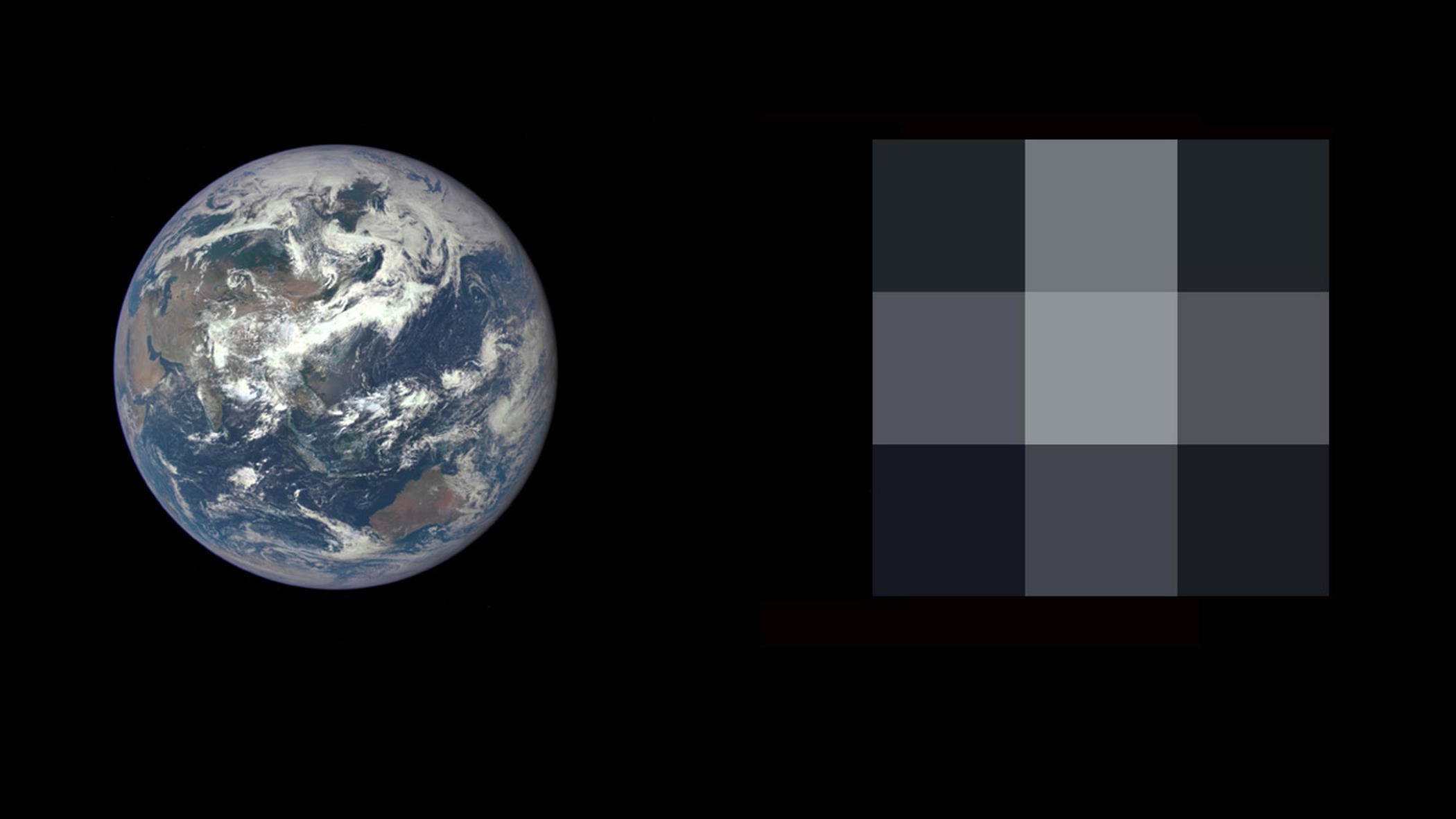 Left, an image of Earth from the DSCOVR-EPIC camera. Right, the same image degraded to a resolution of 3 x 3 pixels, similar to what researchers will see in future exoplanet observations (assuming the light from the central pixel bleeds into adjacent ones). If we were to build a telescope capable of obtaining ~60–70 micro-arc-second resolution, we’d be able to image an Earth-like planet at this level at the distance of Alpha Centauri. Habitable Worlds Observatory, with a novel coronagraph, as well as the ground-based ExoLife Finder, could image Earth-sized worlds at Earth-like distances from Sun-like stars, albeit only as a single pixel.
Credit: NOAA/NASA/Stephen Kane
Left, an image of Earth from the DSCOVR-EPIC camera. Right, the same image degraded to a resolution of 3 x 3 pixels, similar to what researchers will see in future exoplanet observations (assuming the light from the central pixel bleeds into adjacent ones). If we were to build a telescope capable of obtaining ~60–70 micro-arc-second resolution, we’d be able to image an Earth-like planet at this level at the distance of Alpha Centauri. Habitable Worlds Observatory, with a novel coronagraph, as well as the ground-based ExoLife Finder, could image Earth-sized worlds at Earth-like distances from Sun-like stars, albeit only as a single pixel.
Credit: NOAA/NASA/Stephen Kane
Of course, that’s looking for a very small signal against the background of “noise” that is the rest of the Solar System. If you want to image Earth at a great distance, you have to take care that your observations don’t get swamped by Earth’s much larger and brighter neighbor: the Sun. The Sun is tens of billions of times intrinsically brighter than Earth across all wavelengths, and coronagraphy or a starshade must be used to great effectiveness if one wishes to pick out the signal of the Earth that’s just separated by one astronomical unit (around 150,000,000 kilometers) from the relatively much more brilliant star that we orbit.
Even if we can do that, and extract the signal of Earth against the background of the Sun’s light, it’s still a tremendous challenge to pick out the signatures that showcase war, violence, or other sources of conflict or disaster on our world. The leading signals of Earth, at least in the form of electromagnetic radiation, showcase our planet’s oceans and other bodies of water, clouds, icecaps, continents, and atmospheric composition. Extracting the tiny variations in those properties that occur over time is a much greater achievement: one we have yet to reach for any Earth-sized exoplanet at Earth-like distances from a Sun-like star.
It can be done, with sophisticated enough technology and enough continuous observing time, but that all assumes that one would even bother to look at planet Earth on a continuous basis.
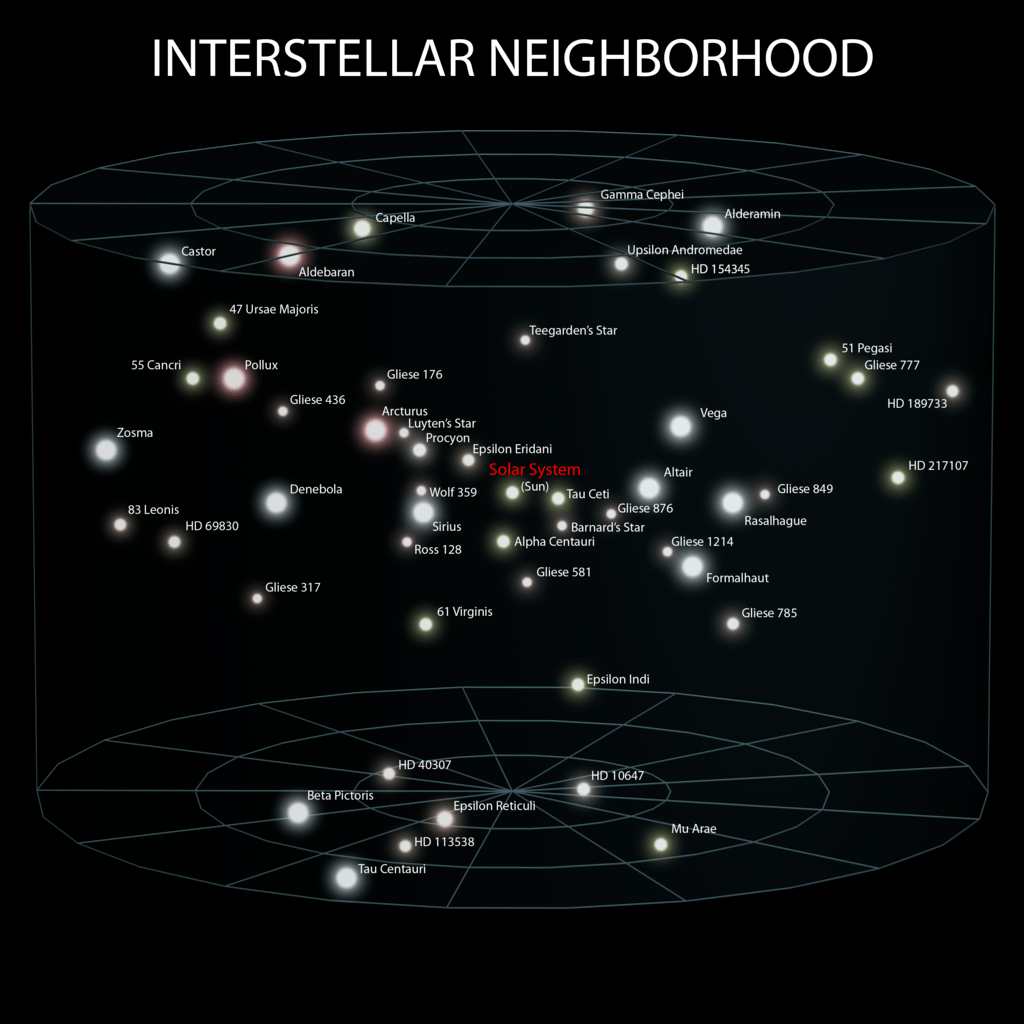 In the early 21st-century, we’ve successfully mapped out practically all the stars in our neighborhood in three-dimensional space. The closest stars to us don’t always align with the stars we can see, as what’s visible is determined by a combination of distance and intrinsic brightness, but all stars beyond the Sun are at a much, much greater distance than anything within our Solar System. The Alpha/Proxima Centauri system is a trinary, and has the three closest stars to our Sun at present; Barnard’s star is the fourth closest, and is the nearest singlet star system to our own.
Credit: Andrew Z. Colvin
In the early 21st-century, we’ve successfully mapped out practically all the stars in our neighborhood in three-dimensional space. The closest stars to us don’t always align with the stars we can see, as what’s visible is determined by a combination of distance and intrinsic brightness, but all stars beyond the Sun are at a much, much greater distance than anything within our Solar System. The Alpha/Proxima Centauri system is a trinary, and has the three closest stars to our Sun at present; Barnard’s star is the fourth closest, and is the nearest singlet star system to our own.
Credit: Andrew Z. Colvin
If you were an intelligent alien who had already discovered the Earth and had detected signs of life on it, you might be motivated to come back to it over and over again. After all, it remains possible that life is exceedingly rare; we only have constraints on how common it is, without a second positive detection (beyond our own planet) to guide us. However, if you were an intelligent alien from another world who discovered the Earth, it would indeed provide at least a second example, teaching you that life was not unique to your world. If you’re the only one you know, you might be alone, but if there’s a second example, you can be certain that there are many.
The same type of science that allows us to detect changes in the night sky — what we call transient events, like supernovae, tidal disruption events, or fast radio bursts — can be applied to planets like Earth, even from afar. If there’s a large event that:
- changes the reflectivity of the planet,
- adds a new species of gas to the atmosphere in copious amounts,
- causes the release of a large amount of energy,
- or changes the color of a particularly large region of the world,
these can all be detected by a dedicated-enough observer, even from interstellar distances away.
However, these signals aren’t the only ones that human activity, including war, can create. There are, on a fundamental level, nuclear reactions that can be observed even from a distance: owing to the generation of neutrinos.
 The Palo Verde nuclear reactor, shown here, generates energy by splitting apart the nucleus of atoms and extracting the energy liberated from this reaction. The blue glow comes from emitted electrons streaming into the surrounding water, where they travel faster than light in that medium, and emit blue light: Cherenkov radiation. The neutrinos (or more accurately, antineutrinos) first hypothesized by Pauli in 1930 were detected from a similar nuclear reactor in 1956.
Credit: Department of Energy/American Physical Society
The Palo Verde nuclear reactor, shown here, generates energy by splitting apart the nucleus of atoms and extracting the energy liberated from this reaction. The blue glow comes from emitted electrons streaming into the surrounding water, where they travel faster than light in that medium, and emit blue light: Cherenkov radiation. The neutrinos (or more accurately, antineutrinos) first hypothesized by Pauli in 1930 were detected from a similar nuclear reactor in 1956.
Credit: Department of Energy/American Physical Society
Whether from nuclear power or from nuclear weapons, nuclear reactions that either fuse light nuclei into heavier ones or that split atomic nuclei apart in fission reactions emit neutrinos and/or antineutrinos: reactions that impart a specific energy spectrum onto those neutrinos. With a large-enough directional neutrino detector, such as a large-enough tank of water sufficiently lined with photomultiplier tubes, the nuclear activity that humans have conducted on Earth could be detected from afar. If one could coordinate optical/electromagnetic signals with those nuclear signals from neutrinos, one could even obtain multi-messenger signals of nuclear activity on Earth.
Of course, that isn’t necessarily easy to do: there are natural backgrounds of neutrinos that can easily swamp the terrestrial signals we generate here on Earth. The Sun, for example, emits many more neutrinos than even the full sum of all the nuclear events on Earth: reactors, bombs, physics experiments, etc. But in the nuclear reactions that generate neutrinos on Earth, there are specific signatures, such as:
- the type/species of neutrino created,
- the nature (neutrino or antineutrino) and spectrum of those neutrinos,
- and the energy properties of those neutrinos,
that can be teased out of the data. From even far-enough away, the individual sources of those neutrinos can be determined, enabling a faraway alien species to detect the type of activity we’re conducting.
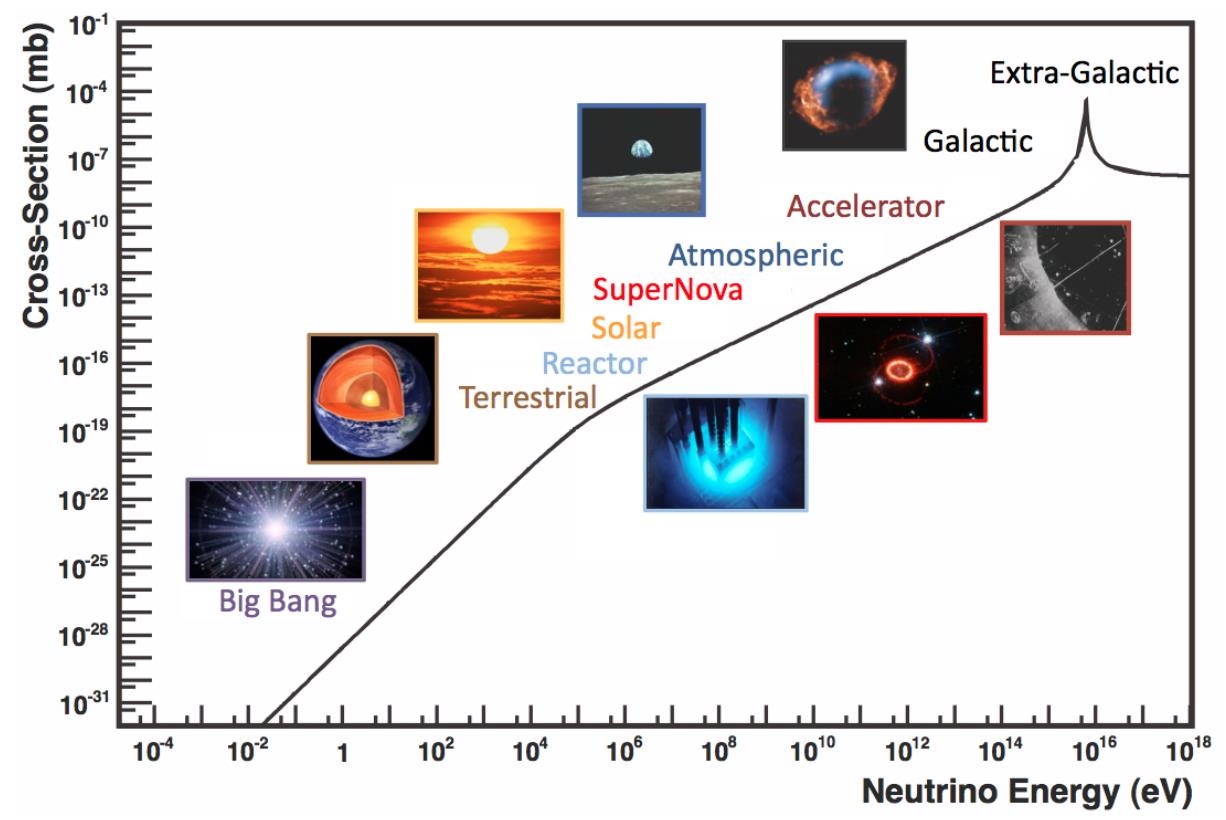 Neutrinos come in a wide variety of energies and have been observed (and calculated) to have a wide variety of cross-sections. Neutrinos have been detected from an enormous number of sources, but never left over from the Big Bang, as their cross-section is far too low to be accessible to experiment. Even so, neutrino-particle interactions should have enough energy, even today, to enable all possible flavor oscillations.
Credit: J. A. Formaggio and G. P. Zeller, Rev. Mod. Phys., 2012
Neutrinos come in a wide variety of energies and have been observed (and calculated) to have a wide variety of cross-sections. Neutrinos have been detected from an enormous number of sources, but never left over from the Big Bang, as their cross-section is far too low to be accessible to experiment. Even so, neutrino-particle interactions should have enough energy, even today, to enable all possible flavor oscillations.
Credit: J. A. Formaggio and G. P. Zeller, Rev. Mod. Phys., 2012
But, as important and informative as those signals all are, there’s one more problem that comes along with them: the finite speed of light.
- It’s been seven years since the dawn of the era of satellite megaconstellations, which means that only the Sun, the Alpha Centauri system, the Barnard’s star system, and the Luhman 16 system can detect them. Anyone farther away would have no evidence Earth’s orbit is becoming so heavily polluted.
- It’s been 81 years since the dawn of the atomic bomb era: with the first detonation on Earth (Trinity). Even though neutrinos (and antineutrinos) travel at nearly the speed of light, there are only a few thousand — likely somewhere between 4000 and 10,000 — stars within 81 light-years of the Sun. That means, from farther away, no alien, no matter what technology they have to look, could detect our discovery of nuclear technology.
- It’s only been 131 years since Guglielmo Marconi sent the first human-made radio signals (in Morse code), meaning that someone more distant than 131 light-years away wouldn’t be able to even detect human-generated radio or television waves.
Similarly, it’s been only about 250 years since the start of the industrial revolution, about 1200 years since the invention of gunpowder, and about 12,000 years since the dawn of agriculture. Even in most locations within our home galaxy, there exists only scant evidence for the presence of humans.
 This illustration shows a frozen-over planet, but one that still possesses a significant liquid ocean beneath the surface ice. Many worlds in our Solar System may be described by this scenario at various points in cosmic history, including even planet Earth more than two billion years ago.
Credit: Pablo Carlos Budassi/Wikimedia Commons
This illustration shows a frozen-over planet, but one that still possesses a significant liquid ocean beneath the surface ice. Many worlds in our Solar System may be described by this scenario at various points in cosmic history, including even planet Earth more than two billion years ago.
Credit: Pablo Carlos Budassi/Wikimedia Commons
In fact, for most of planet Earth’s history, it didn’t necessarily even bear much of a physical resemblance to the “blue marble” we recognize today. Our planet has changed dramatically in appearance over time in ways we don’t often think about.
- 65 million years ago, a catastrophic asteroid impact caused a great mass extinction, blanketing the planet in a pall of ash lasting weeks or more: dramatically changing the planet’s appearance from afar.
- From 180 million to 300 million years ago, the superocean Panthalassa covered roughly 70% of Earth’s surface, with the supercontinent Pangaea concentrating Earth’s land masses into a single object.
- Prior to about 400 million years ago, the continents did not become green, but rather remained the color of the rock beneath them, as plants had not yet colonized the land.
- And several times throughout Earth’s history, including for about a 300 million years period from between 2.5 billion to 2.2 billion years ago, the entire planet was frozen over: creating a Snowball Earth scenario.
From far away, these would be the notable features about Earth: not any sign of whether it’s inhabited and certainly not any sign of human-caused conflict on the surface. In fact, from a distance of more than 4.5 billion light-years away, Earth would not even be detectable at all, as our Solar System, Sun, and planet would not have yet formed.
 As shown with Chandra X-ray data (left) and with contours of radio data from the Very Large Array (right), quasar 3C 9 broke the cosmic distance record in 1965 and became the first object with a redshift of 2 or greater and is located at a distance of 16 billion-light years. Although many more quasars (and, eventually, galaxies as well) would extend that record, from the point of view of someone on this quasar, no evidence of Earth, the Sun, or our Solar System could be detected.Credit: A. C. Fabian, A. Celotti, & R. M. Johnstone, MNRAS, 2003
The farther away you go, in fact, the less you can see and detect about what’s happening here on Earth. Only the very nearest perspectives can give us a glimpse into the activity we think of as human: industrial and nuclear activity, as well as our most destructive weapons of war. Only within the Milky Way, and perhaps the Magellanic Clouds, can we detect any evidence for the presence of humans at all. Only within 400 million light-years — just one-millionth of the volume of the visible Universe — can we detect signs of plant life on the planet’s surface; for over 90% of our planet’s history, the continents were barren.
From far away, Earth not only appears as just a simple planetary point, but nothing at all appears remarkable about it. We weren’t even a “pale blue dot” for much of our history, but took on a variety of appearances across time. The farther away we go and imagine what Earth would look like, the less and less Earth-like it appears, at least, by modern standards. Humanity’s rise to prominence on Earth, and our ensuing transformation of the planet, has been a swift but transient phenomenon. If we aren’t careful in our stewardship of this world, it will erase the legacy of our presence just as quickly as we constructed it.
It might take a bit of imagination to envision our planet as seen by alien eyes, but to nearly all aliens in the Universe that happened to view our planet as they see it today, they would indeed be viewing an alien Earth: with no hint of the violent changes we’ve wreaked upon it in recent years.
-
Science and TechAstronomyUniverse ExpansionSpace ExplorationAstrobiology
Theoretical astrophysicist and science writer
Full Profile Monthly Issue
March 2026
The Roots of Resilience
In this monthly issue, we look at resilience not as a buzzword or a self-help prescription, but as a property — one that shows up, or doesn’t, at every scale.
2 videos
14 articles
Monthly Issue
March 2026
The Roots of Resilience
In this monthly issue, we look at resilience not as a buzzword or a self-help prescription, but as a property — one that shows up, or doesn’t, at every scale.
2 videos
14 articles

Related Content
Starts With A BangAsk Ethan: Do gravitational waves redshift like light does?
As light travels across the Universe, it's subject to cosmic expansion, changing fields, and relative motion. How about gravitational waves?
by Ethan Siegel Starts With A Bang
The 4 ways science confirms the Moon landings were real
Even though no human has stepped foot on the Moon's surface in 50 years, the evidence of our presence there remains unambiguous.
by Ethan Siegel Starts With A Bang
Earth’s orbit is getting crowded. Here’s how we avoid a disaster.
We’ve populated low-Earth orbit with satellites in record time — now we have to figure out how to keep it safe.
by Ethan Siegel Science & Tech
How rats conquered Earth
Cognitive flexibility, opportunistic survival, and social cooperation have allowed rats to thrive in conditions that wipe out other species.
by Jason Bittel Learn from the world's biggest thinkers.
-
Videos
- Latest
- The Big Think Interview
-
Columns
- Mini Philosophy
- Starts with a Bang
- Big Think Books
- The Long Game
- Strange Maps
- 13.8
- The Well
- Rethinking Possible
-
Sections
- Philosophy
- Mind & Behavior
- Science & Tech
- Business
- History & Society
-
Classes
- Class Library
-
Subscribe
- Membership
- Free Newsletters
-
Partner
- Big Think+ Learning
- Creative Studio
- Advertise with Us
- Events
-
More
- About
- Careers
- Contact
- Privacy Policy
- Terms of Sale
- Accessibility