- Search Popular SearchesCritical thinkingPhilosophyEmotional IntelligenceFree Will Latest Videos Latest Articles
-
Topics
Philosophy
- Ethics
- Religion
- Flourishing
- Knowledge
- Philosophy of Science
- Philosophy of Art
- Language
- Political Theory
- Identity
- Meaning & Purpose
Science & Tech
- Physics
- Biology
- Aerospace
- Health
- Geology
- Computing
- Engineering
- Energy
- Biotechnology
Mind & Behavior
- Psychology
- Neuroscience
- Decision-Making
- Mental Health
- Consciousness
- Emotional Intelligence
- Personality
- Relationships
- Parenting
Business
- Entrepreneurship
- Leadership
- Finance
- Marketing
- Innovation
- Strategy
- Management
- Artificial Intelligence
- Startups
- Economics
History & Society
- History
- Literature
- Art
- Music
- Film
- Progress
- Culture
- Sociology
- Policy
- Geopolitics
-
Videos
Latest Videos
 Is there a Planet B? An astrophysicist answers.
with
Sara Seager
Is there a Planet B? An astrophysicist answers.
with
Sara Seager
 What nihilism acknowledges that other philosophies don’t
with
Alex O’Connor
What nihilism acknowledges that other philosophies don’t
with
Alex O’Connor
 Steven Pinker: The mechanics of trust in money and relationships
with
Steven Pinker
Steven Pinker: The mechanics of trust in money and relationships
with
Steven Pinker
 The computing revolution that secretly began in 1776
with
David Alan Grier
The computing revolution that secretly began in 1776
with
David Alan Grier
 How the Industrial Revolution invented modern computing
with
David Alan Grier
How the Industrial Revolution invented modern computing
with
David Alan Grier
 Why modern fitness culture misunderstands human bodies
with
Daniel Lieberman
See All
Why modern fitness culture misunderstands human bodies
with
Daniel Lieberman
See All
-
Columns
 Mini Philosophy
A philosophy column for personal reflection.
Mini Philosophy
A philosophy column for personal reflection.
 Starts With A Bang
An astrophysics column on big questions and our universe.
Starts With A Bang
An astrophysics column on big questions and our universe.
 Books
A literature column to feed your curiosity.
Books
A literature column to feed your curiosity.
 The Long Game
A business column on long-term thinking.
The Long Game
A business column on long-term thinking.
 Strange Maps
A geography column on history and society.
Strange Maps
A geography column on history and society.
 The Well
A collection of essays and videos on life’s biggest questions.
The Well
A collection of essays and videos on life’s biggest questions.
 13.8
A column at the intersection of science and culture.
13.8
A column at the intersection of science and culture.
-
Classes
Featured Classes
 Members
6 videos
Transform Your Organization with AI
Daphne Koller
Founder and CEO of insitro.
Members
6 videos
Transform Your Organization with AI
Daphne Koller
Founder and CEO of insitro.
 Members
10 videos
Unlocking Your Team’s Hidden Potential
Adam Grant
Organizational psychologist and author
Members
10 videos
Unlocking Your Team’s Hidden Potential
Adam Grant
Organizational psychologist and author
 Members
6 videos
The Secrets of Unreasonable Hospitality
Will Guidara
Restaurateur and Author, Unreasonable Hospitality
Members
6 videos
The Secrets of Unreasonable Hospitality
Will Guidara
Restaurateur and Author, Unreasonable Hospitality
 Members
12 videos
How to Afford Anything
Paula Pant
Host, Afford Anything Podcast, Afford Anything
Members
12 videos
How to Afford Anything
Paula Pant
Host, Afford Anything Podcast, Afford Anything
 Members
7 videos
True Ingredients of Successful Leadership
Atul Gawande
Professor and author
Members
7 videos
True Ingredients of Successful Leadership
Atul Gawande
Professor and author
 Members
8 videos
Productivity for Mortals
Oliver Burkeman
Author, “Meditations for Mortals”
Browse
Members
8 videos
Productivity for Mortals
Oliver Burkeman
Author, “Meditations for Mortals”
Browse
-
More
- About Big Think
- Work with Us
- Newsletters
- Monthly Issues
- Events
- Careers
- Our Mission
- Get Big Think+ for Business
- Freethink Media
- View our Twitter (X) feed View our Youtube channel View our Instagram feed View our Substack feed
-
My account
- My Classes
- My Account
- My List
- BT+ for my Business
- Early Releases
- Sign Out
- Membership
-
Topics
Back
Philosophy
- Ethics
- Religion
- Flourishing
- Knowledge
- Philosophy of Science
- Philosophy of Art
- Language
- Political Theory
- Identity
- Meaning & Purpose
Science & Tech
- Physics
- Biology
- Aerospace
- Health
- Geology
- Computing
- Engineering
- Energy
- Biotechnology
Mind & Behavior
- Psychology
- Neuroscience
- Decision-Making
- Mental Health
- Consciousness
- Emotional Intelligence
- Personality
- Relationships
- Parenting
Business
- Entrepreneurship
- Leadership
- Finance
- Marketing
- Innovation
- Strategy
- Management
- Artificial Intelligence
- Startups
- Economics
History & Society
- History
- Literature
- Art
- Music
- Film
- Progress
- Culture
- Sociology
- Policy
- Geopolitics
-
Videos
Back
Latest Videos
Is there a Planet B? An astrophysicist answers.
30 years ago, we didn’t know other stars had planets orbiting them. Now, we may be on the verge of...
What nihilism acknowledges that other philosophies don’t
"The thing that the nihilist recognizes is that the values he or she holds are not grounded in anything other...
Steven Pinker: The mechanics of trust in money and relationships
"There is a big, powerful idea floating around linguistics and philosophy and economics and game theory."
The computing revolution that secretly began in 1776
"In the process of mapping the heavens, it doesn't take long to realize the data problem they generated."
How the Industrial Revolution invented modern computing
"The process of systematizing, correcting errors, finding approximations, and making them work as civil systems that was what really drove...
Why modern fitness culture misunderstands human bodies
"It's this modern idea of doing voluntary discretionary, physical activity for the sake of health and fitness."
 Why even the healthiest people hit a wall at age 70
"By keeping people biologically younger, we can enjoy a longer health span, a longer period of healthy life where we're...
Why even the healthiest people hit a wall at age 70
"By keeping people biologically younger, we can enjoy a longer health span, a longer period of healthy life where we're...
 The biggest myth about aging, according to science
"This will help people take meaningful steps to slow the rate of aging and increase what we call their health...
The biggest myth about aging, according to science
"This will help people take meaningful steps to slow the rate of aging and increase what we call their health...
-
Columns
Back
Columns
Mini Philosophy
A philosophy column for personal reflection.
Starts With A Bang
An astrophysics column on big questions and our universe.
Books
A literature column to feed your curiosity.
The Long Game
A business column on long-term thinking.
Strange Maps
A geography column on history and society.
The Well
A collection of essays and videos on life’s biggest questions.
13.8
A column at the intersection of science and culture.
-
Classes
Back
Featured Classes
Members
6 videos
Transform Your Organization with AI
Daphne Koller
Founder and CEO of insitro.
Members
10 videos
Unlocking Your Team’s Hidden Potential
Adam Grant
Organizational psychologist and author
Members
6 videos
The Secrets of Unreasonable Hospitality
Will Guidara
Restaurateur and Author, Unreasonable Hospitality
Members
12 videos
How to Afford Anything
Paula Pant
Host, Afford Anything Podcast, Afford Anything
Members
7 videos
True Ingredients of Successful Leadership
Atul Gawande
Professor and author
Members
8 videos
Productivity for Mortals
Oliver Burkeman
Author, “Meditations for Mortals”
-
My Account
Back
- My Classes
- My Account
- My List
- BT+ for my Business
- Early Releases
- Sign Out
- Sign In
- Membership
-
More
Back
- About Big Think
- Work with Us
- Newsletters
- Monthly Issues
- Events
- Careers
- Our Mission
- Get Big Think+ for Business
- Freethink Media
- View our Twitter (X) feed View our Youtube channel View our Instagram feed View our Substack feed
A century ago, quantum physics overthrew our view of a deterministic Universe. A profound 21st century theorem closes the door even further.
by Ethan Siegel February 3, 2026 Illustration of two entangled particles, separated in space and each with indeterminate properties until they are measured. It has been experimentally determined that neither member of the entangled pair exists in a particular state until the critical moment at which a measurement occurs: the key aspect which enables many modern quantum technologies. Whether there's an actual "connection" between these entangled particles, in any sense, remains to be determined.
Credit: Johan Jamestad/The Royal Swedish Academy of Sciences
Key Takeaways- Going all the way back to the birth of quantum mechanics, the nature of the wavefunction, our struggle to identify an objective, observer-independent reality, and the Einstein-Bohr debates all highlight how puzzling this fundamental picture of reality is.
- While many interpretations of quantum mechanics remain valid, our understanding truly improved with various theorems, inequalities, and experiments that support or rule out a variety of attempts to make sense of this reality.
- However, the greatest advance of the 21st century in all of these endeavors is a little-known and vastly underappreciated quantum theorem from 2012: the Pusey-Barrett-Rudolph (PBR) theorem. These are its profound lessons for all of us.

An astrophysics column on big questions and our universe.
NewsletterSince the dawn of the quantum era, perhaps no question has loomed larger in the minds of theoretical physicists than just what, exactly, the nature of reality is. Are quantum objects real, with well-defined positions and momenta, even in the absence of an observation or measurement to determine them? Out of all the ways to interpret quantum mechanics — from parallel universes to a collapsing wavefunction to theories of hidden variables — we still don’t have any evidence that favors one interpretation over another. All we’ve been able to do, even as of 2026, is rule out certain deterministic interpretations that cannot be consistent with the experiments we’ve actually performed.
Nevertheless, despite how slow progress has been in uncovering the full nature of our quantum reality, humanity has taken many important steps since the founding of quantum mechanics. We’ve uncovered the deeper science of quantum field theory, understanding that not just the particles that compose reality but that even the underlying fields have a quantum nature. Bell’s theorem and Bell’s inequality have opened up whole new classes of quantum experiments to probe the behavior of our quantum Universe. The cloning of quantum states has been disproven. Local, real, hidden variable interpretations have been ruled out, and Nobel Prizes have been awarded for advances in quantum foundations, for quantum tunneling, and for improving our understanding of entanglement.
But here in the 21st century, one advance stands out above all the rest: the Pusey-Barrett-Rudolph (PBR) theorem. Although it hasn’t received a lot of fanfare, it was proven back in 2012 and remains the most important quantum advance of this new century. Here’s what it teaches us about reality.
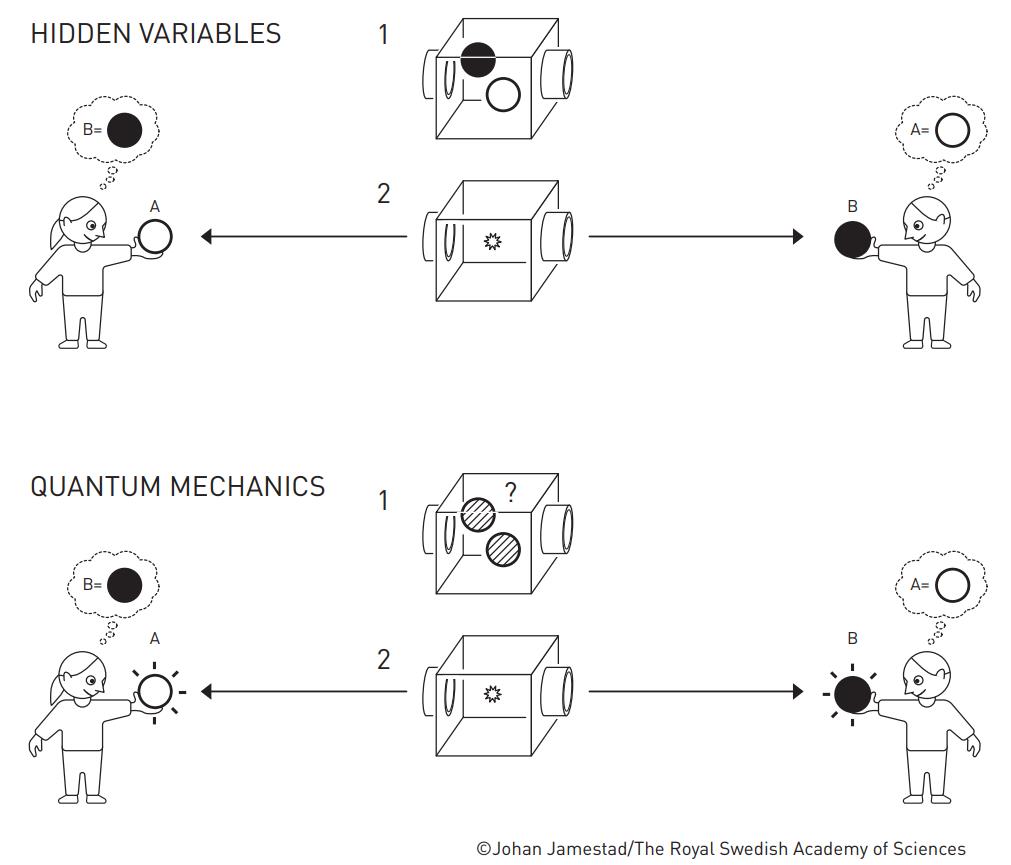 Quantum mechanics’ entangled pairs can be compared to a machine that throws out balls of opposite colors in opposite directions. When Bob catches a ball and sees that it is black, he immediately knows that Alice has caught a white one. In a theory that uses hidden variables, the balls had always contained hidden information about what color to show. However, quantum mechanics says that the balls were gray, or a combination of black and white, until someone looked at them, when one randomly turned white and the other black. Bell inequalities show that there are experiments that can differentiate between these cases. Such experiments have proven that quantum mechanics’ description is correct, and the balls have an indeterminate color until the measurement is made.
Credit: Johan Jamestad/The Royal Swedish Academy of Sciences
Quantum mechanics’ entangled pairs can be compared to a machine that throws out balls of opposite colors in opposite directions. When Bob catches a ball and sees that it is black, he immediately knows that Alice has caught a white one. In a theory that uses hidden variables, the balls had always contained hidden information about what color to show. However, quantum mechanics says that the balls were gray, or a combination of black and white, until someone looked at them, when one randomly turned white and the other black. Bell inequalities show that there are experiments that can differentiate between these cases. Such experiments have proven that quantum mechanics’ description is correct, and the balls have an indeterminate color until the measurement is made.
Credit: Johan Jamestad/The Royal Swedish Academy of Sciences
In quantum physics — at least, to the best of our current knowledge — there are a great many physical scenarios you can set up where even if you know absolutely everything that’s knowable about:
- how the system is set up, including the initial conditions of every particle and the boundary conditions of the system itself,
- and what the laws of physics are that govern the system, including all of the fundamental laws and interactions between every particle and field that exists in the system,
you still won’t be able to determine what’s going to happen and when. The best you’ll be able to do is come up with a set of probabilities for each possible outcome, which is extremely limited in its predictive power.
Have a radioactive atom? You can know what its half-life is, but whether this particular atom decays after a tenth of a half-life, two-thirds of a half-life, one half-life, 2.5 half-lives, six half-lives, or 23 half-lives is something you can’t know in advance; you can only watch the atom and determine when it does actually decay.
The situation is similar if you want to know where an electron passed through a double slit will arrive on a screen behind it, or which direction a spin-½ particle will deflect in an upward-directed magnetic field. You can calculate the probability of a set of outcomes, but quantum physics gives us no way to determine what the outcome of any one particular quantum system will actually be, no matter how much you know about it.
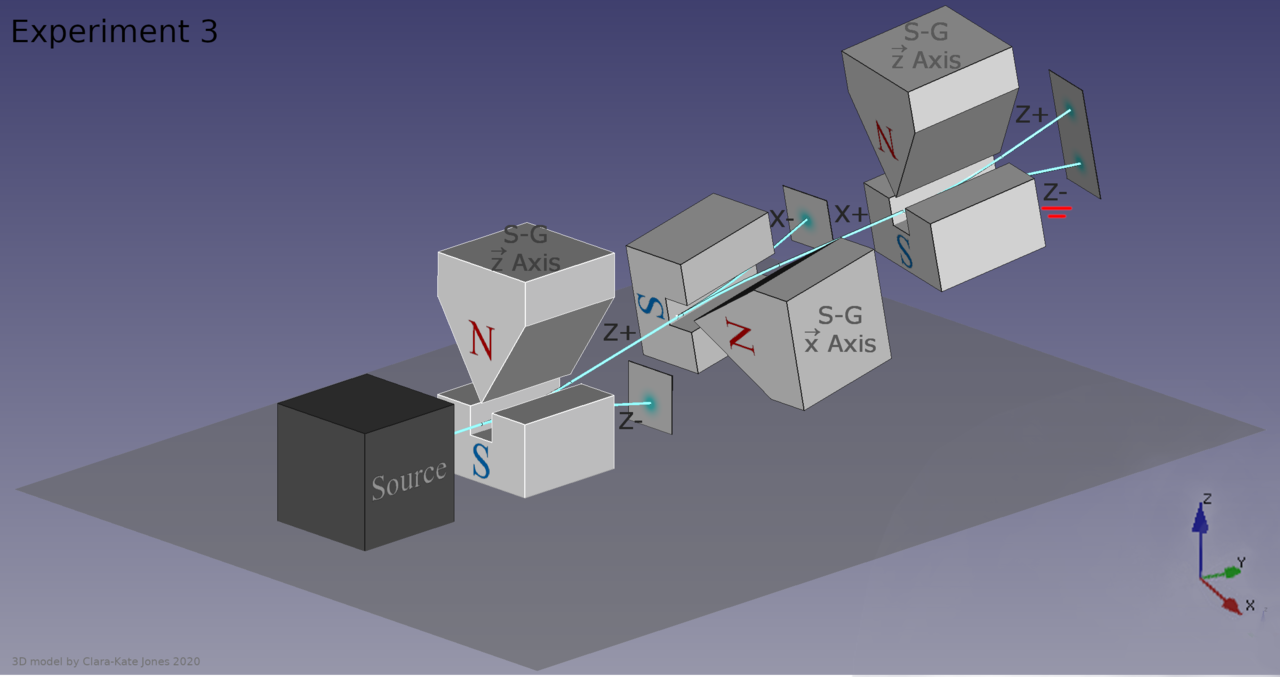 When a particle with quantum spin is passed through a directional magnet, it will split in at least 2 directions, dependent on spin orientation. If another magnet is set up in the same direction, no further split will ensue. However, if a third magnet is inserted between the two in a perpendicular direction, not only will the particles split in the new direction, but the information you had obtained about the original direction gets destroyed, leaving the particles to split again when they pass through the final magnet. Which direction an individual particle deflects in cannot be known ahead of time; it can only be determined via measurement.
Credit: MJasK/Wikimedia Commons
When a particle with quantum spin is passed through a directional magnet, it will split in at least 2 directions, dependent on spin orientation. If another magnet is set up in the same direction, no further split will ensue. However, if a third magnet is inserted between the two in a perpendicular direction, not only will the particles split in the new direction, but the information you had obtained about the original direction gets destroyed, leaving the particles to split again when they pass through the final magnet. Which direction an individual particle deflects in cannot be known ahead of time; it can only be determined via measurement.
Credit: MJasK/Wikimedia Commons
This fact about the Universe has spawned much outrage among physicists and philosophers alike since it was first noticed, which in turn has led to many proposed scenarios to attempt to resolve the feeling of discomfort that we feel when we encounter and ponder these properties.
- One idea, put forth by Bohr and known as the Copenhagen interpretation, is that reality is fundamentally indeterminate until a measurement or observation is made, where a measurement or observation is defined as an energetic enough interaction with another particle that either reveals knowledge about the system’s state or compels the system into a different state.
- Another idea, the ensemble interpretation, is that reality is fundamentally indeterminate and exists as an ensemble of all possible solution states, and that quantum physics can tell you the probability of outcomes for an infinite ensemble of identically prepared systems. It’s the measurement or observation that then “picks out” which state it’s actually in.
- Still another idea is the many-worlds interpretation, which asserts that the wavefunction, each time it’s not in a single, well-determined quantum state, creates and expands into a series of parallel universes, and that only when a measurement occurs is “our Universe’s path” chosen, leaving the others behind as alternative timelines in the multiverse which don’t interact with our own.
- And finally, there are collections of interpretations that insist that reality, as a fundamental level, truly is deterministic, even if we cannot identify or measure the variables that determine those outcomes, and that there are instead “hidden variables” that underlie the system and do 100% determine what outcomes will occur.
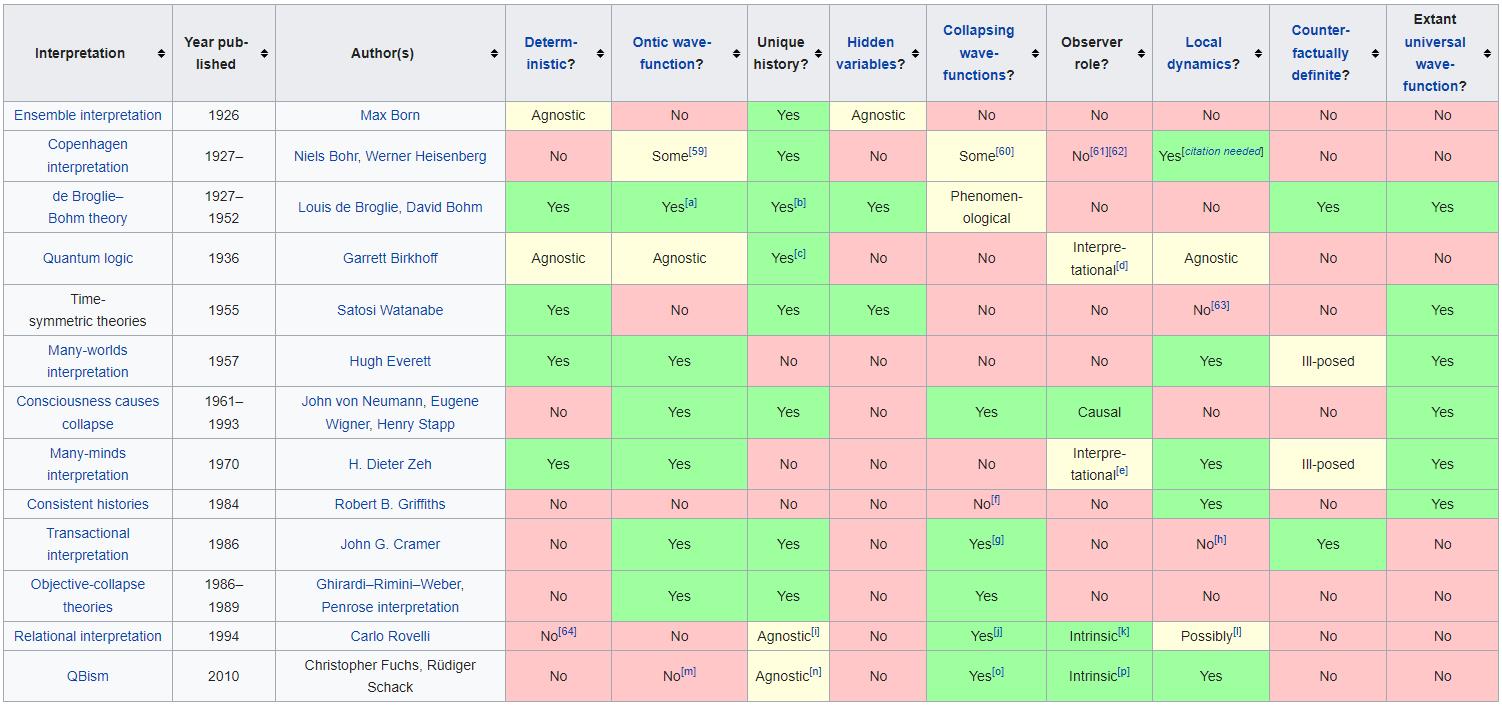 A variety of quantum interpretations and their differing assignments of a variety of properties. Despite their differences, there are no experiments known that can tell these various interpretations apart from one another, although certain interpretations, like those with local, real, deterministic hidden variables, can be ruled out.
Credit: English Wikipedia page on Interpretations of Quantum Mechanics
A variety of quantum interpretations and their differing assignments of a variety of properties. Despite their differences, there are no experiments known that can tell these various interpretations apart from one another, although certain interpretations, like those with local, real, deterministic hidden variables, can be ruled out.
Credit: English Wikipedia page on Interpretations of Quantum Mechanics
This last idea is part of a wide collection of “hidden variable theories” or interpretations of quantum mechanics where even if we ourselves can’t determine what’s going to occur, all of the events that ever have occurred or ever will occur are preordained. It’s sort of like imagining you have a vibrating plate with grains of sand atop it, and that you can only measure the individual grains of sand but you can’t observe or measure the plate or its vibrations. To you, it would appear that the grains of sand fluctuate wildly and at random, but it’s merely a manifestation of classical chaos; if you could see, measure, and understand the physics of the plate, you would find that this was in fact just a complex, deterministic system.
Einstein favored the notion of hidden variables, arguing in his famous 1935 paper (with Nathan Rosen and Boris Podolsky) that quantum mechanics is an incomplete theory, and that finding these hidden variables would complete it. Modern adherents to determinism include pilot wave theory (often known as Bohmian mechanics or de Broglie-Bohm theory), the aforementioned many-worlds interpretation, or the more recent suggestion of superdeterminism.
However, issues about the nature of reality are never, ever decided by our preferences, our ideologies, or our intuition. They are decided by what’s provable and predictable from a theoretical perspective, and then what’s determined to be consistent (or inconsistent) with reality from an experimental, measurable, observable perspective.
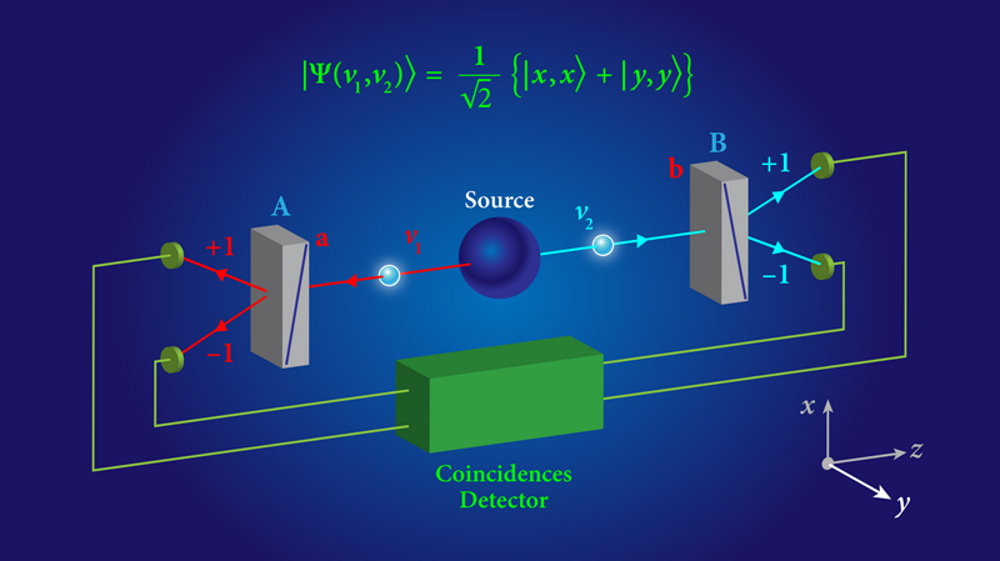 By having a source emit a pair of entangled photons, each of which winds up in the hands of two separate observers, independent measurements of the photons can be performed. The results should be random, but aggregate results should display correlations. Whether those correlations are limited by local realism or not depends on whether they obey or violate Bell’s inequality.
Credit: APS/Alan Stonebreaker
By having a source emit a pair of entangled photons, each of which winds up in the hands of two separate observers, independent measurements of the photons can be performed. The results should be random, but aggregate results should display correlations. Whether those correlations are limited by local realism or not depends on whether they obey or violate Bell’s inequality.
Credit: APS/Alan Stonebreaker
The first meaningful step toward this came in 1964, when physicist John Stewart Bell came up with a collection of theorems and inequalities that allowed the first meaningful, experimental constraints on local (where no signals travel faster-than-light) hidden variable theories. The early tests of Bell’s theorem, as well as extensions to it, were sufficient to rule out or constrain a number of local hidden variable interpretations of quantum mechanics, and that was what the 2022 Nobel Prize in physics — awarded to Alain Aspect, John Clauser, and Anton Zeilinger — was all about.
However, there are always loopholes in any theorem, and one potential way to “get away with” having hidden variables is to have them be non-local: where things happening in one location can affect things happening in another region not via a signal exchanged at or below the speed of light, but at speeds exceeding it, even up to the maximum speed of instantaneously. Contained in these non-local hidden variable theories are the hopes of everyone who seeks to make deterministic sense of the quantum Universe, and the hope that somewhere, somehow, there’s a way to extract more information about reality and what outcomes will occur than standard, conventional quantum mechanics permits.
 Schematic of the third Aspect experiment testing quantum non-locality. Entangled photons from the source are sent to two fast switches that direct them to polarizing detectors. The switches change settings very rapidly, effectively changing the detector settings for the experiment while the photons are in flight. Different settings, puzzlingly enough, result in different experimental outcomes.
Credit: Chad Orzel
Schematic of the third Aspect experiment testing quantum non-locality. Entangled photons from the source are sent to two fast switches that direct them to polarizing detectors. The switches change settings very rapidly, effectively changing the detector settings for the experiment while the photons are in flight. Different settings, puzzlingly enough, result in different experimental outcomes.
Credit: Chad Orzel
In classical mechanics, after all, there’s no role that the observer plays in determining the outcome of an observation. What happens would have happened the exact same way whether you were there to see it or not.
But in quantum mechanics, we know this isn’t the case in a variety of ways. For example, there’s the double slit experiment. If you pass a series of particles (like electrons) or waves (like light) through a double slit, you won’t get, as an outcome, two piles that correspond to things that went through slit #1 and things that went through slit #2. Instead, you’ll get an interference pattern: a hallmark of the quantum wavefunction.
If you reduce the series of particles or waves to individual quanta — electrons sent one at a time or photons sent one at a time through the double slit — you still get the interference pattern. However, if you measure “which slit does each quantum go through,” you can indeed make that measurement, but the act of making it destroys the interference pattern and leads to you seeing the “two piles” option instead. It seems as though nature really does behave differently whether you watch it or not, where “watching” or “making an observation” involves an interaction with another, sufficiently energetic particle to determine the quantum state of the particle passing through the slits.
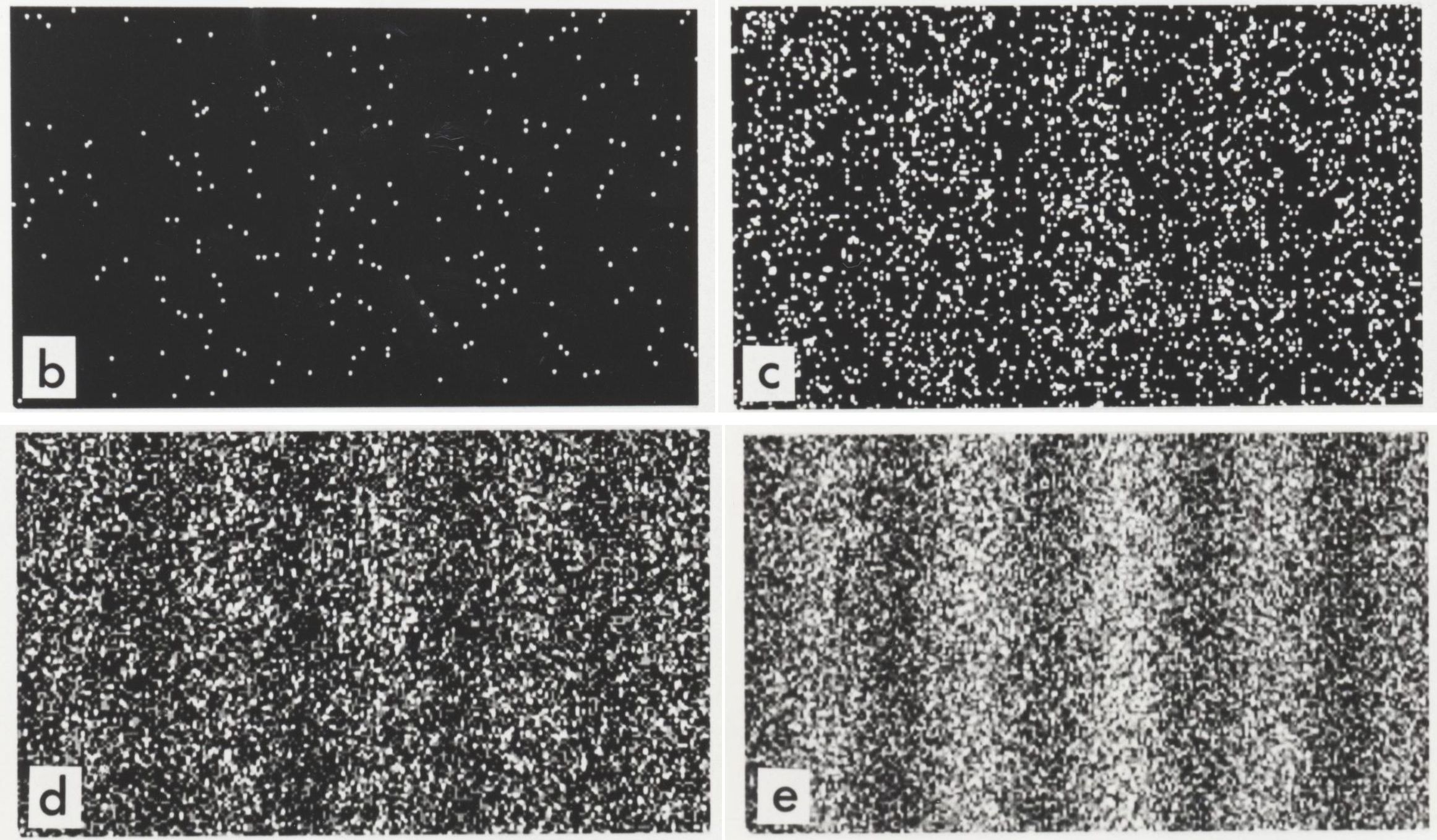 The wave pattern for electrons passing through a double slit, one-at-a-time, with both slits open/available to the electron. If you measure “which slit” the electron goes through, you destroy the quantum interference pattern shown here. However, the wave-like behavior remains so long as the electrons have a de Broglie wavelength that’s smaller than the size of the slit they’re passing through. This wave-like and particle-like behavior has been demonstrated for electrons, photons, and even larger, composite entities.
Credit: Dr. Tonomura; Belsazar/Wikimedia Commons
The wave pattern for electrons passing through a double slit, one-at-a-time, with both slits open/available to the electron. If you measure “which slit” the electron goes through, you destroy the quantum interference pattern shown here. However, the wave-like behavior remains so long as the electrons have a de Broglie wavelength that’s smaller than the size of the slit they’re passing through. This wave-like and particle-like behavior has been demonstrated for electrons, photons, and even larger, composite entities.
Credit: Dr. Tonomura; Belsazar/Wikimedia Commons
That’s what physicists often wonder: is there a way to extract more information about the quantum state of any system — and hence, to know more about the potential outcome that will occur — than standard quantum mechanics provides? Are there, at some level, even if we can’t see or measure them, hidden variables? The argument still rages today. Fifteen years ago, a paper came out proving that no extension of quantum theory can have improved predictive power over the predictions of standard quantum mechanics, but then another paper came out arguing that they indeed found loopholes, and potentially testable counterexamples, to that proof.
At the core of the argument is whether quantum states are “ontic” or “epistemic” in nature. These aren’t common terms that people use (even most physicists rarely use them), with the difference being as follows.
- For ontic quantum states, those states would correspond directly to states of reality, with no room for additional knowledge about reality existing in some hidden, but unknown to humans, set of information-carrying variables.
- Meanwhile, for epistemic quantum states, those states may correspond only to probabilistic states of knowledge about reality, but those states are allowed to be incomplete, where additional knowledge could exist in some type of hidden, information carrying variables.
With this background in mind, we come to the Pusey-Barrett-Randolph (PBR) theorem, put forth in a paper in 2012.
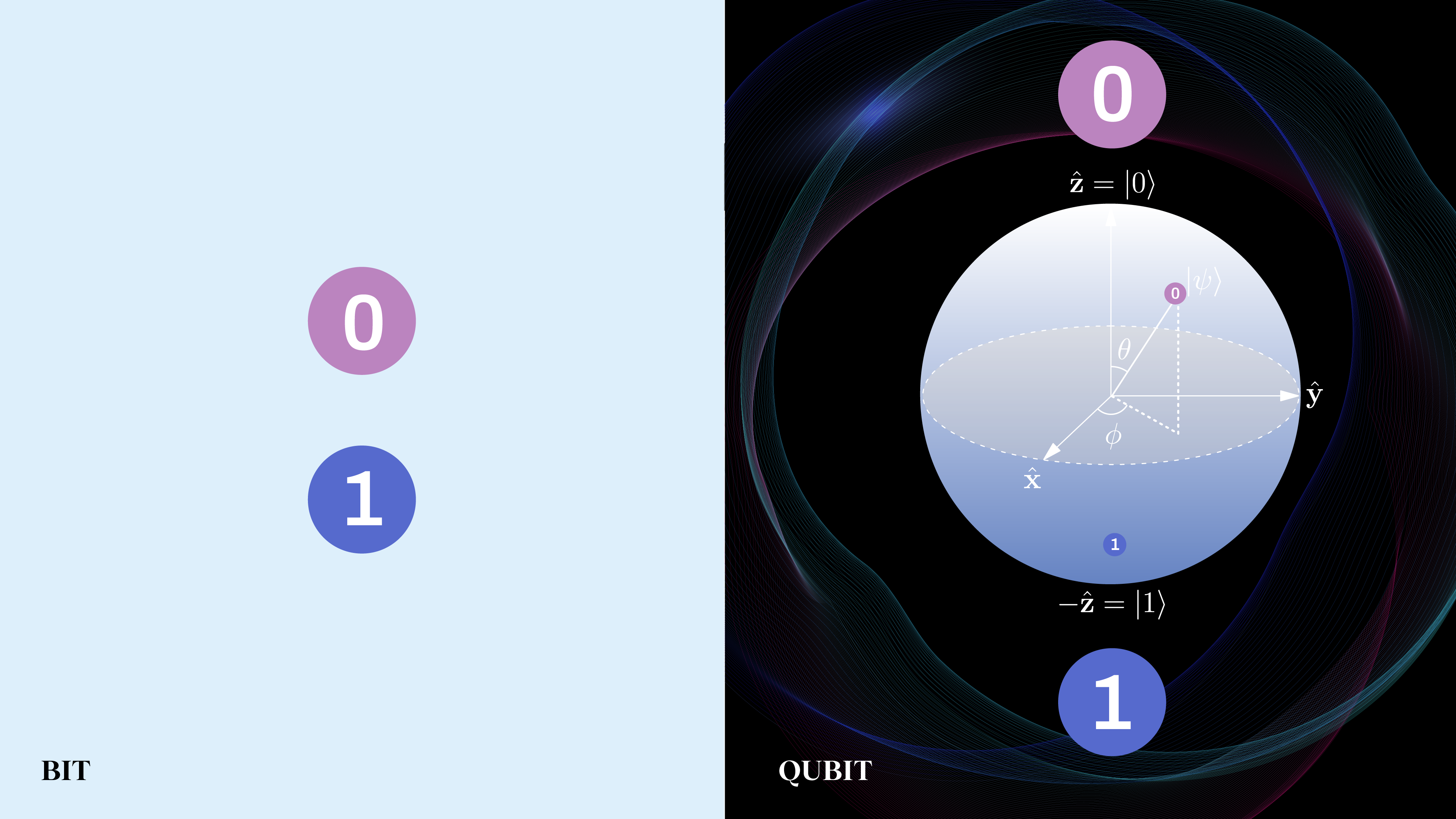 On the left, a classical “bit” is illustrated: a two-state system that can have either “0” or “1” as its value. On the right, a quantum two-state system, or qubit, is shown. When you make a measurement, you’ll always observe either a “0” or a “1” in practice, but when you perform operations on that qubit, you act on the indeterminate state represented by the arrow shown on the sphere. In quantum physics, there is no way to predict what the quantum state of an indeterminate state, composite state, or superposition of states is going to be ahead of time; you can only predict a statistical spectrum of outcomes probabilistically, with the act of measurement required to reveal its physical properties at any moment.
Credit: Ben Gibson/Big Think
On the left, a classical “bit” is illustrated: a two-state system that can have either “0” or “1” as its value. On the right, a quantum two-state system, or qubit, is shown. When you make a measurement, you’ll always observe either a “0” or a “1” in practice, but when you perform operations on that qubit, you act on the indeterminate state represented by the arrow shown on the sphere. In quantum physics, there is no way to predict what the quantum state of an indeterminate state, composite state, or superposition of states is going to be ahead of time; you can only predict a statistical spectrum of outcomes probabilistically, with the act of measurement required to reveal its physical properties at any moment.
Credit: Ben Gibson/Big Think
So, what does a quantum state represent? Is the state a physical property of a quantum system, the same way “position” or “momentum” is a physical property of a classical (non-quantum) system? Or is the quantum state only a statistical/probabilistic property, the same way that the temperature of a gas is a statistical property of a classical system, where the physics can tell you the mean speed of all of the particles and how those speeds are distributed, but cannot tell you anything meaningful about the actual speed of any one individual particle?
That’s what’s at stake if we can determine whether the quantum state is ontic, in which case there is no “hidden” information that could be gleaned if you somehow knew more than what quantum mechanics provides, or epistemic, where just as (classical) particles do have well-defined speeds, the actual quantum state could have underlying properties that are indeed better-informed than we are from quantum mechanics.
The theorem begins, as all good theorems do, from a set of assumptions.
- Quantum systems (like atoms, electrons, and photons) exist, and have at least some physical properties.
- And that either the quantum state encodes everything there is that’s knowable about the system (the ontic approach) or that it merely encodes what an experimenter can know about a system’s properties (the epistemic approach).
These assumptions are generally not seriously debated, as observations and experiments are extraordinarily consistent with all of them.
 This figure shows the preparation of two quantum systems, prepared independently, whose quantum state is determined by the method of preparation for each system, and whether that state is |0>, |+>, or a superposition of both. The outcome of the measurement is only allowed to depend on the physical properties of each system at the moment each system is measured.
Credit: M. Pusey, J. Barrett, & T. Rudolph, Nature Physics, 2012
This figure shows the preparation of two quantum systems, prepared independently, whose quantum state is determined by the method of preparation for each system, and whether that state is |0>, |+>, or a superposition of both. The outcome of the measurement is only allowed to depend on the physical properties of each system at the moment each system is measured.
Credit: M. Pusey, J. Barrett, & T. Rudolph, Nature Physics, 2012
They then proceed by imagining there are two different methods of preparing a quantum system: method 1, which leads to one quantum state, and method 2, which leads to a second quantum state that is not identical to the first quantum state. Because of the first assumption, after state preparation, these two quantum systems then have some physical properties. Whether those properties are completely described by quantum physics, or whether they’re only completely described by some other, yet undiscovered theory is irrelevant; only that they exist. Whatever those physical properties are, it’s possible to make a complete list of them, at least from a mathematical point of view. Then depending on how reality works, two options arise.
- If the quantum state is ontic, then if you specify the full list of physical properties, you uniquely determine the quantum state.
- On the other hand, if the quantum state is epistemic, then fully specifying the full list of physical properties might not uniquely determine the quantum state; there may be multiple compatible options.
Then imagine that you prepare two quantum systems independently, and that each one’s quantum state is determined by the preparation method. The outcome of the measurement may then only depend on the physical properties of the two systems at the time they are measured.
What Pusey, Barrett, and Rudolph then showed is that unless the quantum state is ontic in nature, the measuring device is sometimes uncertain which preparation method was used. But because the quantum state is determined by the preparation method, it runs the risk of giving an outcome that quantum theory demands must have 0 probability: it cannot occur. And therefore, there is no physical state that can be compatible with both “method 1” and “method 2” simultaneously.
If you then apply this same argument to any pairs of quantum states that arise from preparing two quantum systems made of identical particles in two different ways, then you can uniquely infer the quantum state from the observed physical states. The quantum state is therefore a physical property of the system, and the statistical/epistemic view is demonstrated to be false.
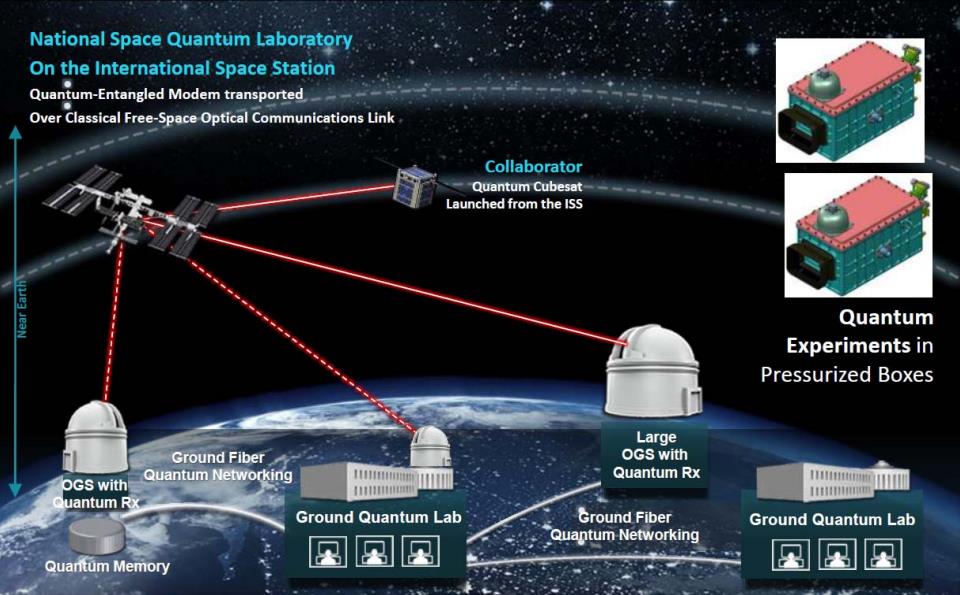 Many entanglement-based quantum networks across the world, including networks extending into space, are being developed to leverage the spooky phenomena of quantum teleportation, quantum repeaters and networks, and other practical aspects of quantum entanglement. The quantum state is “cut-and-pasted” from one location to another, but cannot be cloned, copied, or “moved” without destroying the original state. Although no information is ever being exchanged faster than light, the quantum wavefunction is allowed to collapse instantaneously, even across large distances.
Credit: S.A. Hamilton et al., 70th International Astronautical Congress, 2019
Many entanglement-based quantum networks across the world, including networks extending into space, are being developed to leverage the spooky phenomena of quantum teleportation, quantum repeaters and networks, and other practical aspects of quantum entanglement. The quantum state is “cut-and-pasted” from one location to another, but cannot be cloned, copied, or “moved” without destroying the original state. Although no information is ever being exchanged faster than light, the quantum wavefunction is allowed to collapse instantaneously, even across large distances.
Credit: S.A. Hamilton et al., 70th International Astronautical Congress, 2019
This has enormously profound consequences. It implies that the phenomenon known as “quantum collapse” or “wavefunction collapse” must correspond to a real, physical process, even one that occurs simultaneously between entangled particles separated by large distances: in a non-local fashion. However, if there is no collapse of the quantum state (as in many deterministic interpretations), then each measurable component of the quantum state must have a direct counterpart in reality: undermining the very idea of “hidden variables that determine reality” inherent to the epistemic point of view!
What’s remarkable about this theorem is that it relies solely on three base assumptions made by the authors:
- That if an isolated (non-entangled) quantum system can be prepared with a pure state, there will be a well-defined set of physical properties resulting from that preparation.
- That multiple quantum systems can be independently prepared such that their physical properties are uncorrelated with one another.
- And that measuring apparatuses respond solely to the physical properties of the systems that they are measuring, whether or not those properties are well-determined or obey a probability distribution.
If any of these assumptions are violated or invalidated, then there’s still wiggle room to argue that the quantum state is not a real object, or that quantum systems don’t have any physical properties at all. However, if all three of these assumptions are accepted, then the epistemic interpretation of reality is ruled out, leaving us with no alternative but to accept the “weirdness” of quantum mechanics as inherent to, and fundamental to, the nature of reality. That truly is profound, and why the PBR theorem stands tall as the most important development in quantum foundations of the 21st century so far!
Ethan SiegelTheoretical astrophysicist and science writer
Full Profile
Related Content
Starts With A BangDark matter’s “nightmare scenario” looks more likely than ever
Our great hope is that today's indirect, astrophysical evidence will someday lead to successful direct detection. What if that's impossible?
by Ethan Siegel Starts With A Bang
Ask Ethan: Where are all the blueshifted galaxies?
Even in an expanding Universe, we expect both redshifted and blueshifted galaxies. But nearly every one we see is redshifted. Here's why.
by Ethan Siegel Starts With A Bang
The most underappreciated achievement in theoretical physics
Many view the development of fringe, alternative theories as a useless waste of time. But when they can be tested, it shows what reality is.
by Ethan Siegel Starts With A Bang
It’s time to stop teaching the biggest lie about Hawking radiation
It's not about particle-antiparticle pairs falling into or escaping from a black hole. A deeper explanation alters our view of reality.
by Ethan Siegel Learn from the world's biggest thinkers.
-
Videos
- Latest
- The Big Think Interview
-
Columns
- Mini Philosophy
- Starts with a Bang
- Big Think Books
- The Long Game
- Strange Maps
- 13.8
- The Well
-
Sections
- Philosophy
- Mind & Behavior
- Science & Tech
- Business
- History & Society
-
Classes
- Class Library
-
Subscribe
- Membership
- Free Newsletters
-
About
- Our Mission
- Work with Us
- Contact
- Privacy Policy
- Terms of Sale
- Accessibility
- Careers