- Physics & Mathematics
- Quantum Physics
Researchers have demonstrated that a nanoparticle of 7,000 sodium atoms can act as a wave, creating a record-setting superposition.
When you purchase through links on our site, we may earn an affiliate commission. Here’s how it works.
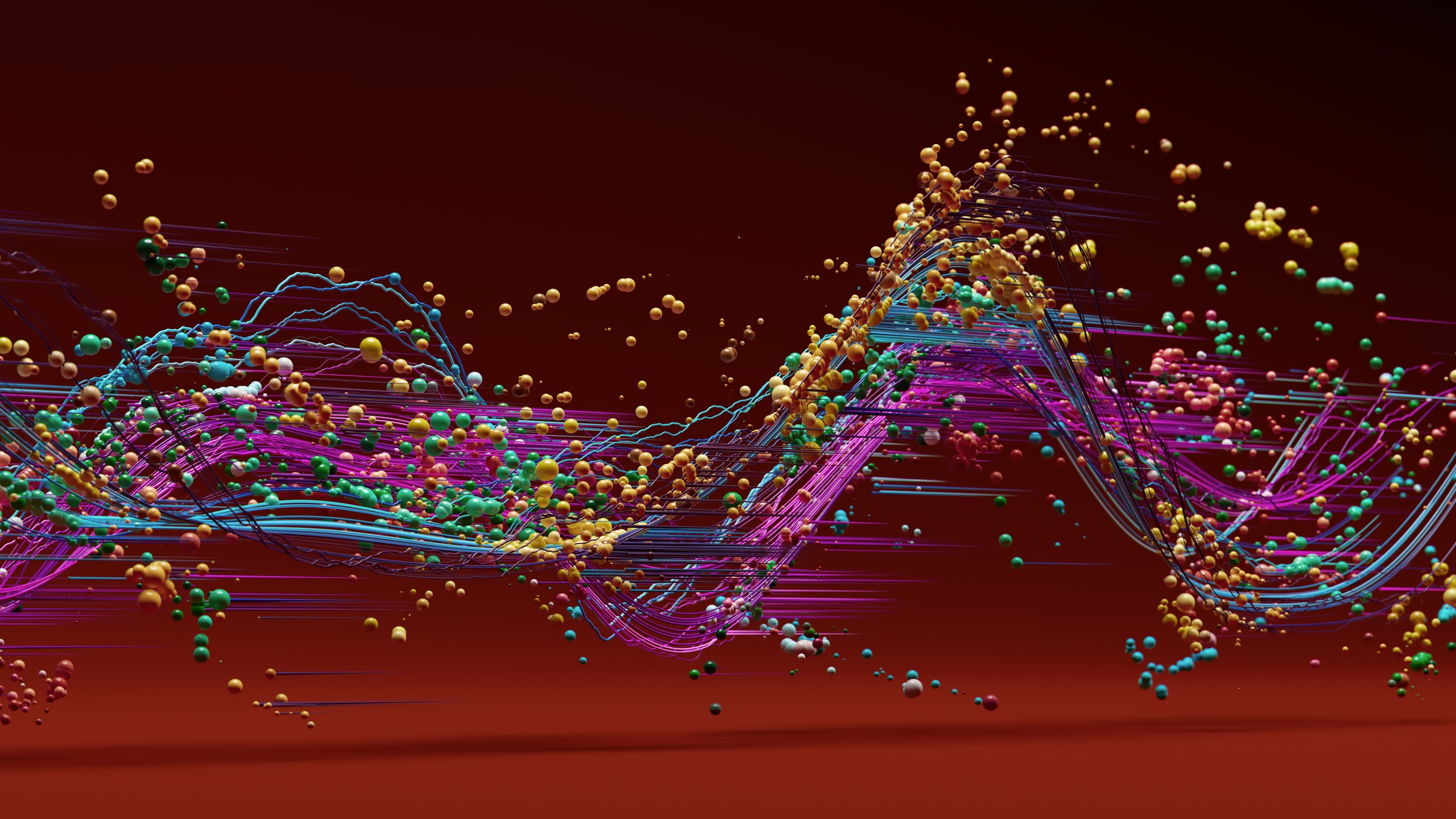 An illustration of particles behaving like a wave. Physicists have coaxed thousands of sodium nanoparticles into acting like waves in a new superposition experiment.
(Image credit: Getty Images)
An illustration of particles behaving like a wave. Physicists have coaxed thousands of sodium nanoparticles into acting like waves in a new superposition experiment.
(Image credit: Getty Images)
- Copy link
- X
Get the world’s most fascinating discoveries delivered straight to your inbox.
Become a Member in Seconds
Unlock instant access to exclusive member features.
Contact me with news and offers from other Future brands Receive email from us on behalf of our trusted partners or sponsors By submitting your information you agree to the Terms & Conditions and Privacy Policy and are aged 16 or over.You are now subscribed
Your newsletter sign-up was successful
Want to add more newsletters?

Delivered Daily
Daily Newsletter
Sign up for the latest discoveries, groundbreaking research and fascinating breakthroughs that impact you and the wider world direct to your inbox.
Signup +
Once a week
Life's Little Mysteries
Feed your curiosity with an exclusive mystery every week, solved with science and delivered direct to your inbox before it's seen anywhere else.
Signup +
Once a week
How It Works
Sign up to our free science & technology newsletter for your weekly fix of fascinating articles, quick quizzes, amazing images, and more
Signup +
Delivered daily
Space.com Newsletter
Breaking space news, the latest updates on rocket launches, skywatching events and more!
Signup +
Once a month
Watch This Space
Sign up to our monthly entertainment newsletter to keep up with all our coverage of the latest sci-fi and space movies, tv shows, games and books.
Signup +
Once a week
Night Sky This Week
Discover this week's must-see night sky events, moon phases, and stunning astrophotos. Sign up for our skywatching newsletter and explore the universe with us!
Signup +Join the club
Get full access to premium articles, exclusive features and a growing list of member rewards.
Explore An account already exists for this email address, please log in. Subscribe to our newsletterPhysicists have put thousands of atoms into a "Schrödinger's cat" state — smashing the record for the most macroscopic object to be observed in a quantum state.
In a new study, researchers observed nanoparticles of 7,000 sodium atoms acting as a cohesive wave, pushing the strange world of quantum mechanics to new limits. Building on this research, future experiments could finally put biological molecules into a quantum state, opening up new ways to investigate their physical properties.
You may like-
 For the first time, physicists peer inside the nucleus of a molecule using electrons as a probe
-
 'This is easily the most powerful quantum computer on Earth': Scientists unveil Helios, a record-breaking quantum system
-
 Exotic 'time crystals' could be used as memory in quantum computers, promising research finds
Both here and there
In the quantum realm, particles can be both here and there. This strange phenomenon is known as quantum superposition.
The quantum physicist Erwin Schrödinger likened this to placing a cat in a sealed box with a vial of poison that is set to be released when a radioactive source decays, meaning the cat could be killed at any moment after the box has been sealed. This puts the cat into a superposition of being both dead and alive. It is only if the box is opened and the cat is observed that the superposition collapses and the cat is defined as either dead or alive.
Incredibly, this is how particles behave at the quantum scale; they are in multiple places at once and act as both a particle and a wave until they are observed.
Sign up for the Live Science daily newsletter nowContact me with news and offers from other Future brandsReceive email from us on behalf of our trusted partners or sponsorsBy submitting your information you agree to the Terms & Conditions and Privacy Policy and are aged 16 or over.This bizarre world raises a question: Where is the boundary between the quantum world and the one we observe every day? At what point does a particle start acting like a wave?
The reason we don't see quantum superposition all around us is because of a process called decoherence. If something in a quantum superposition interacts with its environment, it will decohere and no longer be both here and there; instead, it will be forced into one place. Larger objects are constantly interacting with their environment, so they can't maintain a quantum superposition. So the real challenge when trying to observe larger particles acting as a wave is to isolate them so they can stay in a coherent quantum superposition.
Searching for interference
For the new study, Pedalino attempted to observe the large nanoparticles of sodium in a quantum superposition. To do this, he and his team converted a few grams of sodium into a beam of nanoparticles, which he then aimed at a narrow slit.
You may like-
For the first time, physicists peer inside the nucleus of a molecule using electrons as a probe
-
'This is easily the most powerful quantum computer on Earth': Scientists unveil Helios, a record-breaking quantum system
-
Exotic 'time crystals' could be used as memory in quantum computers, promising research finds
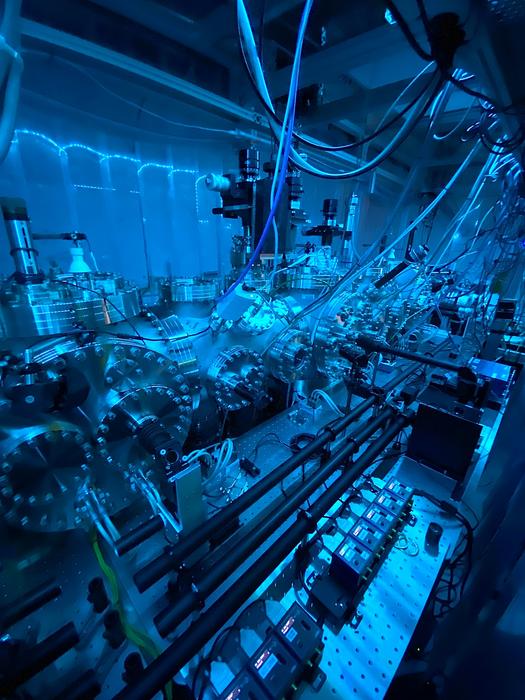
If the sodium nanoparticle was in a quantum superposition, this would mean that it spread out like a wave after passing through the slit. This would then produce an interference pattern. However, if it decohered and started acting like a normal particle, the sodium would pass straight through the slit and the team would see a flat line.
"For two years, I was looking at flat lines," Pedalino said. "We were trying to see the interference pattern, but we had flat lines. And in the end, the flat line is not really helpful, as it is inconclusive."
Finally, the single line they had been seeing on the detector widened and became the unmistakable interference pattern that meant the sodium nanoparticles were behaving as both particles and waves.
related stories—'The universe has thrown us a curveball': Largest-ever map of space reveals we might have gotten dark energy totally wrong
—Could the universe ever stop expanding? New theory proposes a cosmic 'off switch'
—Cosmic voids may explain the universe's acceleration without dark energy
"That moment was unbelievable," Pedalino said. "It was already late in the night, and I called my professor. And he came back to the lab, and we took measurements until 3 a.m., when we ran out of the sodium."
The team determined the "macroscopicity" — a quantity that describes how much a quantum object pushes into the classical world — of the sodium nanoparticles to be 15.5, beating the previous record for macroscopicity by an order of magnitude.
This discovery opens the door for future experiments where scientists could feasibly observe biological materials, such as a virus or proteins, in a quantum superposition. The experiment represents a major step forward and brings this strange quantum phenomenon tantalizingly close to the real world.
IN CONTEXT IN CONTEXTBrandon SpecktorSpace and Physics editor
Nobody wants to think about a dead cat — so why is Schrödinger's thought experiment so enduring in physics? In part, it's because superposition reveals a stark break in our understanding of the universe.
Decades of experiments show that tiny particles follow one set of rules (quantum mechanics), while larger structures, such as stars, galaxies and — yes — house cats, follow another (Einstein's relativity). Scientists have long sought to reconcile these two rule sets into a "theory of everything," but they have so far come up short. However, recent research hints that tweaks to Schrödinger's equations could provide a pathway to a solution.
 Rory HarrisSocial Links NavigationContributor
Rory Harris is a science writer, covering a wide range of topics but with a specialty in astronomy and particle physics. He holds a Master's degree in Physics from the University of Manchester and an MSc in Science Communication from Imperial College London.
View MoreYou must confirm your public display name before commenting
Please logout and then login again, you will then be prompted to enter your display name.
Logout Read more For the first time, physicists peer inside the nucleus of a molecule using electrons as a probe
 'This is easily the most powerful quantum computer on Earth': Scientists unveil Helios, a record-breaking quantum system
 Exotic 'time crystals' could be used as memory in quantum computers, promising research finds
 New 'physics shortcut' lets laptops tackle quantum problems once reserved for supercomputers and AI
 Scientists build 'most accurate' quantum computing chip ever thanks to new silicon-based computing architecture
 New semiconductor could allow classical and quantum computing on the same chip, thanks to superconductivity breakthrough
Latest in Quantum Physics
New semiconductor could allow classical and quantum computing on the same chip, thanks to superconductivity breakthrough
Latest in Quantum Physics
 'Paraparticles' would be a third kingdom of quantum particle
 Physicists take step toward a 'theory of everything'
 Physicists spot elusive 'free-range' atoms ineracting in space for first time ever
 Physicists create hottest Schrödinger's cat ever in quantum breakthrough
 Scientists claim to find 'first observational evidence supporting string theory,' which could finally reveal the nature of dark energy
 'Einstein's equations need to be refined': Tweaks to general relativity could finally explain what lies at the heart of a black hole
Latest in News
'Einstein's equations need to be refined': Tweaks to general relativity could finally explain what lies at the heart of a black hole
Latest in News
 Hydrogen leak derails Artemis II wet rehearsal, pushing launch date back by weeks
 'System in flux': Scientists reveal what happened when wolves and cougars returned to Yellowstone
 In the search for bees, Mozambique honey hunters and birds share a language with distinct, regional dialects
 'Landmark' elephant bone finding in Spain may be from time of Hannibal's war against Rome
Scientists smash record for superposition, bringing quantum world tantalizingly close to reality
'Landmark' elephant bone finding in Spain may be from time of Hannibal's war against Rome
Scientists smash record for superposition, bringing quantum world tantalizingly close to reality
 Preserved hair reveals just how bad lead exposure was in the 20th century
LATEST ARTICLES
Preserved hair reveals just how bad lead exposure was in the 20th century
LATEST ARTICLES- 1Hydrogen leak derails Artemis II wet rehearsal, pushing launch date back by weeks
- 2'Landmark' elephant bone finding in Spain may be from time of Hannibal's war against Rome
- 3Mokoqi Star Projector Night Light review
- 4'System in flux': Scientists reveal what happened when wolves and cougars returned to Yellowstone
- 5In the search for bees, Mozambique honey hunters and birds share a language with distinct, regional dialects